UAE226/8
 OMA14/0 (5.2/50 ov, target 227)
 HH-W154/7 (20 ov)
 MR-W
 REN
 OLY
 WI-A
 LIONS
 AEK
 RMA
 FEN
 LIV
 DOR
 BET
 FCP
 NAP
 RCL
 COMO
 PSV
 BRU
 NZ185 (40.2 ov)
 IND143/5 (22.4/32 ov, target 143)
 Atlético0
 Bayern2
 Barcelona3
 Aston Villa0
 Bodo/Glimt0
 Lille0
 MEGHA144
 NAGA254 & 184 (78.5 ov)
 TPURA268 & 191
 SAU118 & 95/6 (30 ov, target 342)
 BENG143 & 72/3 (20 ov)
 MAHA218
 ODSA23/0 (5 ov)
 JHK433/8d
 CHD94 & 116/1 (32 ov) (f/o)
 TN571/7d
 CGR284 & 191/5 (53 ov)
 HYD280
 DELHI344
 SVCS266 & 178/3 (40 ov)
 GUJ534/9d
 KER269/6 (83 ov)
 HP153
 RAJ78 & 521/8d (131.1 ov)
 J & K378/1 (108 ov)
 PONDI385
 BAN
 WI
 AFG
 ZIM
 AS-W
 BH-W
 ST-W
 PS-W
 JAB
 LUL
 BIK
 KAG
 EASTN
 DOLPH
 CD283 (45.5/50 ov, target 358)
 AUCK357/7
 WELL354/7
 ND152 (35.1/50 ov, target 355)
 OTAGO179/4 (37/46 ov, target 176)
 CANT175 (43.3/46 ov)
 POA97/9
 RBL
 MNC
 Feyenoord0
 Inter Milan3
 LASK Linz4
 S Bratislava0
 Man Utd3
 AS Roma2
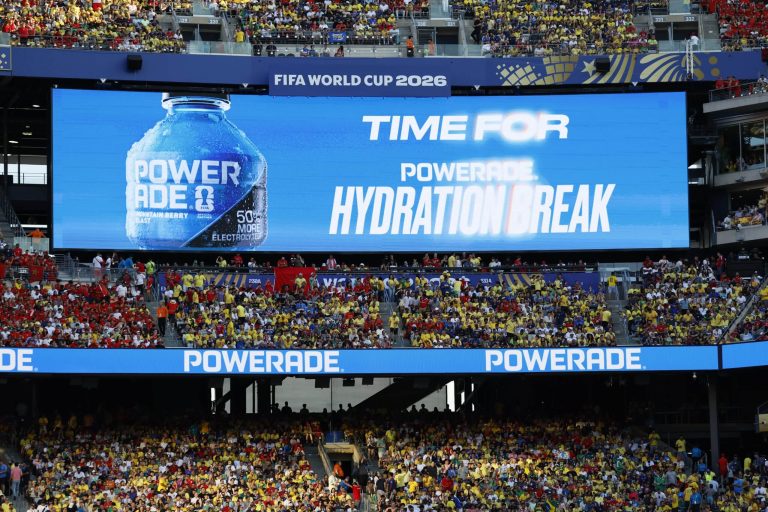
It has become one of the defining features of the 2026 World Cup — and one of its most debated.
The referee blows his whistle approximately 22 minutes into each half, stopping play to allow players to rehydrate. Mandatory three-minute drinks breaks in all 104 games have been introduced to help players cope with stifling heat and humidity levels across venues in Mexico, Canada, and the United States.
But not everyone is convinced.
Some have described the breaks as commercial interruptions designed to appease American broadcasters. Others point out — with some exasperation — that hydration breaks are taking place even at grounds with retractable roofs and interior climate control.
Mauricio Pochettino, head coach of co-hosts USA, was direct: “I don’t like it. I only like it when the conditions are extreme. But when the conditions are good, it is unnecessary.”
The evidence from the opening games suggests the breaks are having a real impact on results. Here is who has benefited and who has suffered.
The Case for Calling Them ‘Momentum Breaks’
USA women’s head coach Emma Hayes — speaking to ITV Sport — offered the clearest analysis of what these breaks actually represent in practice:
“It’s advantageous for the team losing momentum — that’s why I call them momentum breaks. When you’re on top, you don’t want it; when you’re losing, you do.”
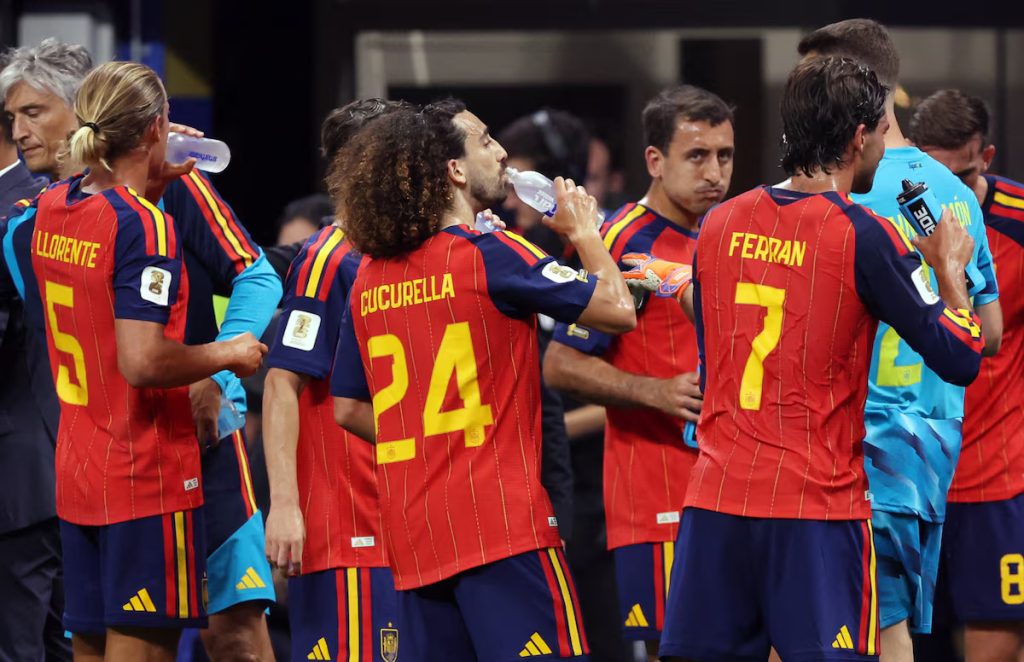
She added: “Sometimes it’s not even coaching during the hydration break. It’s about taking on fluid and calming players. Sometimes it can be doing nothing, but that can be considered coaching as well.”
The data from the early games supports her view.
The Winners: Teams That Came Back After a Break
| Match | Situation at Break | Outcome After Break |
|---|---|---|
| Brazil vs Morocco | Brazil trailing 0-1 | Brazil equalised within 6 minutes of play resuming |
| Canada vs Bosnia-Herzegovina | Canada trailing | Substitute Cyle Larin equalised soon after second-half break |
| Australia vs Türkiye | — | Australia scored their opener in similar circumstances |
| Scotland vs Haiti | — | Scotland scored the only goal shortly after a break |
Brazil vs Morocco was the most striking example in the opening round. When Brazil’s players took on water midway through the first half at the New Jersey New York Stadium, they deservedly trailed Morocco 1-0 after a lacklustre start. Six minutes after play resumed, they were level — Vinícius Júnior cutting inside and lashing a brilliant strike into the roof of the net.

Carlo Ancelotti acknowledged precisely how the break helped. “You can explain a problem to the players,” the Brazil coach said. “Make a tactical adjustment that can be very good.”
Which raises an important question: if hydration breaks are designed to protect player welfare, should managers even be allowed to use them to deliver tactical instructions?
The Losers: Teams Whose Momentum Was Destroyed
The clearest victims have been teams who were on top when the break arrived.
Curaçao vs Germany was perhaps the most dramatic example. The tournament debutants — the smallest nation ever to appear at a World Cup — had just equalised to make it 1-1 and were in dreamland, briefly threatening one of the great upsets. The hydration break intervened. Germany regrouped. The final score was 7-1.
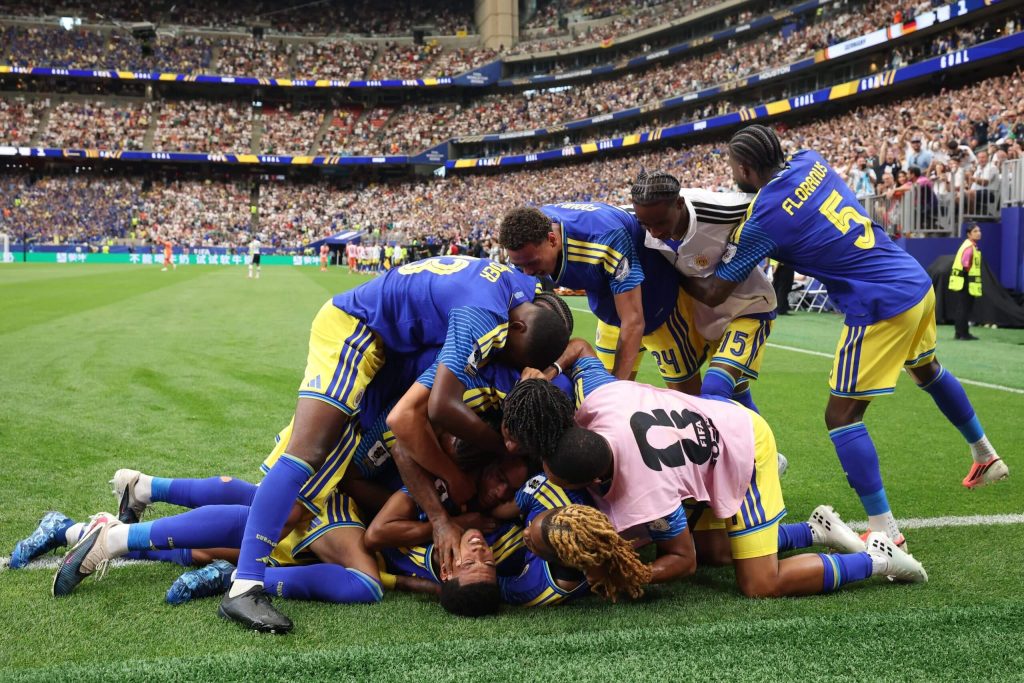
Czech Republic vs South Korea followed a similar pattern. The Czechs had been on top throughout the first half, their pressure building toward a second goal. The break abruptly ended that momentum. When play resumed, they lost control of the game and ultimately lost 2-1 despite having taken the lead.
Netherlands vs Japan saw the Dutch lead 2-2 going into the second-half hydration break in Arlington, Texas, having been 2-1 up. They failed to protect their lead after play resumed and drew 2-2.
The breaks are not always the definitive cause of momentum shifts — football is fluid and results are determined by many factors. But the pattern across the opening games is striking.
The Coaching Debate: Help or Interference?
Juan Mata, a World Cup winner with Spain in 2010, was unequivocal from a player’s perspective.
“As a player I don’t think it’s great. When you’re losing, you want to score, and when you’re winning you want to keep the ball. I think they break the momentum.”
Hayes went further, noting that the interruption benefits certain types of teams structurally — and not necessarily the better ones. A side being outplayed gets a free reset at regular 22-minute intervals. A side building toward a decisive moment is denied the right to strike.
The Commercial Suspicion
Former Arsenal and England forward Ian Wright was direct about what he believes is really happening.
“I just think it’s another way of getting adverts into it from an American point of view. They’ve used the fact that it’s for the players, but it’s not for me.”
The suspicion is not unfounded. US broadcaster Fox overran advertisements during a hydration break in the tournament’s opening match between Mexico and South Africa — a moment that felt illustrative of what the breaks enable commercially.
The coincidence of introducing mandatory three-minute breaks to a tournament hosted in the world’s most advertising-revenue-intensive sports market is one that critics have noted prominently.
The Case in Favour
Not everyone opposes the breaks, and some arguments in their favour carry genuine weight.
Spain head coach Luis de la Fuente — speaking ahead of his side’s game against Cape Verde — acknowledged that conditions vary significantly across venues and weeks.
“Throughout the week, we’ve seen huge temperatures. It’s very difficult to be exposed to these temperatures for so long when you’re working. The best thing to do is to drink lots of water. Take a break, let them breathe for a few seconds.”
He acknowledged the specific circumstances of the Spain fixture — played in Atlanta in a temperature-controlled, retractable-roof stadium — but framed the broader principle as a health concern that he considers legitimate.
Even Hayes — despite her “momentum breaks” framing — acknowledged the conditions argument: “I can understand it in really warm parts of the country.”

The challenge is that the blanket application to all 104 games, regardless of conditions, venue type, or temperature, undermines the welfare justification significantly. A game played in a climate-controlled indoor venue at comfortable temperatures does not present the same physical challenge as a midday kick-off under the Mexican sun.
A Policy That Is Hard to Defend Uniformly
The World Cup hydration breaks may have a legitimate basis in venues where the heat and humidity are genuinely extreme. But their application to every match — including climate-controlled indoor facilities — makes the welfare argument difficult to sustain.
What is clear from the opening round is that they are already shaping results. Brazil came back. Curaçao’s brief dream ended. Czech Republic lost control. The Netherlands conceded their lead.
Whether coincidence, correlation, or causation, the breaks are changing matches. And as the tournament continues, that pattern will only become more significant.
Read More: FIFA World Cup 2026: Argentina Preview – Can Messi Do What No World Champion Has Managed Since 1962?
Also Read: FIFA World Cup 2026: Norway Preview – After 26 Years Away, Norway’s Golden Generation Dreams of Something Special
Continue Reading: FIFA World Cup 2026: Jordan Preview – Their 40-Year World Cup Dream Is Finally a Reality