Mohun Bagan
 Chennaiyin
 PSG
PSG Lyon
Lyon Sevilla
 Osasuna
 NED
NED OMA
OMA NZ
NZ IND
IND NAM
NAM IRE
IRE PAK
PAK SL
SL SA
SA AUS
AUS BAR1
BAR1 RMA2
RMA2 UDI0
UDI0 MIL2
MIL2 RSO2
RSO2 LEV1
LEV1 LEC0
LEC0 JUV2
JUV2 BRB76/3 (9/15 ov)
 MOW
MOW NZ-A317
 IND-A113 & 488/8 (119 ov)
 SYL280/2 (84 ov)
 KHU
KHU MYMS465/7d
 CHATT134/2 (40 ov)
 DHA521
 RAJ103/6 (26 ov)
 RAN402
 BAR179/3 (56.1 ov)
 SIKM
SIKM NAGA6/0 (1 ov)
 JHK
JHK DELHI36/0 (12 ov)
 ODSA49/0 (13 ov)
 SVCS
SVCS BRODA24/0 (8 ov)
 J & K
J & K CHD51/0 (10 ov)
 HP
HP CGR
CGR AP30/1 (7 ov)
 LUL
LUL SPR
SPR TOK
TOK MIS
MIS MEX-W51 (12.5/20 ov, target 187)
 ARG-W186/7
 NGA148
 UGA147/9 (20 ov, target 149)
 GMB112/9
 LES109 (19.5/20 ov, target 113)
 MOZ110/7 (19/20 ov, target 110)
 ZMB109/9
 IND-W328/6
 ZIM-W207 (48.5/50 ov, target 329)
 ENG241
 Abha
Abha Al Faisaly
 Neftchi Fergana
 Al Ittihad
 Besiktas
 Istanbul BB
 Caykur Rizespor
 Trabzonspor
 Al Ahli
 Al-Gharafa
 SUN0
SUN0 LEE0
LEE0 SCF1
SCF1 MUN3
MUN3
Knockout football asks unusual things of the human mind. It invites us to believe that victory belongs to the team with the clearest ideas, only to remind us that clarity is often hostage to nerves, chance and the irreversible weight of a single mistake. League football permits regret — there is always another weekend to repair a misjudgement. A knockout tie offers no such mercy. Every decision acquires the gravity of a confession.
The match between Brazil and Japan at World Cup 2026 was shaped by precisely this tension. It revealed that in football’s most unforgiving moments, success belongs not to the side that controls every moment, but to the one that endures uncertainty long enough to impose its own terms.
Brazil’s Build-Up and Why Escaping the First Line Was Never the Real Problem
Much of the post-match discussion focused on Japan’s first line of pressure, as though Ayase Ueda’s duels with Brazil’s centre-backs explained the game. It is an understandable conclusion because the first line is the most visible. Yet visibility should not be confused with influence.
Brazil escaped Japan’s initial pressure relatively comfortably. Marquinhos circulated possession to Gabriel Magalhães, Alisson remained available as the free player, and Casemiro dropped regularly into the first line to create temporary numerical superiority. The real difficulty began only after that first problem had been solved.
Build-up is not measured by escaping the first defender. It is measured by arriving in the next space under favourable conditions. Brazil repeatedly progressed beyond Ueda’s cover shadow but almost never reached midfield with the structural stability needed to attack the next line.
That responsibility belonged chiefly to Kaishu Sano and Daichi Kamada. Rather than pressing early, both delayed their movements until the pass had already travelled. Only when Casemiro or Bruno Guimarães committed to receiving did they accelerate, arriving as the Brazilian midfielders attempted to turn. Japan were not pressing the passer — they were pressing the reception.
Japan’s Defensive Timing Mechanism
| Pressing Action | Target | Effect on Brazil |
|---|---|---|
| Ueda’s cover shadow | Casemiro’s passing lanes | Forces backwards or sideways pass |
| Sano and Kamada’s delayed press | Ball reception moment | Casemiro receiving facing own goal |
| Tomiyasu stepping aggressively | Vinícius receiving wide | Forces ball facing touchline, not goal |
| Nakamura narrowing from wing | Bruno Guimarães in half-space | Corridor exists but narrows each touch |
This timing transformed Brazil’s possession. Casemiro was rarely dispossessed, yet he seldom received on the half-turn. Instead of opening his hips towards Paquetá or Vinícius, he frequently controlled the ball facing Marquinhos or Alisson. A player facing his own goal loses more than time — he loses possibilities. Japan did not steal possession. They stole orientation.
The same pattern appeared higher up the pitch. Vinícius often dropped towards Douglas Santos to create left-side superiority, yet Tomiyasu’s aggressive stepping and Ritsu Doan’s recovery runs ensured he received facing the touchline rather than the penalty area. Paquetá found pockets between the lines only to discover that Hiroki Ito, Kamada and Sano had already shaped his first touch before it arrived.
What made Japan’s defensive display so impressive was that it required remarkably few tackles. Their superiority emerged through curved pressing runs, delayed pressure, subtle narrowing movements and perfectly timed defensive steps. Japan did not simply defend passes. They defended the relationships between them.
The Asymmetrical Rest-Defence Trap
One of the defining characteristics of Carlo Ancelotti’s Brazil has been the balance between attacking occupation and defensive security. Rather than committing both full-backs simultaneously, Brazil constructed their attacking shape around an asymmetrical rest-defence.
Danilo often remained alongside Marquinhos and Gabriel Magalhães, while Douglas Santos advanced aggressively to support Vinícius and Paquetá on the left. Casemiro acted as the stabilising reference behind the ball, creating what frequently resembled a 3+1 structure. On paper, this offered both numerical protection against transitions and sufficient freedom for Brazil’s positional play.
The effectiveness of such a structure, however, depends less on its shape than on its stability. Rest-defence is not something a team possesses automatically because players occupy certain positions. It only exists as long as possession itself remains structurally secure.
Japan recognised this distinction remarkably well.
Brazil’s Attacking Shape vs the Moment Sano’s Goal Was Conceded
| Player | Intended Role | Actual Position When Danilo Lost Ball |
|---|---|---|
| Douglas Santos | Left-back | Already advanced high |
| Paquetá | Left half-space | Pushed into left half-space |
| Vinícius | Left wing | Occupying Tomiyasu deep |
| Casemiro | Central shield | Shifted towards developing attack |
| Danilo | Right-sided defender | Lost the ball in a transition moment |
Sano’s opening goal emerged from precisely this relational imbalance. The decisive mistake was not simply Danilo’s misplaced pass — technical errors occur in every match. What transformed it into a dangerous transition was the positional moment in which it occurred. Brazil’s carefully constructed asymmetry suddenly became a vulnerability because the collective distances required for rest-defence no longer existed.
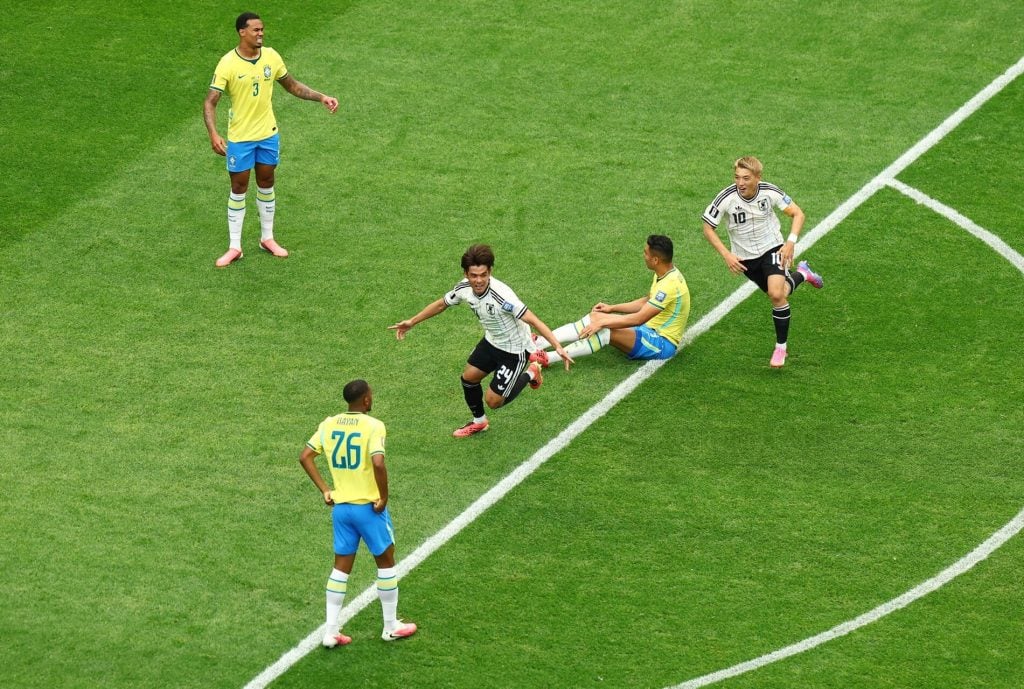
Ayase Ueda’s contribution deserves equal attention. Although Sano finished the move, Ueda’s positioning prevented Marquinhos and Gabriel Magalhães from stepping aggressively towards the ball immediately after possession was lost. By remaining as a vertical reference, Ueda occupied both centre-backs simultaneously, delaying Brazil’s first defensive reaction and allowing Sano to drive into the exposed central corridor.
The second half revealed Ancelotti’s response. Brazil did not abandon their asymmetrical structure — they improved its connectivity. Endrick’s introduction altered the occupation of the highest line, reducing the need for Paquetá to drop excessively towards the ball. Bruno Guimarães remained closer to Casemiro after attacks broke down, while Danilo narrowed more quickly to compress the central corridor whenever Douglas Santos advanced.
Brazil’s security was restored not because more players stayed behind the ball, but because the players behind the ball remained connected to one another.
Endrick and the Structure of Depth
Football frequently attributes tactical change to substitutions because a new player appears to transform a game. Yet substitutions rarely alter a match through individual quality alone. More often, they reorganise the spatial relationships around everyone else.
Endrick’s introduction at half-time — replacing the injured Paquetá — belongs firmly to this category.
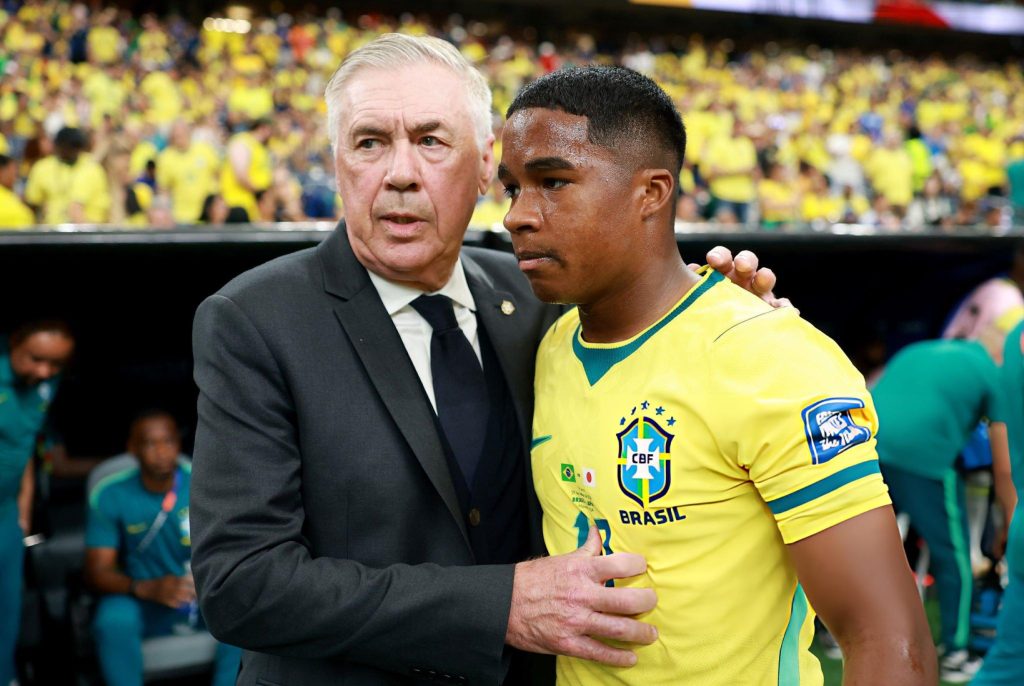
Throughout the first half, Brazil’s attack had been overwhelmingly oriented towards receiving to feet. Matheus Cunha repeatedly dropped into midfield to combine, Vinícius often came short to escape Tomiyasu’s attention, while Rayan drifted inside searching for connections. These movements improved access to possession but simultaneously reduced Brazil’s occupation of the deepest spaces.
Hiroki Ito, Shogo Taniguchi and Tomiyasu therefore defended with remarkable confidence. Their defensive line could step forward because there was almost no immediate threat behind them. Every metre they gained compressed the space available for Casemiro and Bruno Guimarães.
First Half vs Second Half — Attacking Occupation
| Phase | Front Line Behaviour | Effect on Japan’s Defensive Line |
|---|---|---|
| First half (without Endrick) | Dropping to feet; avoiding depth | Japan’s back three step confidently into midfield |
| Second half (with Endrick) | Threatening space behind defenders | Tomiyasu and Taniguchi cannot step aggressively |
Endrick’s first instinct was not to receive between Japan’s lines but to threaten the space behind them. Every curved run towards Suzuki’s goal forced Tomiyasu and Taniguchi to reconsider the aggressive stepping that had defined Japan’s defensive success.
The consequences spread through Japan’s entire defensive network. Sano could no longer attack Casemiro’s first touch with the same conviction, because a single vertical pass now exposed the retreating backline. Kamada found himself caught between protecting Bruno’s reception and remaining deeper against Endrick’s movements. For the first time in the match, Japan’s midfielders began defending uncertainty rather than certainty.
Brazil’s wider attackers also benefited. Vinícius began receiving with marginally more space because Tomiyasu could no longer abandon the last line as quickly. Rayan found greater freedom inside because Hiroki Ito increasingly respected Endrick’s movement across his shoulder. Bruno Guimarães discovered passing lanes that had been invisible in the first half — not because his technique improved, but because Japan’s defensive triangle no longer closed around him with the same synchronisation.
Endrick occupied defenders even when the ball travelled elsewhere. Geometry preceded execution.
Counterpressing Through Proximity Rather Than Intensity
One of the most significant tactical changes after the interval was not Brazil’s increased crossing volume or Endrick’s introduction. It was the way they behaved immediately after losing possession.
Throughout the first half, Brazil’s counterpress had been reactive — the nearest player sprinting towards the ball while remaining attackers attempted to recover positions. The intention was correct; the collective distances were too large to sustain pressure.
In the second half, Brazil no longer counterpressed primarily through speed. They counterpressed through proximity.
Brazil’s Counterpress — First Half vs Second Half
| Metric | First Half | Second Half |
|---|---|---|
| Counterpress method | Reactive individual sprints | Collective proximity before ball lost |
| Japan’s escape rate | High — Sano/Tanaka found second passes | Low — exits blocked before first pass |
| Territorial recovery zone | Deep in own half | Around Japan’s midfield line |
| Ball recovery quality | Isolated | Multi-layered |
The change began with the occupation of the final third. During the first half, Vinícius, Rayan, Cunha and Paquetá searched for the ball in different horizontal zones. Their movements improved circulation but stretched the attacking structure. Whenever possession was lost, Sano or Ao Tanaka often had immediate access to Ueda because the Brazilian attackers were too far apart to surround the ball collectively.
After half-time, Brazil’s attacking players became compressed around the zone where possession was most likely to be lost. The counterpress had effectively been prepared before the attack had even begun.
When Douglas Santos lost possession near the left touchline, Vinícius did not simply chase the ball — he closed Doan’s outside passing lane. Bruno Guimarães jumped towards the carrier from inside. Casemiro positioned himself to collect the loose second ball. Gabriel Magalhães stepped higher to compress the space behind. Each action was individually modest. Together they transformed a transition into another Brazilian attack.
By the final twenty minutes, Brazil had transformed the game into continuous territorial compression. Japan no longer experienced transitions as opportunities to attack but as brief interruptions before the next Brazilian wave arrived.
Territorial Compression and Casemiro’s Equaliser
Casemiro’s equaliser was not created by Gabriel Magalhães’ cross or by an exceptional header alone. It was the inevitable consequence of Brazil gradually compressing the match into Japan’s defensive third.
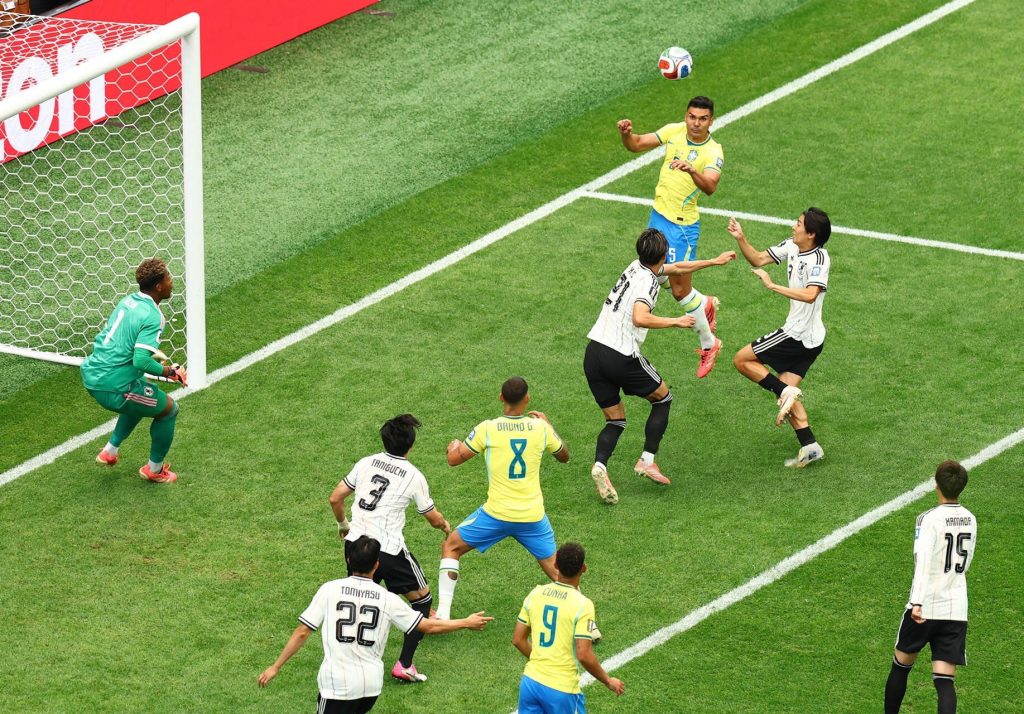
By the 56th minute, the equaliser had become the logical outcome of an increasingly one-sided territorial relationship. The header merely gave visible form to a process already unfolding since the start of the second half.
Progression of Brazil’s Territorial Control
| Period | Average Recovery Position | Japan’s Defensive Posture |
|---|---|---|
| 0-45 mins | Deep inside own half | Confident stepping into midfield |
| 45-60 mins | Around Japan’s midfield line | Beginning to retreat |
| 60-75 mins | Consistently in Japan’s half | Defending inside penalty area edge |
| 75-90+ mins | Permanent presence in Japan’s third | Confined to six-yard area |
Before Gabriel Magalhães delivered the cross, Brazil had already forced Japan’s defensive line onto the edge of their own six-yard box through successive recoveries and recycled attacks. Casemiro, recognising that Hiroki Ito and Taniguchi had become preoccupied with Endrick and Cunha, delayed his movement rather than attacking the space immediately. His late arrival disrupted Japan’s marking references completely.
Gabriel’s delivery also deserves tactical attention. The cross became available because Japan’s compact block had retreated to such depth that their defenders could no longer step aggressively towards the ball without exposing the six-yard area behind them. Gabriel enjoyed both the time and the angle required to deliver with precision — something Japan had consistently denied Brazil throughout the first half.
Martinelli’s Winner — When Counterpressing Becomes Attack
By the closing stages, Brazil’s counterpress had become indistinguishable from their attack. Recoveries occurred so high, supporting distances became so short, and positional references remained so stable that every defensive action simultaneously contained the beginning of the next offensive sequence.
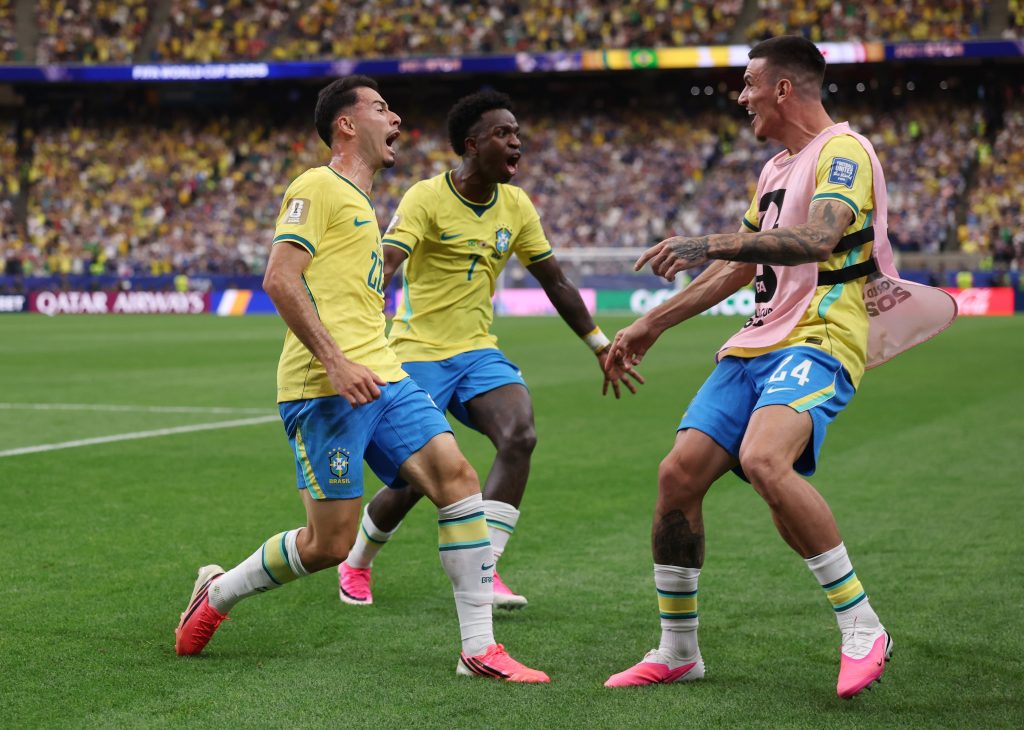
The winning sequence illustrated this relational superiority perfectly. Japan appeared to escape Brazil’s immediate pressure, but the escape remained incomplete because the supporting distances around the ball had already deteriorated. Ao Tanaka received without a nearby triangle of support from Sano or Kamada, while Ueda had become isolated against both Marquinhos and Gabriel Magalhães.
Bruno Guimarães recognised this fragile moment instantly. Rather than retreating into Brazil’s defensive shape, he accelerated forward, dispossessed Tanaka, and immediately transformed the recovery into an attacking action. The transition from defence to attack lasted a single touch — because, tactically, Brazil had already prepared the attack before the ball had been regained.
Martinelli’s Winner — Relational Breakdown
| Action | Player | Tactical Significance |
|---|---|---|
| Dispossession | Bruno Guimarães | Recovery in Japan’s territory, not Brazil’s |
| Movement away from ball | Martinelli | Stretches Tomiyasu-Taniguchi defensive gap |
| Delayed release | Bruno | Waits until Ito shifts before passing |
| Blind-side run | Martinelli | Between Tomiyasu and Taniguchi |
| Composed finish | Martinelli | Far post, via Suzuki and inside of post |
Martinelli did not move towards the ball during the transition as most forwards instinctively would. He moved away from it, towards the space between Tomiyasu and Taniguchi. This prevented Japan’s defensive line from immediately collapsing around Bruno and created the corridor he would exploit seconds later.
The finish reflected the composure Brazil had increasingly acquired across the second half. Martinelli’s first touch stabilised the situation, allowing him to open his body before guiding the ball beyond Suzuki. What appeared to be an individual act of calmness was, in reality, the final expression of Brazil’s restored collective stability.
The goal was also, according to Opta, the latest match-winning goal in regulation time of a World Cup knockout match since such records have been available from 1966.
Connections, Coherence and the Margin That Decided Everything
For the opening hour, Japan controlled the connections that determined the game. Their delayed press stole Brazil’s orientation. Their asymmetrical defensive block denied depth. Their transition moments exploited Brazil’s relational gaps at the precise moment they were most exposed.
By the 95th minute, those connections belonged completely to Brazil.
The match was ultimately decided not by individual quality — though Casemiro’s header and Martinelli’s finish were both outstanding — but by the restoration of relational coherence. Once Brazil shortened the distances between Casemiro, Bruno Guimarães, Gabriel Magalhães and Marquinhos after each attacking sequence, Japan’s transitions lost their immediacy. Recoveries that had previously led directly towards Alisson now encountered immediate pressure from multiple directions.
Ancelotti did not change his team’s identity at half-time. He improved its connectivity. That distinction is the difference between a manager who reacts to problems and one who understands their source.
Brazil are through. They were not dominant for the full 90 minutes. They were, for significant stretches, outmanoeuvred by a Japan side that prepared meticulously and executed a specific tactical plan with admirable collective intelligence.
But they adapted. They found their connections. And in the end, the connections were everything.
Read More: Julian Nagelsmann Resigns as Germany Head Coach After Shock World Cup Exit to Paraguay