UAE168/3 (37.5/50 ov)
 NED
NED PAK
PAK ENG7/1 (2.2/50 ov)
 Inter Milan
 Fiorentina
 Churchill
 Punjab FC
 NGA
NGA UGA
UGA Athletic
 Getafe
 MEX-W
MEX-W ARG-W
ARG-W C Palace
 Newcastle
 Hull
Hull Brentford
 Liverpool
 Brighton
 ATM1
ATM1 DEP0
DEP0 LAZ2
LAZ2 PAR1
PAR1 RCL2
RCL2 PAR1
PAR1 MOUNT6/0 (4.5/50 ov)
 TUSK
TUSK ROCKS
ROCKS EAGLE65/0 (8.4/50 ov)
 NZ-A317
 IND-A113 & 106/2 (36 ov)
 SYL
SYL KHU
KHU MYMS299/4 (87 ov)
 CHATT
CHATT DHA293/3 (84.1 ov)
 RAJ
RAJ RAN320/5 (80 ov)
 BAR
BAR BOL
BOL TITNS
TITNS EASTN
EASTN SA-EM
SA-EM KZNIN
KZNIN WPR
WPR NWEST
NWEST NCAPE
NCAPE SIKM
SIKM NAGA
NAGA JHK
JHK DELHI
DELHI GMB93/9
 ZMB97/2 (11.4/20 ov, target 94)
 LES62
LES62 MOZ19
MOZ19 NAM321/6
 IRE290 (47.3/50 ov, target 322)
 Man United
 Bournemouth
 Atalanta
 Frosinone
 RIY2
RIY2 TAA1
TAA1 CHE0
CHE0 TOT2
TOT2 VAL1
VAL1 VIL2
VIL2
Tottenham sacked Thomas Frank on Wednesday, February 11, 2026, after the former Brentford manager oversaw the worst period in the club’s Premier League history. Despite initial steadfast support from the board, Tuesday night’s woeful performance in defeat to Newcastle proved the final straw as Spurs slid to 16th place, just five points clear of the relegation zone.
Frank departs with the lowest win rate (26.9%) and points per game (1.12) of any Tottenham manager to have taken charge of at least five Premier League games. The appointment, made after sacking Ange Postecoglou, has proven a terrible mistake — Spurs scored just 1.05 expected goals per game, relied on set-pieces for 36.1% of their goals (highest in the league), and went winless in eight matches before Frank’s dismissal.
The Numbers Tell a Damning Story
Worst Win Rate in Tottenham’s Premier League History
Frank’s statistics at Tottenham make for grim reading. He averaged just 1.12 points per game with a win rate of 26.9% across his tenure — the worst of any Spurs manager to take charge of at least five Premier League games.
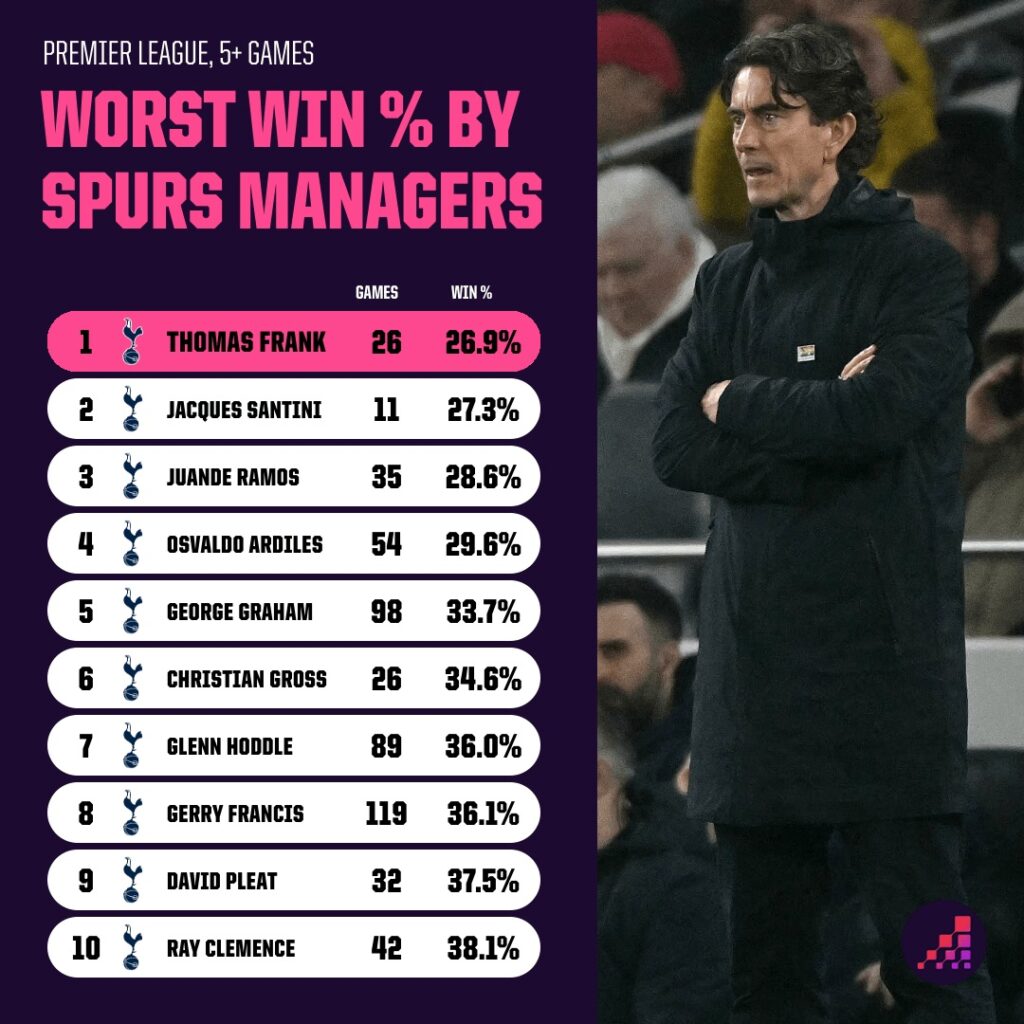
Even more alarmingly, the managers with comparable records are all from the early years of the Premier League when Tottenham were persistently poor. No modern-era manager appears on the list alongside Frank — not even Postecoglou, who oversaw a 17th-placed finish last season.
Frank’s Tottenham Record
| Metric | Performance |
|---|---|
| Win rate | 26.9% (lowest in club PL history for managers with 5+ games) |
| Points per game | 1.12 (lowest in club PL history for managers with 5+ games) |
| Goals scored | 36 (more than only 8 other teams) |
| Expected goals per game | 1.05 (more than only Sunderland, Burnley and Wolves) |
| Set-piece goal reliance | 36.1% of goals from set-pieces (highest in Premier League) |
| Open play xG per game | 0.69 (higher than only West Ham, Wolves, Burnley, Sunderland) |
| Goals from corners | 13 (second only to Arsenal with 14) |
Catastrophic Recent Form
Frank’s final 17 Premier League matches yielded just two wins and 12 points — at least seven fewer than every other team in that timeframe aside from doomed Wolves (six) and Burnley (five). Spurs were winless in their final eight Premier League games under Frank, matching their longest such run since going nine without victory from May to October 2008 under Juande Ramos.
Tactical Failures: Defensive Solidity Came at Crippling Offensive Cost
The Mandate and the Reality
Frank was brought in on the back of an incredibly impressive body of work at Brentford to shore up a defence that had been too leaky under Postecoglou. But in trying to achieve that — which he also ultimately failed to do adequately — he made Spurs almost completely inept in attack. The club built nothing sustainable when it comes to their attacking play.
Attacking Impotence
| Attacking Metric | Performance | Premier League Rank |
|---|---|---|
| Expected goals per game | 1.05 | 17th of 20 (only Sunderland, Burnley, Wolves worse) |
| Open play xG per game | 0.69 | 16th of 20 (only West Ham, Wolves, Burnley, Sunderland worse) |
| Progressive passes per game | 20.1 | 14th of 20 |
| Line-breaking passes per game | 44.5 | 14th of 20 |
| xG outperformance | +8.6 | Highest in league (unsustainable) |
Progressive passes are open-play successful passes played in the attacking two-thirds of the pitch that move the ball at least 25% closer to the goal. Tottenham ranked 14th in the Premier League for both progressive passes and line-breaking passes. They didn’t create chances reliably, appearing to have little or no plan for progressing the ball up the pitch with the ball on the floor, despite patently having the players to do it.
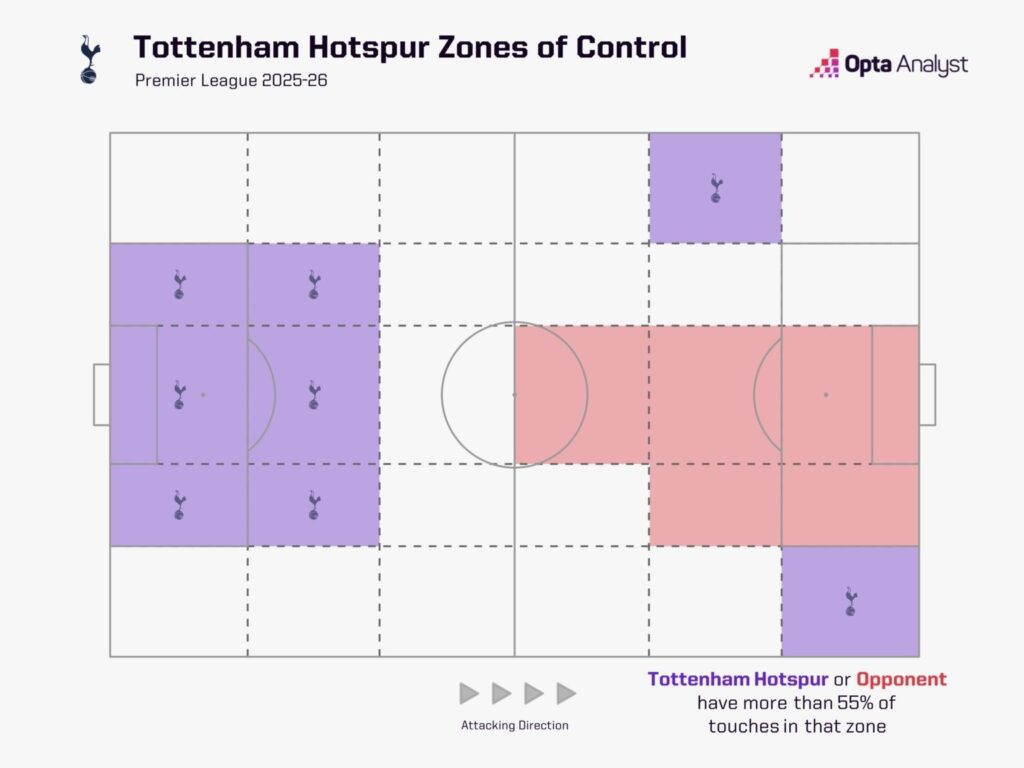
There was almost no attempt to control games by dominating the ball, and Spurs were outplayed by many teams with far less in the way of resources than them.
Set-Piece Overreliance
When Frank came in, there was some relief among fans that they now had a pragmatic manager who saw the value in making use of set-pieces after the idealism of Postecoglou. Long throws were introduced on day one, and set-piece routines were practised on the training ground.
Frank made Spurs into a force at dead balls at both ends of the pitch. They scored 13 goals from corners this season, second only to Arsenal (14), and for that he deserves some credit.
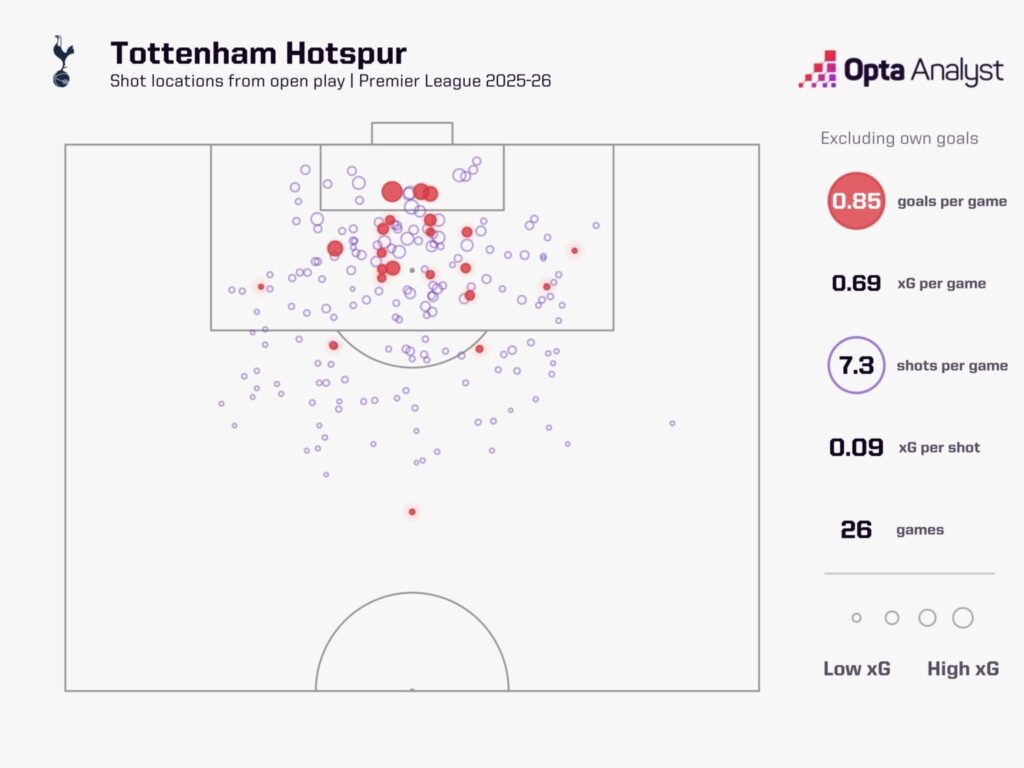
But they ultimately became too reliant on those situations. Their 36.1% of goals coming from set-pieces was the highest proportion of any team in the Premier League this season. It is no coincidence that, after Richarlison, their top scorers in the Premier League this season are centre-backs Cristian Romero and Micky van de Ven (four goals each).
Top Scorers Under Frank
| Player | Goals | Position |
|---|---|---|
| Richarlison | — | Forward |
| Cristian Romero | 4 | Centre-back |
| Micky van de Ven | 4 | Centre-back |
The Slide Towards Relegation
Alarming Decline
Relegation became a real and terrifying possibility under Frank. Spurs slid from third place after five games — when they made a distractingly positive start to life under the new manager — to 16th on Wednesday morning, just five points clear of the relegation zone. West Ham in 18th have closed the gap by eight points over the past five matchdays, giving them every chance of catching up in the space of the 12 games that remained.
Home Form Catastrophe
Particularly painful was Spurs’ woeful home form. The club charges some of the highest ticket prices in the country but gave fans only two home wins in 13 league games all season. Frank hadn’t given them much reason to keep coming back, and the swathes of empty seats at the stadium at every recent home game might have gone some way to scaring the club into acting.
Recent Form Timeline
| Period | Performance | Context |
|---|---|---|
| First 5 games | 3rd place | Distractingly positive start |
| Final 17 games | 2 wins, 12 points | Fewer than all but Wolves (6) and Burnley (5) |
| Final 8 games | 0 wins | Longest winless run since 2008 (9 games under Ramos) |
| February 11 | 16th place | 5 points above relegation zone |
Why the Board Finally Acted
Abandoned Principles
The hierarchy had been steadfast in their position that they would ride this out and stick by the man they trusted to take them forward for the long term. The thinking seemed to be that the previous Tottenham regime, led by the now-departed Daniel Levy, had been too trigger-happy with firing and hiring managers. The club needed continuity and stability to build something sustainable that would last longer than any of the previous failed eras since Mauricio Pochettino left in 2019.
They might have been right. Short-term thinking had got Spurs nowhere with José Mourinho and Antonio Conte. They have gone backwards since sacking Postecoglou. Maybe Frank would have one day turned it around and gone on to bring long-term success to Tottenham.
But even the Spurs board realised they got this one wrong.
What Went Wrong
Given how dreadful results were, how toxic the atmosphere became at the Tottenham Hotspur Stadium, and how utterly hopeless the players looked, it shouldn’t have been a surprise that Frank was sacked. Following Tuesday night’s woeful performance in defeat to Newcastle, the Tottenham board finally lost patience.
There was little on the pitch to inspire the fans, and as performances worsened through the winter months and Frank cut an increasingly clueless figure on the touchline, patience ran out.
The Injury Crisis Excuse
Frank had to deal with an atrocious injury crisis. After Wilson Odobert went off against Newcastle, Spurs had 11 first-team players out, plus they were also without captain Romero for another three games after his red card at Manchester United at the weekend.
But there is no way this group — even accounting for only the fit and available players — are anywhere near as bad as their performances and results have been. They looked completely shot of confidence, devoid of ideas under a manager who hadn’t given them any good ones, and were steaming head first towards relegation. The ceiling for this team is much higher than they made it look in recent weeks.
Read More: Direct, Disciplined, Dangerous: Keith Andrews’ Brentford Blueprint for Europe