MBSG0
MBSG0 CFC0
CFC0 NEF1
NEF1 ITT1
ITT1 PSG
PSG LYON
LYON SEV
SEV OSA
OSA NED
NED OMA
OMA NZ
NZ IND
IND NAM
NAM IRE
IRE PAK
PAK SL
SL SA
SA AUS
AUS Abha
Abha Al Faisaly
 Barcelona1
 Real Madrid2
 Udinese0
 Milan2
 Real Sociedad2
 Levante1
 Lecce0
 Juventus2
 MOW63/6 (14/20 ov)
 TOK
TOK NZ-A317
 IND-A113 & 488/8 (119 ov)
 SYL575/4 (167.3 ov)
 KHU
KHU MYMS465/7d
 CHATT424/6 (121 ov)
 DHA521
 RAJ162 & 215/5 (59.1 ov) (f/o)
 RAN402 & 5/0 (2.3 ov)
 BAR443/9d
 SIKM30/1 (15 ov)
 NAGA187
 JHK
JHK DELHI309/5 (90 ov)
 ODSA194
 SVCS13/0 (5 ov)
 BRODA259/6 (86 ov)
 J & K
J & K CHD363/2 (87 ov)
 HP
HP CGR35/1 (14 ov)
 AP231
AP231 BRB
BRB MIS
MIS BIK
BIK CHR
CHR JER
JER KUW
KUW MEX-W51 (12.5/20 ov, target 187)
 ARG-W186/7
 NGA148
 UGA147/9 (20 ov, target 149)
 GMB112/9
 LES109 (19.5/20 ov, target 113)
 MOZ110/7 (19/20 ov, target 110)
 ZMB109/9
 IND-W328/6
 ZIM-W207 (48.5/50 ov, target 329)
 ENG241
 Sassuolo
 Lazio
Lazio AS Roma
 Cagliari
 Torino
 Como
Como BES
BES IBFK
IBFK CAY
CAY TRAB
TRAB Sunderland0
 Leeds0
 Freiburg1
 Bayern3
This is the biggest showdown in Hollywood history — and it doesn’t involve superheroes, spaceships, or a single camera.
It’s a battle over who controls the future of movies, television, and storytelling itself. And right now, the entire entertainment industry is picking sides.
Paramount–Warner Bros. Merger Deal Overview
| Detail | Info |
|---|---|
| Deal | Paramount acquires Warner Bros. Discovery (WBD) |
| Deal Value | ~$111 billion |
| Price Per Share | $31.00 cash |
| Announced | February 27, 2026 |
| Expected Close | Q3 2026 |
| Equity Backed By | Ellison Family & RedBird Capital ($47B) |
| Projected Synergies | Over $6 billion |
| Streaming Outcome | Paramount+ and Max to merge into one platform |
| Films Committed | Minimum 30 theatrical releases annually |
What’s the Merger About?
Paramount will pay $31.00 per share in cash for all outstanding shares of WBD, with the transaction unanimously approved by the Boards of Directors of both companies and expected to close in Q3 2026, subject to regulatory clearances. Paramount
Paramount’s victory came after a chaotic bidding war — Netflix had previously agreed to an $83 billion deal but ultimately declined to match Paramount’s revised offer, with Netflix co-CEOs stating the deal was “no longer financially attractive.” Wikipedia
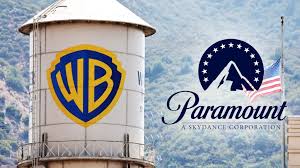
The combined company would unite iconic franchises — Game of Thrones, Harry Potter, Mission: Impossible, Top Gun, the DC Universe, and SpongeBob SquarePants — under one roof.
Hollywood Revolts: The Open Letter
This is where it gets electric. More than 1,000 writers, actors, and directors — including Bryan Cranston, Jane Fonda, Ben Stiller, Joaquin Phoenix, Emma Thompson, Jason Bateman, Lin-Manuel Miranda, and Kristen Stewart — signed an open letter warning the merger would leave just four major U.S. film studios. Deseret News
The signatory list has since grown to over 2,000, with Edward Norton, Pedro Pascal, Florence Pugh, and Atsuko Okatsuka among the latest to add their names.
The letter’s core argument is blunt: “The result will be fewer opportunities for creators, fewer jobs across the production ecosystem, higher costs, and less choice for audiences in the United States and around the world.”
Paramount Fires Back
Paramount responded by making the case that the transaction will ensure “more avenues for their work, not fewer,” stating the deal “uniquely brings together complementary strengths to create a company that can greenlight more projects, back bold ideas, support talent across multiple stages of their careers.”
The studio also reiterated its commitment to releasing a minimum of 30 high-quality feature films annually with full theatrical releases and “preserving iconic brands with independent creative leadership.” NBC News
Political & Regulatory Heat
The fight isn’t just in Hollywood. The UK’s Competition and Markets Authority announced a preliminary probe into the deal on April 13, 2026, signaling that resistance isn’t confined to California. FinancialContent Meanwhile, a U.S. Senate hearing has also been called to scrutinize the merger’s implications for creators and competition.
According to Wikipedia, the merger is expected to take 6–18 months to close pending full regulatory and shareholder approval — and industry observers are bracing for significant layoffs once it does.
For more on this developing story and the latest entertainment industry news, follow our coverage at TechnoSports Entertainment and check out our latest OTT and Hollywood updates for everything you need to know.