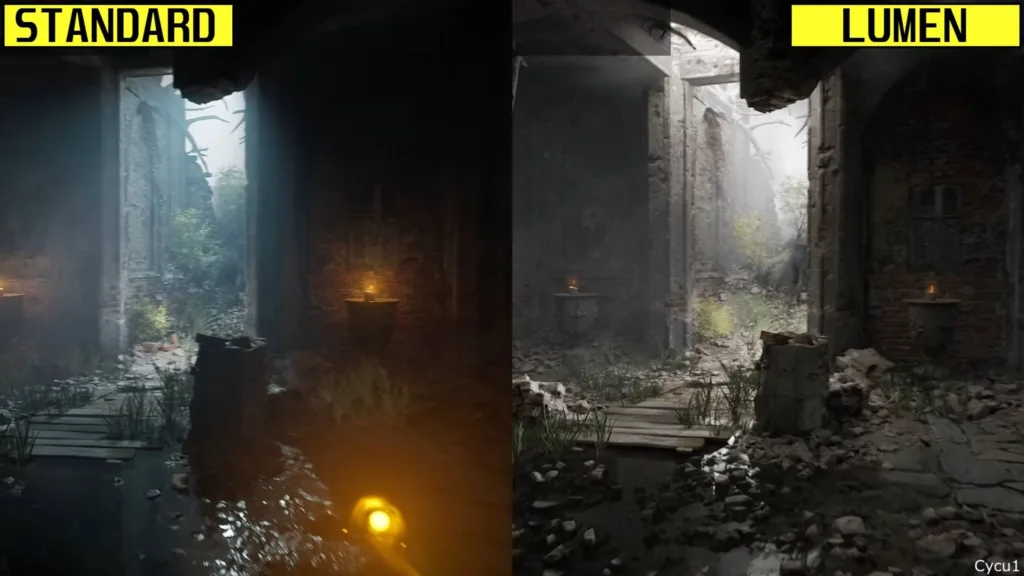
Epic Games added Lumen Irradiance Cache to Unreal Engine 5’s development branch—a lightweight dynamic lighting mode specifically designed for low-power devices like Nintendo Switch 2. This probe-based lighting solution delivers 2.5x faster performance while maintaining Lumen’s signature real-time global illumination, potentially bringing Switch 2 visuals closer to PS5 and Xbox Series X.
Table of Contents
Lumen Irradiance Cache: Key Technical Details
| Feature | Hardware Lumen (Default) | Lumen Irradiance Cache |
|---|---|---|
| Target Hardware | PS5, Xbox Series X, PC | Switch 2, mobile, low-end PC |
| Architecture | GPU hardware ray tracing | Probe-based approximation |
| Gather Stage Speed | Baseline | 2.5x faster |
| Overall Scene Speed | Baseline | 1.5x faster |
| Occlusion Detail | High | Reduced |
| Reflection Quality | High fidelity | Simplified |
| Memory Usage | Higher | Optimized |
| Development Status | Production-ready | Early preview |
Why Switch 2 Needs Lumen Optimization
Currently, Unreal Engine 5 games on Switch 2 like Cronos: The New Dawn don’t use Lumen due to CPU limitations. Even Fortnite—Epic’s own flagship title—runs without Lumen and Nanite on the console. This new Irradiance Cache mode addresses these constraints by replacing GPU-intensive hardware ray tracing with probe-based approximation that’s friendlier to mobile architectures.
According to tech artist Dylan Browne, the tradeoff is acceptable: occlusion detail decreases and reflections simplify, but games retain dynamic global illumination—the lighting effect that makes environments feel alive as light bounces realistically off surfaces. For a handheld targeting 1080p/120fps or docked 4K/60fps, this compromise maintains visual fidelity without crushing performance.

2.5x Performance Boost Changes Everything
A now-removed GitHub commit revealed that Lumen Irradiance Cache accelerates the “gather stage” by 2.5x, contributing to an overall 1.5x speedup for Lumen Scene calculations. This dramatic efficiency gain means Switch 2 games could feature dynamic lighting previously reserved for $500+ consoles.
Consider the visual gap between current Switch games and their PS5 counterparts—often stark due to baked lighting on Switch. With Lumen Irradiance Cache, developers can implement real-time day-night cycles, destructible environments with proper lighting response, and photorealistic indoor/outdoor transitions without pre-baking light maps for weeks.

What This Means for Switch 2 Ports
Third-party developers now have a clearer path to near-parity ports. Instead of completely disabling Lumen (resulting in flat, last-gen visuals), studios can use Irradiance Cache for “good enough” dynamic lighting. Games like The Witcher 4, Cyberpunk 2088, and Final Fantasy XVII could feasibly run on Switch 2 with recognizable visual identity to their console versions.
Epic’s focused optimization suggests strong collaboration with Nintendo. With Switch 2 supporting Unreal Engine 4 and 5 officially, and Epic committing resources to mobile-specific features, the console’s third-party library could be its strongest yet.
For Unreal Engine updates, visit Epic Games’ official page. Check out TechnoSports for more gaming tech news.