BAR1
BAR1 RMA2
RMA2 SCP0
SCP0 ACV1
ACV1 Mohun Bagan
 Chennaiyin
 PSG
PSG Lyon
Lyon Sevilla
 Osasuna
 NED
NED OMA
OMA NZ
NZ IND
IND NAM
NAM IRE
IRE PAK
PAK SL
SL SA
SA AUS
AUS UDI0
UDI0 MIL2
MIL2 RSO2
RSO2 LEV1
LEV1 LEC0
LEC0 JUV2
JUV2 SUN0
SUN0 LEE0
LEE0 LIMWn
LIMWn NW-W
NW-W NCWmn
NCWmn FsWm
FsWm NZ-A317
 IND-A113 & 132/2 (40.6 ov)
 SYL280/2 (84 ov)
 KHU
KHU MYMS465/7d
 CHATT134/2 (40 ov)
 DHA521
 RAJ103/6 (26 ov)
 RAN402
 BAR179/3 (56.1 ov)
 BRB
BRB MOW
MOW LUL
LUL SPR
SPR TOK
TOK MEX-W51 (12.5/20 ov, target 187)
 ARG-W186/7
 NGA148
 UGA147/9 (20 ov, target 149)
 GMB112/9
 LES109 (19.5/20 ov, target 113)
 MOZ110/7 (19/20 ov, target 110)
 ZMB109/9
 IND-W328/6
 ZIM-W207 (48.5/50 ov, target 329)
 ENG241
 LAFC
LAFC LA
LA Neftchi Fergana
 Al Ittihad
 Besiktas
 Istanbul BB
 Caykur Rizespor
 Trabzonspor
 Al Ahli
 Al-Gharafa
 SCF1
SCF1 MUN3
MUN3 AUX1
AUX1 MNS1
MNS1
The beauty of the World Cup is the variety of unique styles and players competing against each other on football’s biggest stage. Sometimes this creates unusual tactical challenges that require on-the-fly solutions. Alternatively, with the popularity and influence of the Premier League and Champions League, nations increasingly borrow ideas from club football when the tournament comes around.
Twelve games in and common patterns, trends and matchups are already emerging. Here are five that have stood out most clearly.
1. The Return of the 4-4-2
Football tactics are continuously developed and analysed in increasingly sophisticated ways — which makes it genuinely interesting to see the 4-4-2 become so commonly used at this tournament.
Premier League football of the early 2000s was defined by the 4-4-2. Spaces between players were bigger, with fewer low blocks and less drilled high presses. This created more time and space for attackers to express themselves.
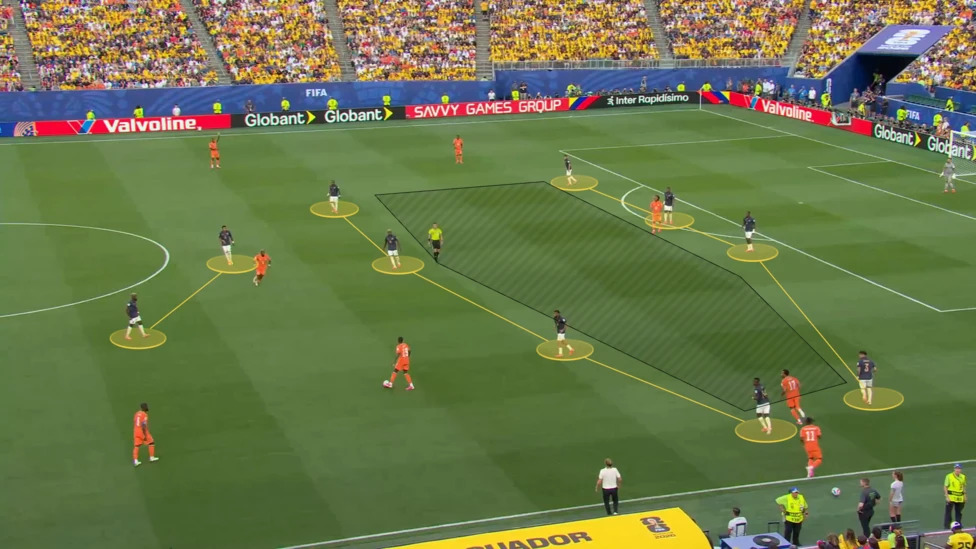
Teams at this World Cup — perhaps due to conditions, heat, and limited coaching time — have reverted to a similar shape. Many sides are opting for a 4-4-2 out of possession, including Ecuador, Ivory Coast, Morocco, Brazil, Haiti, Scotland, and Japan at various points.
In their 4-4-2, these teams are picking specific moments to press rather than committing to a high press for extended periods. Instead, they defend predominantly in a mid-block — neither sitting deep nor pressing high consistently.
| Nations Using 4-4-2 Out of Possession | Notes |
|---|---|
| Ecuador, Ivory Coast, Morocco | Primary defensive shape |
| Brazil, Haiti, Scotland, Japan | Used at various stages |
The formation provides wide, balanced coverage — but it leaves spaces between the lines that attacking teams have exploited effectively. Which leads directly to the tournament’s second major trend.
2. A Focus on Diagonal Play
In a 4-4-2, the defending side are well positioned to stop forward and sideways movements because of their two flat lines of four. As a result, attacking diagonally has emerged as a significant trend — moving from wide positions into dangerous central areas behind the midfield, where flat defensive lines struggle to cover the angles.
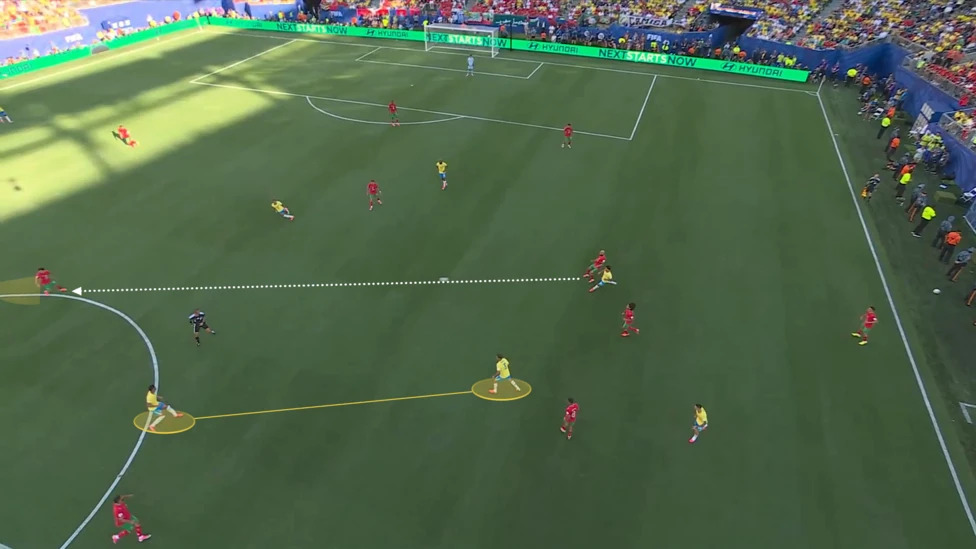
Morocco’s goal against Brazil provided a clear example. Noussair Mazraoui found his attacking midfielder with a diagonal pass from a wide area into the central zone — a movement he had executed multiple times before the decisive goal. Brazil, operating in a 4-2-4 shape with Casemiro and Bruno Guimarães as a midfield duo, were frequently pulled toward the ball as they pressed. This opened space on the far side — a two-man midfield simply lacks the horizontal coverage that a midfield three would provide.
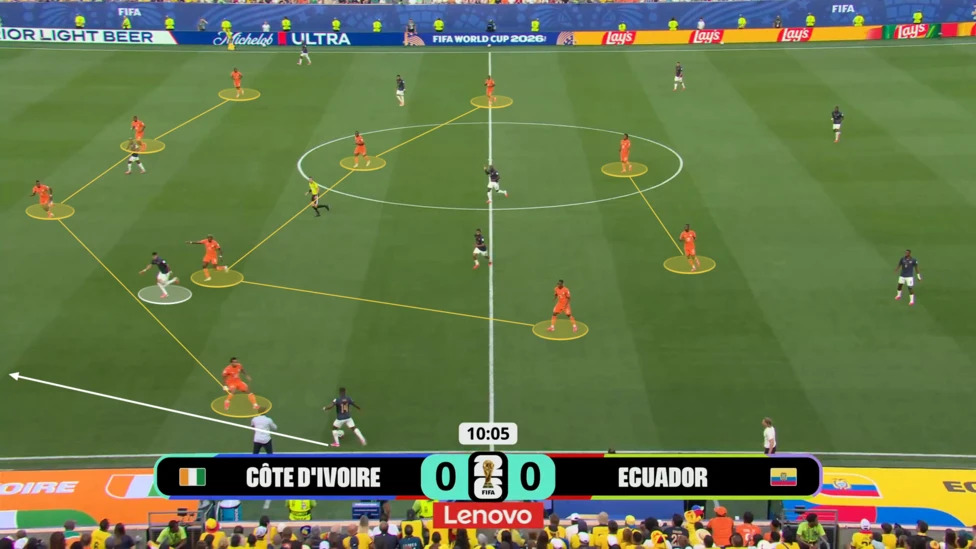
Ecuador’s game against Ivory Coast illustrated a different application of the same principle. Ecuador created good chances by attacking diagonally from in to out — movement from central areas into wide positions. Piero Hincapié shifted into midfield as a holding player, with a teammate rotating into left-back. Ivory Coast’s central midfielders followed Hincapié’s runs toward the wing, dragging central players wide and creating space for crosses and cut-backs.
Ancelotti was observed encouraging the same diagonal pattern down Brazil’s left — with Vinícius Júnior wide and Matheus Cunha making the in-to-out run.
3. The Effectiveness of False Nines
One of the defining trends in the most successful club sides this season was the use of roaming strikers. Harry Kane and Ousmane Dembélé helped Bayern Munich and PSG generate significant possession-based threat by leaving natural striker positions to operate in deeper and wider areas.
On the international stage, Spain have historically found success using midfielders as false nines rather than traditional centre-forwards. By flooding the team with technical players, opponents struggled to win back the ball.
At this World Cup, with teams increasingly adopting man-to-man marking, allowing a striker to drift into unusually deep or wide positions creates a genuine defensive dilemma:
- If centre-backs follow them into deep midfield or to the wing, space opens centrally behind the defensive line
- If centre-backs choose to hold their position, the roaming striker creates an overload in an area of the pitch that helps their side retain possession and build dangerous attacks
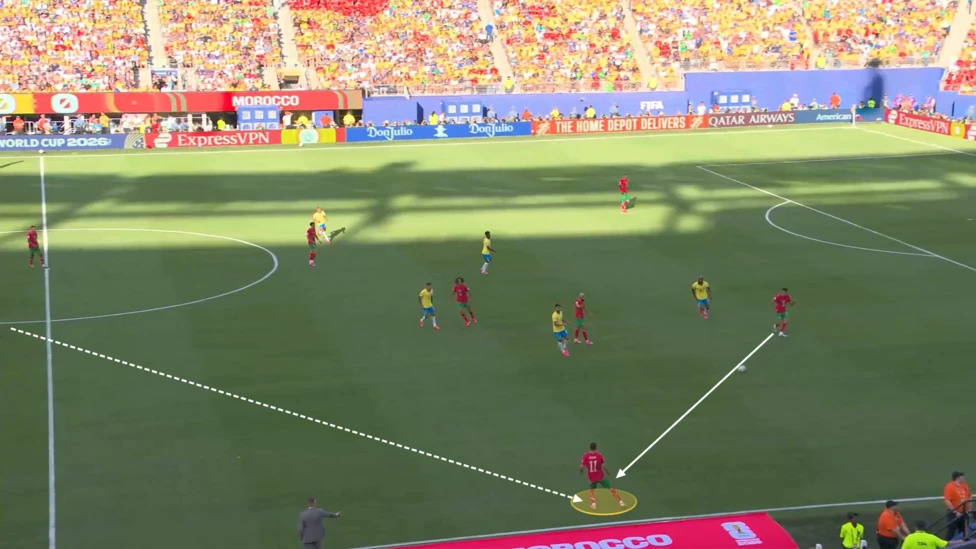
Ismael Saibari (Morocco), Kai Havertz (Germany), and Raúl Jiménez (Mexico) have all used this principle to varying degrees. Kane and Dembélé are expected to do similar jobs for England and France, replicating the roles they executed so effectively at club level this season.
4. Increasingly Fluid Midfields to Entice Pressure
The USA’s 4-1 victory over Paraguay was arguably the best display of attacking football at the tournament so far. Part of that was attributable to Paraguay’s poor defensive approach — but Mauricio Pochettino’s men also provided the clearest example of a broader trend: fluid midfields designed to draw pressure and create overloads.
In possession, the USA played a back three with Antonee Robinson wide left and Sergiño Dest wide right, Folarin Balogun as the fixed striker. The four remaining central players — Tyler Adams, Malik Tillman, Christian Pulisic, and Weston McKennie — moved freely in the central areas, encouraged to play in close proximity to each other.
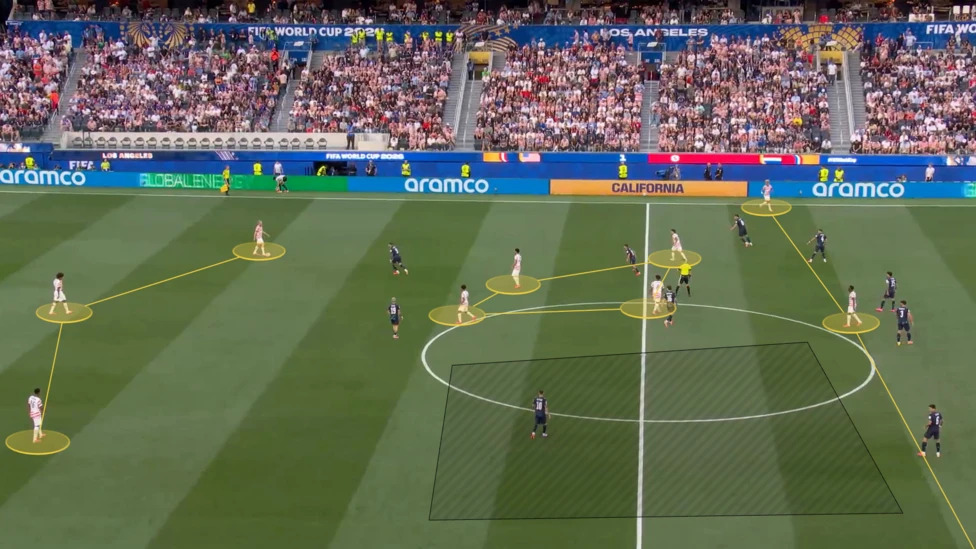
Rather than maintaining a rigid midfield box, the attacking midfielder from the far side would drift toward the ball. Paraguay’s midfielders were unsure whether to follow — which regularly created overloads in central areas for the USA. When opponents were drawn toward that cluster of players, the USA played direct passes for runners in behind, where fewer defenders remained.
South Korea employed a strikingly similar approach against Bosnia. With a fluid midfield box, they dropped deep with multiple players around the ball, drew pressure, then released attackers into the space higher up the pitch. The principle — compress centrally, invite pressure, exploit the gaps created — is becoming one of the tournament’s defining attacking templates.
5. Premier League-Style Set-Pieces (But With Less Grabbing)
No discussion of tactical trends would be complete without set-pieces. Premier League football was defined by the dramatic rise in goals from dead-ball situations in recent seasons, and nations have clearly been taking notes.
In the tournament’s opening twelve games, Czech Republic scored from a long throw, Bosnia and Germany scored from corners, and the Netherlands and Tunisia both scored with follow-up crosses immediately after set-piece situations.
Several of the specific tactics deployed have been borrowed directly from club football:
South Korea defended Czech Republic’s long throw zonally, while Czech Republic placed three players deeper — capable of making runs into attacking positions with momentum — and left others closer to goal who were individually marked. Those man-marked players impaired the movement of South Korean defenders, creating the space the delivery targeted.
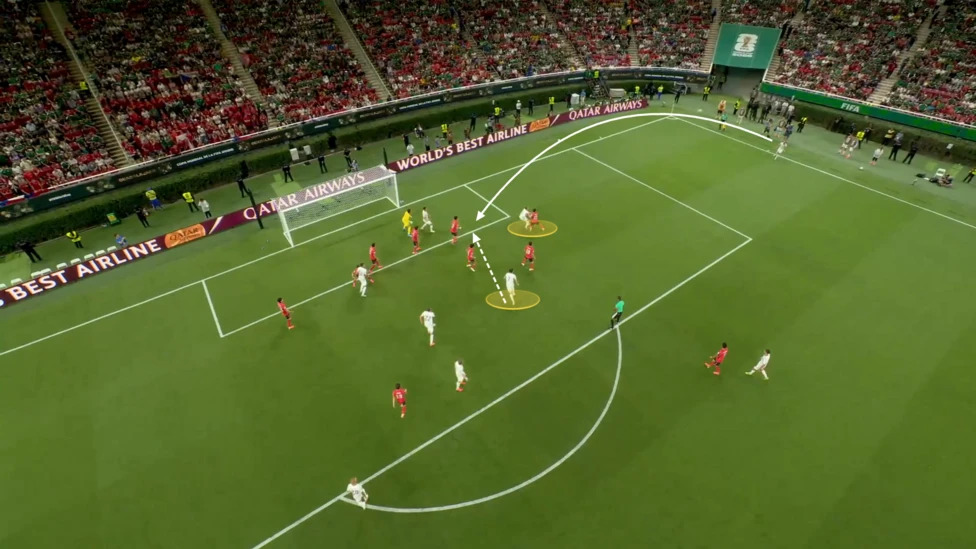
With stricter refereeing on grappling in the box, teams have not crowded the six-yard area as aggressively as Premier League sides sometimes do. The blocking that remains is more subtle — particularly at the near post, where a forward’s movement prevents the defender from retreating to where the ball lands.
The most notable detail from the tournament’s early set-piece goals is how near-post flick-ons have created back-post opportunities. Bosnia and Tunisia’s headed goals both originated from near-post deflections — attackers finding themselves free as front-post defenders shifted toward the ball and the defender behind failed to step up quickly enough. Expect this pattern to be studied and replicated as the tournament progresses.
| Set-Piece Goals — First 12 Games | Method |
|---|---|
| Czech Republic | Long throw |
| Bosnia | Corner |
| Germany | Corner |
| Netherlands, Tunisia | Follow-up cross after set-play |
Read More: Cabo Verde’s World Cup Debut: 10 Fun Facts About the Blue Sharks