

For developers and enterprises building with AI in 2026, the challenge has always been the “intelligence vs. cost” trade-off. Do you deploy a heavyweight model like Claude 4.6 Opus for every task to ensure accuracy, or do you opt for a leaner, faster model like Sonnet or Haiku to save on overhead?
Anthropic has officially solved this dilemma with the introduction of The Advisor Strategy.
By pairing the world-class reasoning of Opus with the speed and efficiency of Sonnet or Haiku, you can now achieve “frontier-level” intelligence at a significantly lower price point. Here is how this architectural shift is redefining AI trends in 2026.
What is the Advisor Strategy?
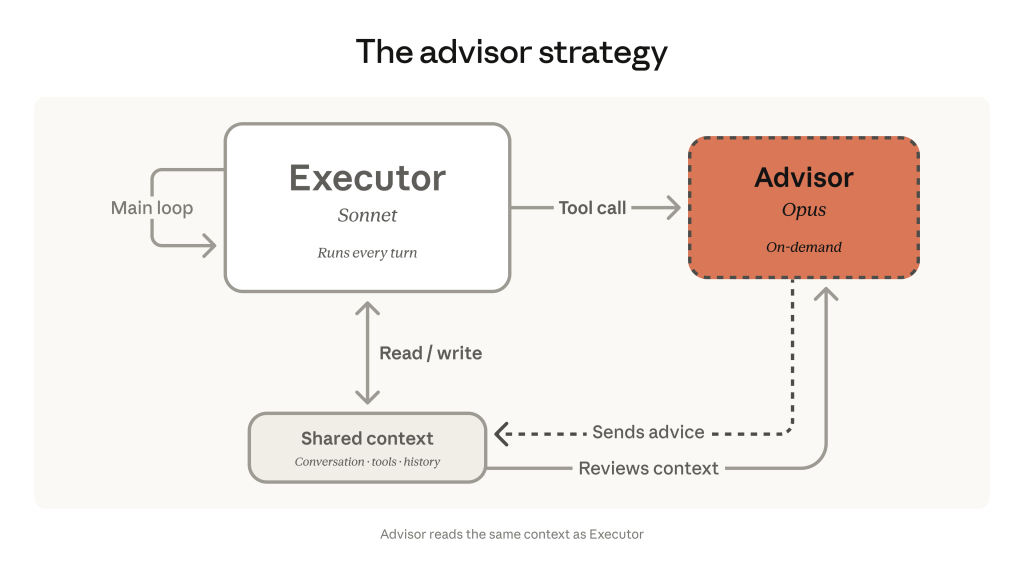
The Advisor Strategy flips the traditional “orchestrator” model on its head. Instead of having a large model break down tasks and manage smaller “worker” models, the Advisor Strategy empowers the smaller model to lead the way.
- The Executor (Sonnet or Haiku): This model handles the bulk of the work—calling tools, processing data, and iterating toward a solution.
- The Advisor (Opus): The high-intelligence model stays on standby. It only steps in when the Executor reaches a complex decision point or encounters an error it can’t resolve.
This “escalation-on-demand” approach ensures that you only pay for Opus-level reasoning when it is strictly necessary. The result? Near-Opus intelligence with costs that stay much closer to Sonnet levels.
The New “Advisor Tool”
To make this strategy accessible, Anthropic has launched the Advisor Tool natively on the Claude Platform. It simplifies what used to be a complex multi-agent setup into a single-line change in your API request.
When the Executor model (like Sonnet 4.6) hits a roadblock, it invokes the advisor tool. The system then routes the curated context to Opus, which returns a concise plan or correction. The Executor then resumes the task immediately. This all happens within a single request, eliminating the need for manual state management or extra round-trips to the server.
For those tracking the intersection of high-performance hardware and AI, this server-side orchestration is a masterclass in efficiency.
Benchmarking the Gains
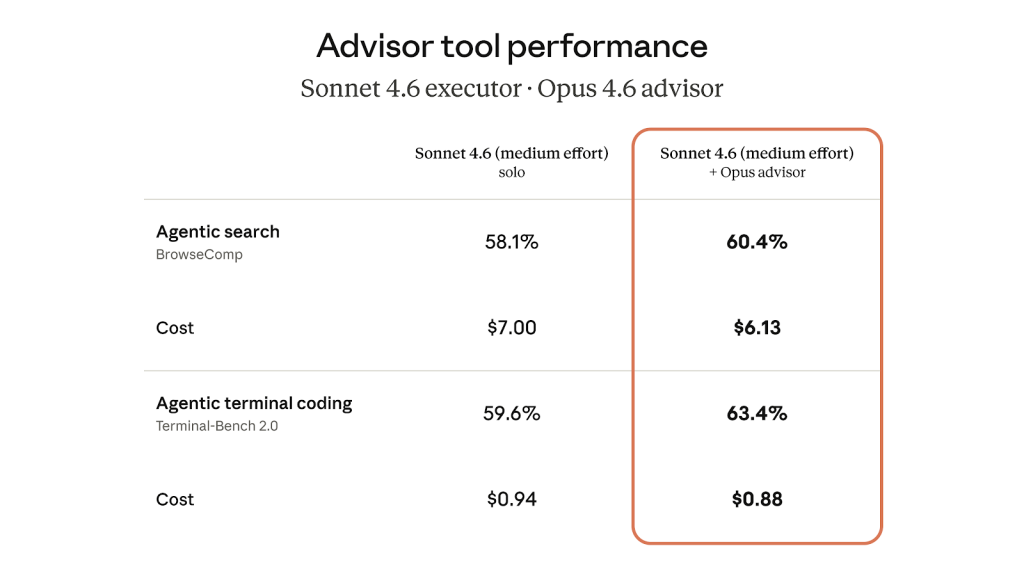
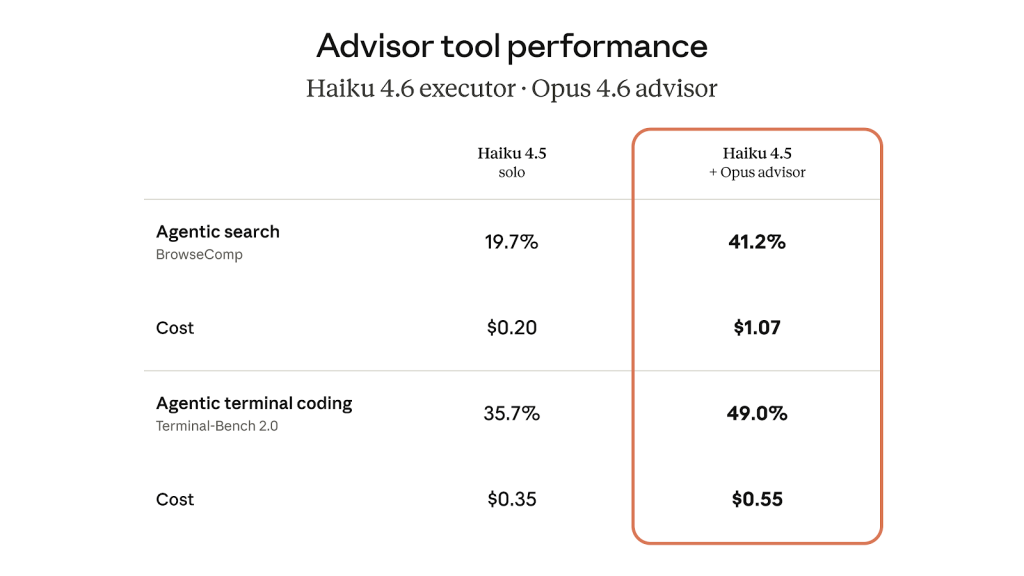
The numbers behind this strategy are impressive. In Anthropic’s internal evaluations, the performance boost across technical benchmarks was clear:
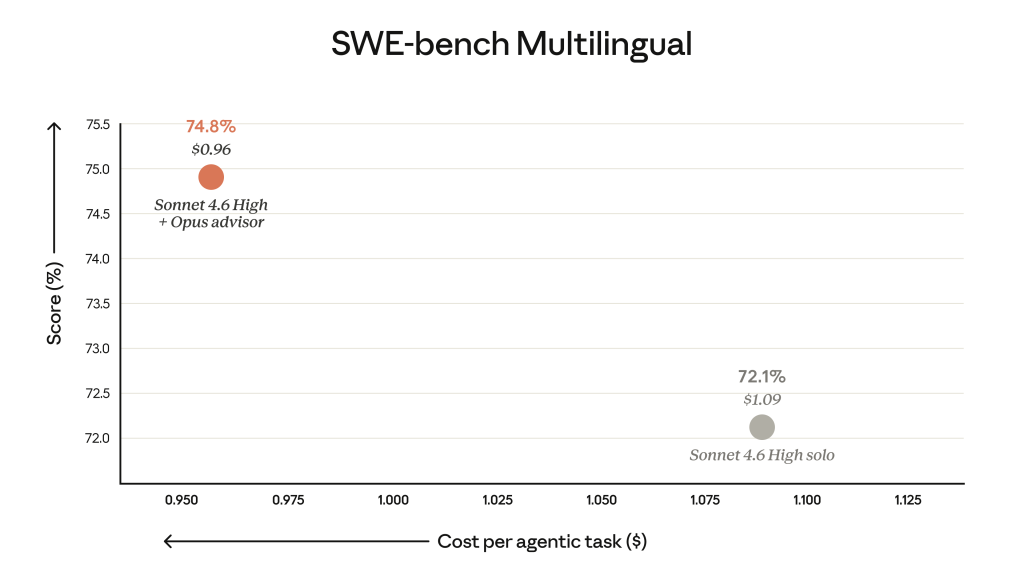
- Coding (SWE-bench Multilingual): Sonnet with an Opus advisor showed a 2.7 percentage point increase in performance while reducing the cost per task by 11.9%.
- Web Browsing (BrowseComp): Haiku with an Opus advisor more than doubled its solo score (from 19.7% to 41.2%).
- Efficiency: Because the Advisor only generates short, high-density plans (typically 400-700 tokens), the “intelligence boost” comes without the massive token bill of a full Opus run.
This is a massive win for the gaming industry and developers building complex, real-time agents who need to balance responsiveness with deep logic.
Why This Matters for Your Bottom Line
In 2026, SEO and digital strategy are increasingly driven by AI agents. Running these agents at scale can become prohibitively expensive if you rely solely on flagship models.
The Advisor Strategy offers built-in cost controls:
- Lower Output Costs: The Executor handles the voluminous text output at its much lower rate.
- Capped Usage: You can set a
max_usesparameter for the advisor tool to ensure your budget stays predictable. - No Idle Overhead: There is no “standing cost” for the advisor; you are only billed for the specific tokens Opus generates during the handoff.
Whether you are optimizing your backend on NVIDIA-powered infrastructure or deploying localized agents, this “layered” intelligence model is the most sustainable way to scale.
How to Get Started
Implementing the Advisor Strategy in April 2026 is straightforward. You simply need to add the advisor tool to your Messages API call:
JSON
{
  "model": "claude-sonnet-4-6", // The Executor
  "tools": [
    {
      "type": "advisor_20260301",
      "name": "advisor",
      "model": "claude-opus-4-6", // The Advisor
      "max_uses": 3
    }
  ],
  "messages": [...]
}
By leveraging this architecture, your agents will make better architectural decisions on complex tasks while adding zero overhead on simple ones.
Final Thoughts: The Future of Collaborative AI
The Advisor Strategy proves that the future of AI isn’t about one single “God-model” doing everything. It’s about collaboration. By letting models specialized in speed work alongside models specialized in reasoning, we can finally build AI applications that are both brilliant and affordable.
To stay updated on how these evolving AI frameworks are impacting the world of technology and gadgets, keep following our deep dives here at TechnoSports.
Are you planning to use Sonnet or Haiku as your primary executor? Let us know your thoughts in the comments!


