NZ180/5 (20 ov)
 IND
IND NAM92/2 (20/50 ov)
 IRE
IRE MOZ
MOZ UGA
UGA AVL
AVL MNC
MNC RAY
RAY ELC
ELC GMB
GMB ZMB
ZMB NGA
NGA LES
LES CAG
CAG BOL
BOL COMO
COMO SAS
SAS FCA
FCA FCU
FCU Ipswich1
 Nottm Forest1
 Alavés1
 Málaga1
 Torino3
 Monza2
 Brest1
 Nice2
Nice2 WA
WA NSW290/5 (42.4/50 ov)
 DEN
DEN KUW
KUW KENYA
KENYA QAT
QAT SWD-W
SWD-W EPR-W
EPR-W TTN-W
TTN-W WPR-W
WPR-W NZ-A135/3 (41 ov)
 IND-A113
 DHA
DHA RAJ
RAJ MYMS
MYMS CHATT
CHATT RAN
RAN BAR
BAR SYL
SYL KHU
KHU MEX-W
MEX-W ARG-W
ARG-W UAE
UAE NED
NED PAK
PAK ENG
ENG IND-W
IND-W ZIM-W
ZIM-W AFG170/3 (34.3/50 ov, target 170)
 ZIM169
 TAS137 (25.2/35 ov, target 276)
 VIC304/7 (50 ov)
 CHE0
CHE0 DYI0
DYI0 CHO1
CHO1 QIN0
QIN0 HEN1
HEN1 BEI0
BEI0 LIA1
LIA1 ZHE0
ZHE0 QWC1
QWC1 YUN0
YUN0 SHX0
SHX0 Shanghai Shenh0
 TIG0
TIG0 SHP0
SHP0 WTT1
WTT1 SHT3
SHT3 KOE
KOE S04
S04 M05
M05 SVW
SVW RBL
RBL ELV
ELV Stuttgart2
 Gladbach3
 Al Ahli4
 Al Khaleej1
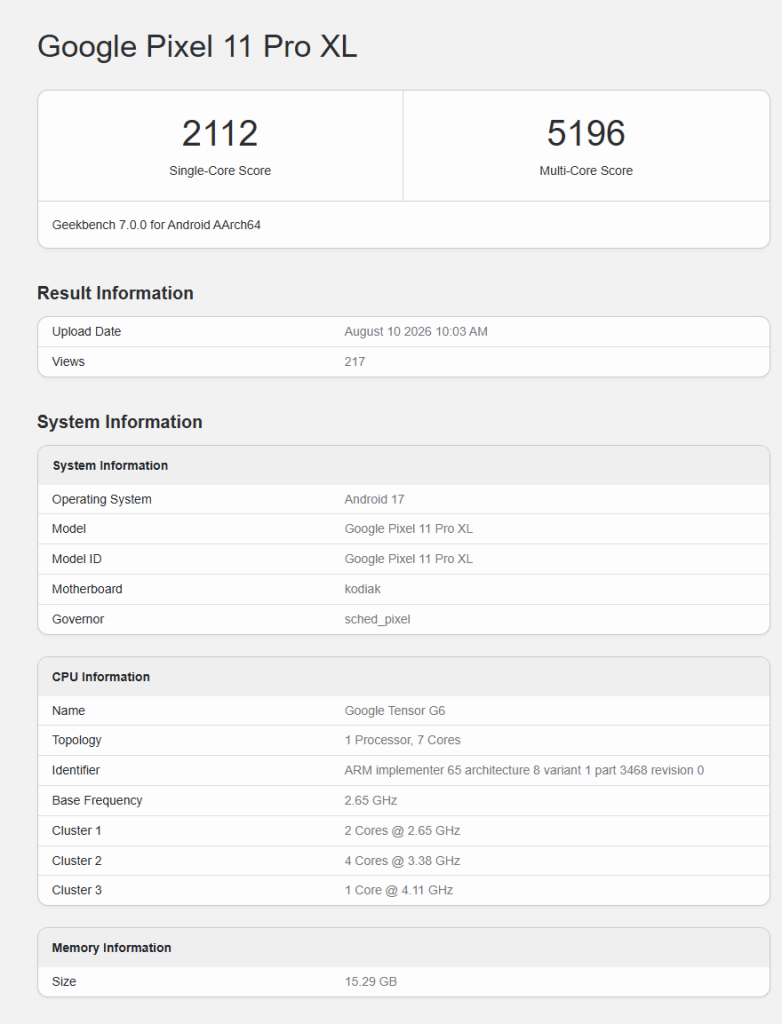
Google’s next flagship silicon, Tensor G6, just left its first real fingerprint online. A Google Pixel 11 Pro XL unit has appeared on Geekbench 7, giving us the earliest concrete look yet at the Tensor G6 — and its most surprising trait isn’t the score, it’s the core count.
The Numbers on the Listing
| Metric | Result |
|---|---|
| Single-Core | 2,112 |
| Multi-Core | 5,196 |
| Chipset | Google Tensor G6 |
| CPU cores | 7 (unusual configuration) |
| CPU clocks | 2× 2.65GHz + 4× 3.38GHz + 1× 4.11GHz |
| RAM | 16GB |
| GPU | PowerVR C-Series CXTP-48-1536 MC1 |
| OS | Android 17 |
For context on how Tensor chips have historically stacked up against rivals, our Pixel and Android coverage has tracked each generation’s benchmark trajectory closely.
Why the Core Count Is the Real Story
Every prior Tensor chip has shipped with eight cores. The G6 instead uses a 1+4+2 “septa-core” layout — a single high-clock prime core at 4.11GHz, four mid-tier performance cores at 3.38GHz, and two efficiency cores at 2.65GHz. That’s a genuinely unusual cluster arrangement compared to typical flagship designs from Qualcomm and MediaTek, which usually lean on two or more powerful “big” cores for heavy multitasking.
Dropping to a single top-tier core suggests Google may be prioritizing thermal efficiency and consistent day-to-day performance over chasing peak multi-core numbers — a trade-off that could show up in real-world multitasking rather than synthetic benchmarks.
GPU Gets a Naming Change, Not Necessarily a Generational Leap
The listing also confirms a switch to a PowerVR C-Series GPU, replacing the D-Series chip used in the Tensor G5. Whether this represents a genuine performance jump remains unclear — some reports suggest the underlying GPU architecture may be closer to a 2021-era design repackaged under a new name, so this is one area worth watching closely once official reviews land.
Should You Trust Early Benchmarks?
As always with pre-release hardware, treat these numbers cautiously. This is a single Geekbench submission, and Google hasn’t confirmed the Tensor G6 or the Pixel 11 series officially. You can track Google’s confirmed hardware announcements directly through the Google Store once details go live.
What This Means for Pixel 11 Buyers
If this listing holds up, the Tensor G6 looks like an evolutionary chip rather than a dramatic leap — more focused on efficiency and AI workloads than raw benchmark bragging rights. Keep following our Pixel launch coverage as more Tensor G6 details and official confirmation emerge ahead of the Pixel 11 series reveal.