SA329 (82.3 ov)
 AUS
AUS BAN
BAN WI
WI IND-W
IND-W ZIM-W
ZIM-W GOA
GOA SC Delhi
 Milan
Milan Bologna
 Parma
Parma Udinese
 Venezia
 Inter Milan
 Genoa
Genoa Juventus
 Monza
Monza Napoli
 ROMA4
ROMA4 CAG2
CAG2 TOR1
TOR1 COMO3
COMO3 SAS2
SAS2 LAZ6
LAZ6 AFG177
 ZIM140 (19.1/20 ov, target 178)
 AUCK
AUCK CANT
CANT CD
CD ND
ND SIKM184
 NAGA187 & 57/4 (41 ov)
 JHK131/4 (47 ov)
 DELHI515/5d
 ODSA194
 SVCS13/0 (5 ov)
 BRODA616
 J & K6/0 (4 ov)
 CHD685/5d
 HP49/0 (14 ov)
 CGR216/8 (95 ov)
 AP231
AP231 HYD193/2 (54 ov)
 PNJB431
 KNTKA297/7 (95 ov)
 TPURA194
 KER101/6 (35 ov)
 BENG350
 UAE
UAE OMA
OMA ENG
ENG SL
SL DEN
DEN QAT
QAT KENYA
KENYA KUW
KUW POA
POA SPR
SPR PAK110
 NAM316/7
 IRE253 (44.5/50 ov, target 317)
 NZ198/3
 IND199/4 (13.2/20 ov, target 199)
 NED371/5
 JAB113 (19.3/20 ov, target 133)
 KAY132/9
 Al Khaleej
 Al Hazem
 Gamba Osaka
 Buriram
 ABH0
ABH0 ALF1
ALF1 Sevilla2
 Osasuna0
 PSG2
PSG2 Lyon0
Lyon0
supermassiveblackhole — The discovery of a supermassive black hole drifting through space without a host galaxy is making astronomers rethink some fundamental rules about cosmic evolution. Usually, these massive gravitational giants sit at the centers of galaxies, growing alongside their stellar environments.
But this rogue object challenges the old assumption that black holes need a galactic “anchor” to reach such gigantic sizes.
Researchers have found a celestial giant that lost its home. They think the object probably got ejected from its parent galaxy after a rare, high-energy gravitational interaction. This event might have happened when two massive galaxies merged, acting like a cosmic slingshot.
The result is a solitary, supermassive entity wandering through the void, which is changing how we understand these structures and their interactions with the universe.
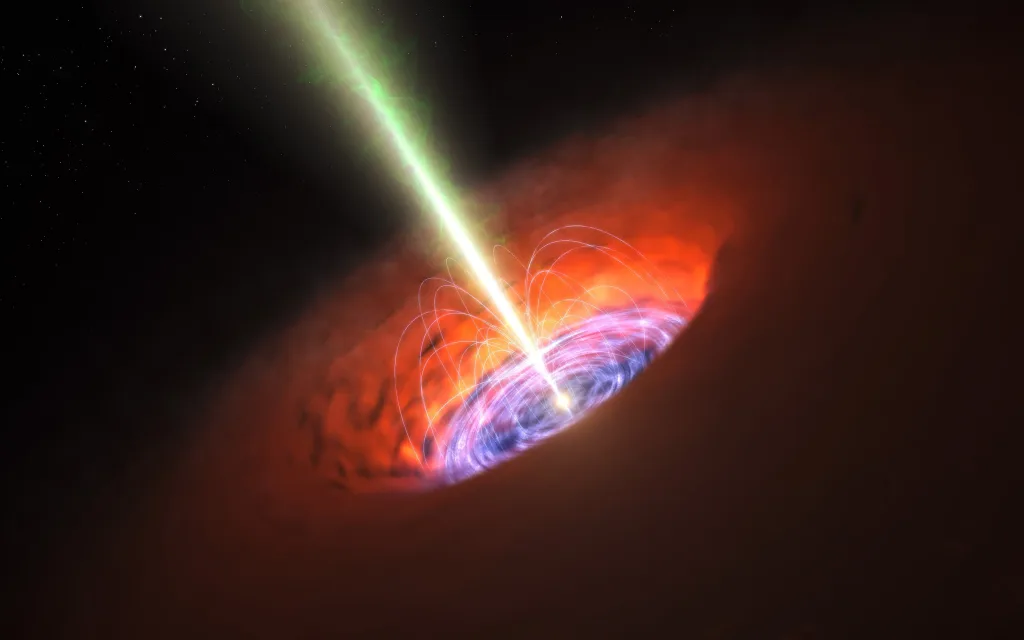
Supermassiveblackhole: Understanding the Rogue Supermassive Black Hole
The scientific community is diving into data to pin down the exact mass and trajectory of this wandering titan. Early observations show that the object has a mass millions of times that of our Sun. But it doesn’t have the surrounding gas and stellar density typically found in galactic centers, as noted in recent coverage by OpenAI Blog.
This lack of a host galaxy makes it really tough to study, since it emits very little light compared to active galactic nuclei.
Not everyone agrees on how it got ejected. Some astrophysicists argue that the energy needed to dislodge a supermassive black hole from its galaxy is almost impossible to generate under normal conditions.
Still, the data hints that in extreme scenarios involving multiple galaxy mergers, the transfer of momentum could be enough to send the black hole into intergalactic space.
Supermassiveblackhole: Implications for Cosmic Evolution
This discovery has big implications for our understanding of how the early universe formed. If supermassive black holes can roam freely, it suggests that our current count of these objects—based mostly on spotting them in bright galactic centers—might be incomplete, as reported by VentureBeat AI.
We might be overlooking a huge, hidden population of rogue black holes that don’t shine through the usual glow of accretion disks.
The potential for future research is huge. By studying this isolated object, scientists hope to learn more about the “seeds” of black hole formation before they get influenced by galactic evolution. It’s a rare chance to observe a cosmic phenomenon in its most basic form, free from the complex noise that typically surrounds it.
The key takeaway isn’t just about one rogue black hole; it’s about the possibility of thousands of similar objects quietly moving through the cosmos.
FAQs
How was this rogue black hole identified?
Astronomers spotted the object by tracking the gravitational lensing effect it created on background light, revealing its massive size despite the absence of a visible host galaxy.
Does this discovery threaten our understanding of gravity?
No, it doesn’t contradict general relativity, but it does challenge current models about how galaxies form and how black holes grow.
Are there other rogue black holes in the universe?
Experts believe this is likely not a one-off case, but a rare outcome of high-energy galactic mergers that have occurred throughout the universe’s history.
How does the rogue supermassive black hole challenge current theories of cosmic evolution?
The rogue supermassive black hole upends existing models by existing independently of a host galaxy, suggesting that supermassive black holes might form or get ejected through mechanisms that current astrophysical simulations don’t fully capture.
Why is the discovery of the rogue supermassive black hole significant for astronomers?
The discovery is significant because it makes astronomers rethink the link between how galaxies form and how central black holes grow, possibly revealing new pathways for how these massive objects navigate through the universe.