UAE65/2 (16.2/50 ov)
 NED
 PAK
 ENG
 IND-W
 ZIM-W
 GMB
 LES
 MOZ
 ZMB
 Inter Milan
 Fiorentina
 Churchill
 Punjab FC
 NGA
 UGA
 Athletic
 Getafe
 MEX-W23 (9.3/20 ov, target 189)
 ARG-W188/5
 ATM1
 DEP0
 LAZ2
 PAR1
 RCL2
 PAR1
 NZ-A317
 IND-A113 & 106/2 (36 ov)
 SYL
 KHU
 MYMS299/4 (87 ov)
 CHATT
 DHA293/3 (84.1 ov)
 RAJ
 RAN320/5 (80 ov)
 BAR
 DEN
 PNG
 KENYA
 JER
 NAM321/6
 IRE290 (47.3/50 ov, target 322)
 C Palace
 Newcastle
 Hull
 Brentford
 Liverpool
 Brighton
 Man United
 Bournemouth
 Atalanta
 Frosinone
 RIY2
 TAA1
 CHE0
 TOT2
 VAL1
 VIL2

SpaceX Starship V3 took off on its first flight from Starbase, Texas, on May 23, 2026. The vehicle successfully cleared the launch pad and reached its initial flight milestones.
However, the mission faced a critical failure during the descent phase, leading to the loss of the Super Heavy booster. Details about what specifically happened during the V3 maiden flight, along with the booster’s final moments, remain. SpaceX hasn’t fully released the telemetry data to the public, which is crucial as the story continues to unfold.
The Starship V3 platform showcases the latest version of SpaceX’s two-stage, fully reusable launch vehicle. It stands at about 121 meters (397 feet) and is designed to carry up to 100 metric tonnes of payload to low Earth orbit. The role of SpaceX’s Starship in this context is significant.
The first stage, called the Super Heavy booster, uses an impressive array of 33 Raptor engines to produce the thrust needed to break free from Earth’s gravity. During this test flight, observers closely watched to see if the updated hardware could match the precision of previous catch attempts using the “mechazilla” tower at Starbase.
Not everyone views the loss of the booster as a setback for the program. Critics point to it as evidence of ongoing challenges in the landing sequence, while supporters argue that the flight yielded valuable data on the performance of the updated Raptor engine configurations.
Ultimately, the iterative nature of the Starship program means that gathering data often takes priority over recovering the vehicle.
Technical Context and Historical Performance
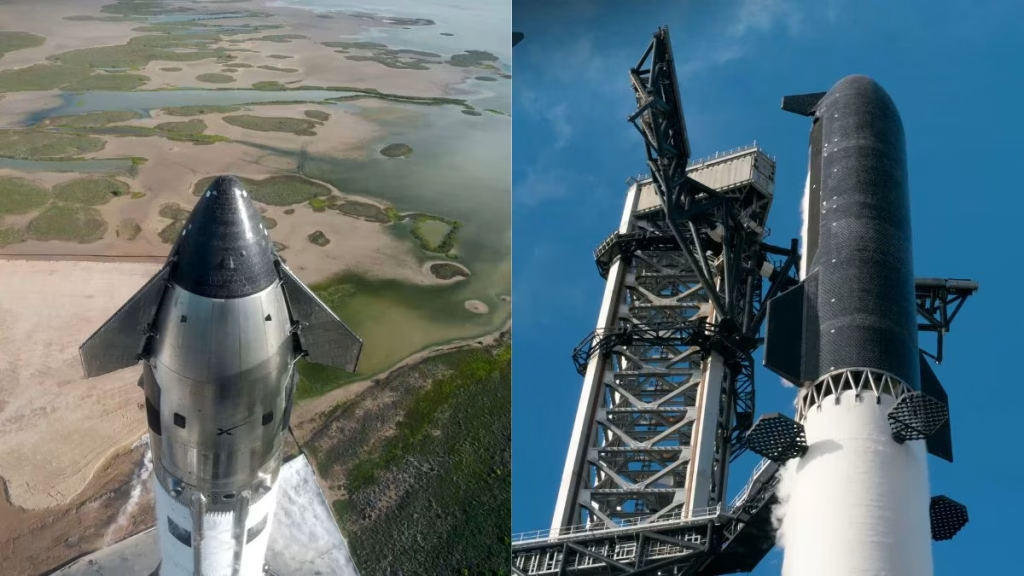
Since the first integrated flight on April 20, 2023, SpaceX has kept up a rapid testing pace. This strategy has enabled the company to refine its systems through multiple iterations, including the notable Flight 7 event in January 2025, where the Starship upper stage broke apart over the Caribbean. (Source: The Verge)
By learning from these past failures, engineers have steadily improved the reliability of the thermal protection system and the engine ignition sequences.
The following table outlines the technical specifications of the current Starship vehicle compared to its operational predecessor.
| Metric | Starship Specifications |
|---|---|
| Total Height | 121 meters (397 feet) |
| Booster Engines | 33 Raptor Engines |
| Payload Capacity | 100 metric tons (LEO) |
| Reusability | Fully Reusable |
Looking Ahead to Future Test Cycles
Going forward, SpaceX plans to thoroughly review the V3 flight logs to pinpoint exactly where things went off track during the return attempt. While losing the Super Heavy booster is a setback, it probably won’t majorly disrupt the overall development timeline. (Source: TechCrunch)
The company is already shifting focus to the next hardware iteration, with teams at Starbase expected to start working on the next available booster soon.
The next flight test will likely emphasize stabilization during the final descent, aiming to ensure the “mechazilla” system can safely capture the booster amid various environmental conditions. As the SpaceX team analyzes the data from this initial flight, the global aerospace community will be eager for updates on when the next launch window opens.
FAQs
What happened to the Super Heavy booster during the V3 flight?
The Super Heavy booster was lost during its return attempt to the launch site. As of May 23, 2026, the specific cause of the failure remains.
Is SpaceX Starship V3 fully reusable?
Yes, the Starship V3 is built as a fully reusable two-stage launch vehicle, designed to bring both the Super Heavy booster and the Starship upper stage back to Earth.
How does the Starship V3 compare to previous models?
Starship V3 includes iterative improvements based on lessons learned from earlier test flights, including insights gained from the Flight 7 upper-stage breakup in 2025 and prior hardware upgrades.
Did the SpaceX Starship V3 successfully complete its maiden flight?
Yes, the SpaceX Starship V3 successfully completed its maiden flight on May 23, 2026, after launching from the facility in Texas.
What happened to the Super Heavy booster during the return attempt?
The Super Heavy booster was lost during its return attempt to Starbase, marking a setback for SpaceX’s recovery efforts during the maiden flight.