

Sony LYTIA 610 Sensor: Telephoto cameras on smartphones have always been the awkward middle child — decent zoom, but never quite as sharp or fast-focusing as the main lens. Sony’s new LYTIA 610 sensor wants to fix that, and the engineering behind it is genuinely clever.
A Pixel Design Built for Zoom
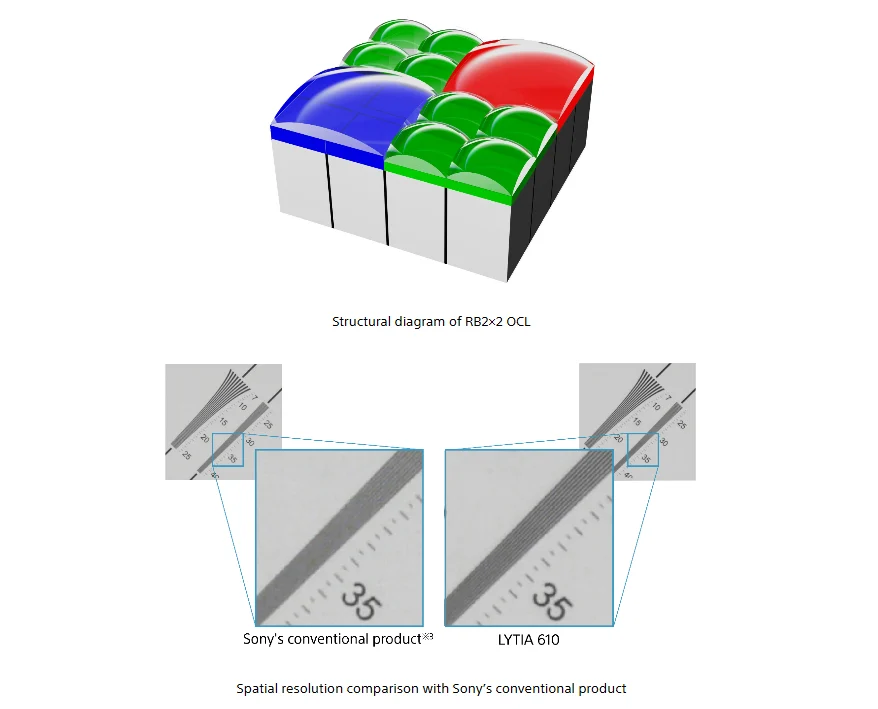
The LYTIA 610 is a 1/2-inch stacked CMOS sensor with approximately 64 megapixels, and it’s the industry’s first mass-produced sensor to feature Sony’s RB2×2 On-Chip Lens (OCL) pixel structure. Unlike a typical sensor where every pixel uses the same lens arrangement, Sony has split the job between pixel types.
| Spec | Detail |
|---|---|
| Sensor Type | 1/2-inch stacked CMOS |
| Resolution | ~64MP |
| Pixel Size | 0.7μm |
| Pixel Structure | RB2×2 On-Chip Lens (industry first) |
| Video | 4K @ 120fps, 4K 60fps HDR |
| Interface | MIPI C-PHY / D-PHY |
| Mass Production | End of June 2026 |
Green pixels — which contribute the most to image clarity — get a dedicated 1×1 lens structure for sharper resolution, while red and blue pixels are grouped under a 2×2 lens design that handles autofocus. A custom remosaicing algorithm ties it together, delivering over 20% higher spatial resolution than the LYTIA 601, despite both sensors sharing the same 0.7μm pixel size.
Faster Readout, Better Video
It’s not just about stills. Sony has also reworked the sensor’s internal processing and data conversion system, roughly doubling readout speed compared to its previous 1/2-inch sensor generation. That jump enables 4K recording at up to 120fps — a first for Sony in this sensor category — alongside 4K 60fps HDR for tricky lighting. Faster readout also means smoother transitions between cameras when switching lenses mid-recording.
Why This Matters for Telephoto Cameras
Phone makers have struggled for years to make zoom lenses as autofocus-reliable as primary sensors, mostly because squeezing in dedicated AF pixels eats into resolution. Sony’s dual-lens-per-sensor trick sidesteps that trade-off entirely — a meaningful step in the broader race toward sharper zoom that TechnoSports has tracked through Sony’s own LYTIA L910 sensor announcement and the industry-wide shift toward high-resolution mobile sensors this year.
Sony’s smartphone camera sensors already have a long track record of trickling down across brands — from flagship Sony Xperia devices to even budget phones like the Lava Bold 2 5G’s Sony IMX752 sensor. Expect the LYTIA 610 to follow a similar path once mass production ramps up.
What’s Next
Mass production shipments for the LYTIA 610 are scheduled to begin by the end of June 2026. That means the first phones carrying it could realistically land by late 2026 or early 2027 — likely starting with Sony’s own Xperia lineup before spreading to telephoto-focused flagships from other brands.
For the official technical breakdown, check Sony Semiconductor Solutions’ mobile sensor lineup.
It’s a small chip with a big ambition: making the zoom lens feel as good as the main camera, finally.


