On Wednesday, August 12, 2026, Sonu Nigam explained why he avoided commenting on the CJP protests: he’d made a promise to his father, Agam Kumar Nigam. That one detail flipped the whole debate. People often expect celebrities to clarify their stance during charged moments—but this wasn’t a casual silence. He tied it directly to a personal vow and family values. When a mainstream star chooses restraint, the silence itself becomes a statement. It also landed in a wider conversation about celebrity activism—what gets said, what gets dodged, and why.
What exactly did Sonu Nigam say about not commenting?
His reasoning on August 12, 2026, came down to a single line: he didn’t comment because he’d promised his father he wouldn’t. That detail matters because it shifts the story from “opinion versus controversy” to “promise versus principle.” It also moves the framing away from politics-as-spectacle and toward personal ethics, where the cost of speaking up—emotionally or reputationally—gets weighed differently. If you’re trying to connect the dots, the key question isn’t just what he said. It’s what standard he claimed to follow. The same announcement-day coverage also showed up in mainstream entertainment reporting.
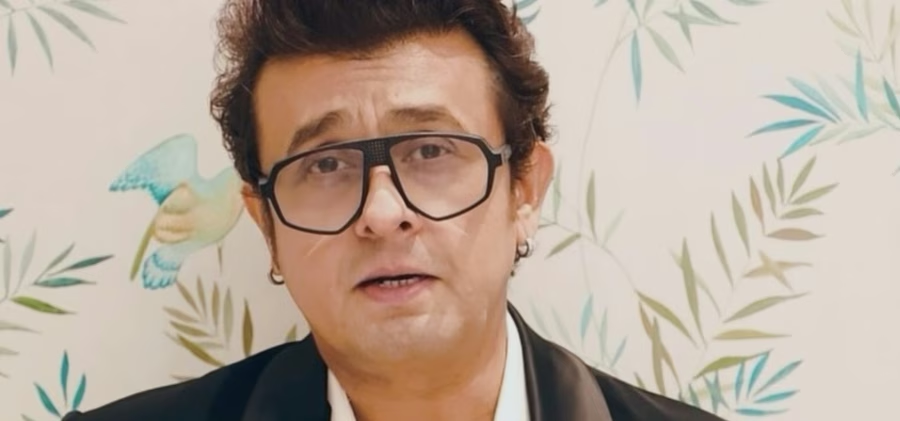
How does Sonu Nigam’s public record affect this silence?
Sonu Nigam isn’t new to controversy, and that context explains why his silence grabbed attention in the first place. In 2017, he sparked a major nationwide debate over loudspeakers used for the Islamic call to prayer (azan) in India. So audiences already link him to high-stakes public fights. That said, his non-comment this time also serves as a counterexample to the idea that celebrities must always step in. You might expect someone who’s spoken out before to keep speaking. But a promise to a parent is a different kind of constraint. It’s not about changing “views”; it’s about setting rules for when not to speak.
What does his career tell us about his relationship with public life?
Sonu Nigam’s public life has been shaped as much by recognition as by debate. In 2020, he received the Padma Shri, India’s fourth-highest civilian honor, from President Ram Nath Kovind—an official nod to his contributions to Indian music. He also built mass familiarity through television; he famously hosted Sa Re Ga Ma Pa on Zee TV starting in 1995, bringing his voice and personality into millions of living rooms.
On the creative side, he lent vocals to the hit song “Kal Ho Naa Ho,” composed by Shankar-Ehsaan-Loy, for the 2003 film starring Shah Rukh Khan and directed by Nikhil Advani. That blend—popular visibility, cultural impact, and moments of public friction—helps explain why his choices outside the studio keep getting picked apart.
So what’s next after this promise-focused clarification?
If Sonu Nigam’s explanation becomes the headline, it may also ease the pressure for immediate political commentary—because the narrative shifts from “stance” to “boundaries.” Audiences will likely keep discussing the CJP protests, but his framing suggests he sees public silence as principled rather than passive. The key tension is predictable: critics may argue that influential public figures should speak; defenders may say promises and personal ethics are legitimate. Our take? Either way, his explanation gives viewers a reasoned framework to interpret the silence instead of filling gaps with assumptions.
Celebrity comments often intensify online polarization, but restraint can also become a public position—just one rooted in family commitments rather than partisan messaging.
Related Articles
FAQs
What did Sonu Nigam reveal about his silence on protests?
He revealed that he didn’t comment on the CJP protests because he had promised his father, Agam Kumar Nigam, that he wouldn’t.
Why did his lack of comments create buzz?
Because he has previously been involved in major nationwide controversy, his restraint on this occasion stood out as unusual to many observers.
Did Sonu Nigam have past controversy related to public issues?
Yes. In 2017, he sparked controversy related to the use of loudspeakers for the Islamic call to prayer (azan) in India.
Has Sonu Nigam been formally honored by the government?
Yes. In 2020, he received the Padma Shri, awarded by President Ram Nath Kovind.
Does his career involve mainstream platforms beyond music?
Yes. He hosted Sa Re Ga Ma Pa on Zee TV starting in 1995, making his presence visible to a wide audience on television.
His clarification may not end debate around protests, but it does explain the silence—grounded in a promise, not a missing opinion. Sonu reveals.
Was this article helpful?
Your feedback directly improves future articles on this site.