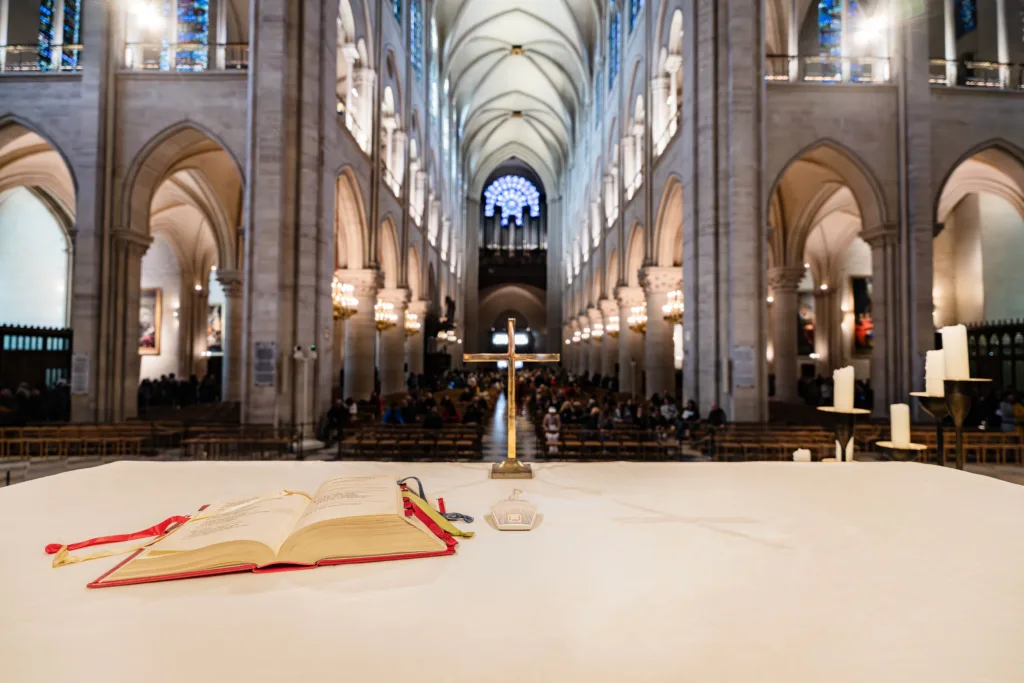
Five years after the devastating fire, Notre-Dame de Paris has reopened with a new Sennheiser Spectera wideband wireless audio system. The installation provides RF coverage across the entire 100+ meter cathedral while remaining virtually invisible, addressing unique challenges of a space that hosts services and welcomes visitors 12 hours daily.
Installation Overview at a Glance
| Detail | Specification |
|---|---|
| System | Sennheiser Spectera (WMAS-based) |
| Coverage | 100+ meters length, 50 meters width at transept |
| Antennas | 4 (vs. 8 needed with traditional systems) |
| Connectivity | Fiber optic with media converters |
| Capacity | Up to 32 mics + 16 stereo IEMs |
| Rack Space | Single 1U Base Station |
| Integration | Dante to DiGiCo console via 4ERA4 matrix |
| Integrator | Novelty |
The Challenge
Notre-Dame needed expanded RF coverage for mobile celebrations where priests move throughout the cathedral while remaining clearly audible without dropouts. The system had to cover new spaces like side chapels while overcoming obstacles including wooden partitions and massive stone pillars—all while remaining discreet in the historic setting.
“Notre-Dame is a place of sharing open to all visitors, whether they wish to attend a service or just want to walk under its vaults,” explains Laurent Prades, Technical Manager at Notre-Dame. The cathedral hosts five daily services while remaining open to the public 12 hours daily, seven days weekly—requiring a system that operates autonomously without constant technical intervention.
Why Traditional Systems Didn’t Work
David Créteur, Project Lead at Novelty, evaluated traditional digital wireless technologies but found them impractical: “We would have had to multiply antennas to at least eight placed throughout the building, then connect them with long cable lengths. To compensate for line losses with copper coaxial cable, we would have needed costly fiber extension solutions, potentially leading to problems with combining antenna pairs and zoning. The installation would have been quite complex.”
Manual zone activation and deactivation posed operational problems in a space that needs to run autonomously.

Spectera’s Solution
Sennheiser’s Spectera system, based on WMAS (Wideband Multi-Channel Audio System), solved these challenges:
- Fewer Antennas: Four antennas instead of eight, halving cabling requirements without sacrificing coverage
- No Diversity Needed: Simplifies antenna placement and eliminates complex zoning
- Ethernet Connectivity: Standard cabling easier to integrate and more affordable than coaxial
- Fiber Compatible: Works with fiber extension via tested media converters
“The further we got into the presentation, the more Spectera seemed to solve problems one by one,” Créteur recalls. “When Sennheiser confirmed fiber extension works perfectly by simply adding a media converter, we realized Spectera was the solution we were looking for.”
On-Site Testing
Before full deployment, Créteur conducted testing in early 2024 with the cathedral still under construction. Working with Sennheiser’s team amid scaffolding, they verified RF stability and audio quality.
Due to tight renovation schedules, Sennheiser delivered a temporary pre-production configuration in autumn 2024—comprising a Spectera Base Station and three SEK bidirectional bodypacks—before the complete system became available.

Current Operation
Liturgical life has resumed with five daily services. Priests choose between handheld microphones or bodypack transmitters with MKE 40 clip-on mics, valued for discretion and sound quality. For altar coverage, the MEB 114 boundary microphone provides aesthetic, precise capture with consistent directivity.
The audiovisual control room supports daily broadcasts by television channel KTO, while wireless mics serve concerts by the “Maîtrise Notre-Dame de Paris” choir held every Tuesday.
Future Scalability
The system’s flexibility enables future expansion. “There may be occasions when priests need to speak in front of the church,” Créteur notes. “In this case, a fifth antenna would be needed. We already tested such a scenario live and simply moved antenna 4 outside during operation. It worked without restarting the system.”
Spectera’s capacity for 32 microphones and 16 stereo IEMs accommodates additional bodypacks for special events, either permanently or on rental basis. Bidirectional capability lets sound engineers monitor via headphones plugged into SEK bodypacks while making tablet adjustments—features not originally requested but proving useful in practice.
For more professional audio and installation news, visit TechnoSports.