Samsung’s next mid-range duo — the Galaxy A57 and Galaxy A37 — have appeared in the EU’s EPREL database ahead of their expected March 2026 launch, revealing key battery, durability, and software details. The upgrades are real, but there’s a notable trade-off buried in the fine print.

Galaxy A57 vs Galaxy A37: EU Energy Label Data
| Specification | Galaxy A57 | Galaxy A37 |
|---|---|---|
| Model Number | SM-A576B/DS | SM-A376B/DS |
| Battery (Rated) | 4,905mAh (marketed as 5,000mAh) | 4,905mAh (marketed as 5,000mAh) |
| Battery Endurance (EU test) | 52 hours | 53 hours |
| Endurance vs Predecessor | Up from ~44 hours (+~20%) | Up from ~41 hours (+~29%) |
| Fast Charging | 45W | 45W |
| Battery Cycle Rating | 1,200 cycles (80% health) | 1,200 cycles (80% health) |
| Previous Gen Cycle Rating | 2,000 cycles | 2,000 cycles |
| IP Rating | IP68 (up from IP67) | IP68 (up from IP67) |
| Drop Resistance | A rating | B rating |
| Repairability | C rating | C rating |
| Energy Efficiency | A rating | A rating |
| Software Support | Min. 5 years (expected 6 years) | Min. 5 years (expected 6 years) |
| Display (leaked) | 6.6″ FHD+ AMOLED 120Hz | 6.7″ FHD+ AMOLED 120Hz |
| Chipset (leaked) | Exynos 1680 | Exynos 1480 |
| Expected Launch | March 2026 | March 2026 |
The Big Upgrade — and the Big Trade-Off
The A37 promises up to 53 hours of runtime on a single charge, while the A57 offers 52 hours — major jumps from the previous generation’s 41 and 44 hours respectively, representing roughly 20–25% better endurance. Notably, these improvements are achieved through enhanced processor efficiency and display optimisation, rather than simply cramming in larger batteries.
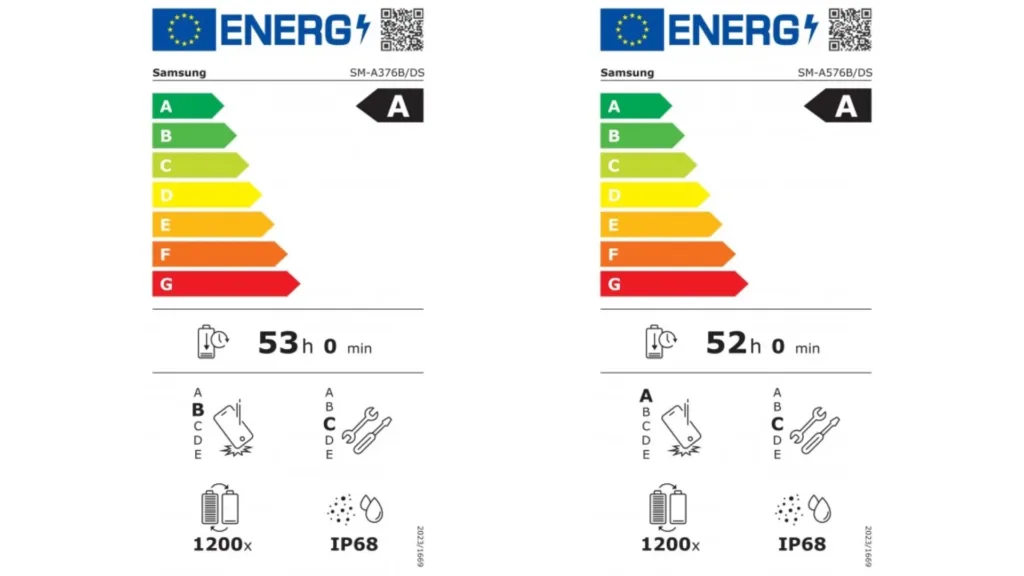
The IP67 to IP68 upgrade puts both phones on par with flagship-tier water resistance — a genuine value-add for mid-range buyers. However, both models are certified for only 1,200 full charge cycles before battery capacity drops below 80% — noticeably lower than the 2,000 cycles previously listed for the Galaxy A56 and A36.
The same reduction was observed on the Galaxy S26 series, suggesting this could be part of a broader shift in Samsung’s battery strategy, possibly tied to chemistry changes or internal design adjustments. For users who keep phones for 3–4 years, daily charging means hitting 1,200 cycles in roughly 3.3 years — worth factoring into the buying decision.
For full specs and pricing, watch Samsung India’s official site. Also check our Samsung Galaxy A56 vs A57 — should you upgrade? and best Samsung mid-range phones in India 2026 on TechnoSports.