NZ180/5 (20 ov)
 IND
IND NAM95/2 (21.1/50 ov)
 IRE
IRE MOZ
MOZ UGA
UGA AVL
AVL MNC
MNC RAY
RAY ELC
ELC GMB
GMB ZMB
ZMB NGA
NGA LES
LES CAG
CAG BOL
BOL COMO
COMO SAS
SAS FCA
FCA FCU
FCU Ipswich1
 Nottm Forest1
 Alavés1
 Málaga1
 Torino3
 Monza2
 Brest1
 Nice2
Nice2 WA
WA NSW290/5 (42.4/50 ov)
 DEN
DEN KUW
KUW KENYA
KENYA QAT
QAT SWD-W
SWD-W EPR-W
EPR-W TTN-W
TTN-W WPR-W
WPR-W NZ-A135/3 (41 ov)
 IND-A113
 DHA
DHA RAJ
RAJ MYMS
MYMS CHATT
CHATT RAN
RAN BAR
BAR SYL
SYL KHU
KHU MEX-W
MEX-W ARG-W
ARG-W UAE
UAE NED
NED PAK
PAK ENG
ENG IND-W
IND-W ZIM-W
ZIM-W AFG170/3 (34.3/50 ov, target 170)
 ZIM169
 TAS137 (25.2/35 ov, target 276)
 VIC304/7 (50 ov)
 CHE0
CHE0 DYI0
DYI0 CHO1
CHO1 QIN0
QIN0 HEN1
HEN1 BEI0
BEI0 LIA1
LIA1 ZHE0
ZHE0 QWC1
QWC1 YUN0
YUN0 SHX0
SHX0 Shanghai Shenh0
 TIG0
TIG0 SHP0
SHP0 WTT1
WTT1 SHT3
SHT3 KOE
KOE S04
S04 M05
M05 SVW
SVW RBL
RBL ELV
ELV Stuttgart2
 Gladbach3
 Al Ahli4
 Al Khaleej1
In a historic moment for Indian football, FIFA’s Players’ Status Chamber on November 19, 2025, officially approved Ryan Williams’ change of association request, formally clearing the Perth-born winger to represent the Blue Tigers on the international stage. The decision marks the culmination of a two-year journey that saw the 32-year-old Bengaluru FC star surrender his Australian citizenship, acquire an Indian passport, and commit his international future to a country connected to him through his Anglo-Indian heritage.
The All India Football Federation (AIFF) confirmed the landmark ruling, stating that FIFA’s regulatory body reviewed the submission in alignment with the Regulations Governing the Application of the Statutes (RGAS) and determined that all eligibility criteria had been satisfied. With this approval now in effect, Williams becomes officially eligible for selection to the Indian football team, representing only the second foreign-born player after Izumi Arata (2012) to complete the naturalization process for Indian football.
“FIFA’s Players’ Status Chamber issued its final decision on November 19, approving the change of association request for Ryan Williams, thereby making him formally eligible to represent the Indian national team,” the AIFF announced in an official statement. “Throughout this process, the AIFF adhered fully to FIFA’s regulatory requirements.”
The Journey from Perth to Blue Tigers: A Two-Year Commitment
Ryan Williams’ path to Indian citizenship began in 2023 when he joined Bengaluru FC from Perth Glory, bringing with him a career forged across Australian and English football. Born on October 28, 1993, in Subiaco, Western Australia, Williams grew up in a football family with deep connections to India through his mother, Audrey, who was born into an Anglo-Indian family in Mumbai.
| Ryan Williams Profile | |
|---|---|
| Full Name | Ryan Dale Williams |
| Date of Birth | October 28, 1993 (Age 32) |
| Birthplace | Perth, Western Australia |
| Current Club | Bengaluru FC (ISL) |
| Position | Winger |
| Previous Nationality | Australian |
| Current Nationality | Indian |
| Previous International | Australia (1 cap, 2019) |
| ISL Record | 10 goals, 4 assists in 36 appearances |
His maternal grandfather, Lincoln “Linky” Grostate, represented Bombay in the prestigious Santosh Trophy during the 1950s, providing Williams with footballing roots in India that stretched back generations. This familial connection became the foundation for what would become an unprecedented commitment: renouncing Australian citizenship to represent the Indian football team.

“My two hands aren’t enough to count the number of people who told me it wouldn’t be possible,” Williams told ESPN in a revealing interview. “People looked at me like I had four heads” when he informed passport officials of his intention to switch from Australia to India. Yet Williams persisted, driven by his grandfather’s dying wish that he one day wear Indian colors and his own conviction that this move felt right.
The naturalization process proved arduous, requiring Williams to live in India for a mandatory 12-month period before documentation could even begin. Approvals from the Ministry of Home Affairs, Ministry of Youth Affairs and Sports, and ultimately ministerial-level clearances in New Delhi were necessary. Sports Minister Mansukh Mandaviya’s office played a key role, reflecting a broader policy shift under the Khelo India initiative to embrace overseas talent of Indian origin.
The Citizenship Ceremony: Sunil Chhetri’s Symbolic Gesture
The emotional culmination of Williams’ naturalization journey came at Bengaluru FC’s training facility, where Indian football legend Sunil Chhetri personally handed the winger his new Indian passport. The heartwarming ceremony, captured on video that quickly went viral among Indian football fans, featured Chhetri playfully quizzing Williams on Indian street food and pop culture in an impromptu “citizenship test.”
Williams passed with flying colors, declaring himself “one of their own”—a statement that drew applause from teammates and symbolized his complete commitment to Indian football. Chhetri, who announced his own retirement plans for after the 2025-26 ISL season, had been instrumental in facilitating discussions between Williams and AIFF President Kalyan Chaubey, lending his considerable influence to make the naturalization possible.
“When something feels right, you have to go for it,” Williams reflected on surrendering his Australian passport. “The positives outweighed everything else. It feels like things have come full circle.” For a player who represented Australia at youth levels (U-20 and U-23) and earned one senior cap in a 2019 friendly against South Korea, relinquishing that connection was no small sacrifice—yet Williams made it willingly for the opportunity to honor his grandfather’s memory and forge his own path in Indian football.
The FIFA Approval Process: Regulatory Hurdles Cleared
While Williams received his Indian passport in early November 2025, FIFA approval represented a separate regulatory requirement that delayed his official debut for the Indian football team. The change of association process fell under FIFA’s RGAS regulations, which govern players switching national team allegiances.
The AIFF submitted Williams’ complete documentation to FIFA’s Players’ Status Chamber for review, including proof of his Indian citizenship, confirmation of his renunciation of Australian citizenship, the No Objection Certificate (NOC) from Football Australia, and evidence of his familial connections to India through his mother’s Anglo-Indian heritage.
Timeline of Williams’ Eligibility Process:
- July 2023: Joins Bengaluru FC, begins naturalization process
- July 2024: Completes mandatory 12-month residency requirement
- November 7, 2025: Receives Indian passport from Sunil Chhetri
- November 13, 2025: Features in closed-door friendly vs Bhutan
- November 18, 2025: NOC from Football Australia arrives (one day late)
- November 19, 2025: FIFA Players’ Status Chamber grants approval
- November 20, 2025: AIFF announces FIFA’s official clearance
The timing proved frustratingly close for Williams’ potential debut. Head coach Khalid Jamil included him in India’s 23-member squad for the AFC Asian Cup 2027 qualifier against Bangladesh on November 20, 2025. However, the NOC from Football Australia—a mandatory document—arrived only on November 18, missing the registration deadline of 11:59 PM on November 17. This administrative timing meant Williams traveled with the squad to Bangladesh but could not be named in the matchday lineup for what ended up being a disappointing defeat.
What Williams Brings to the Indian Football Team
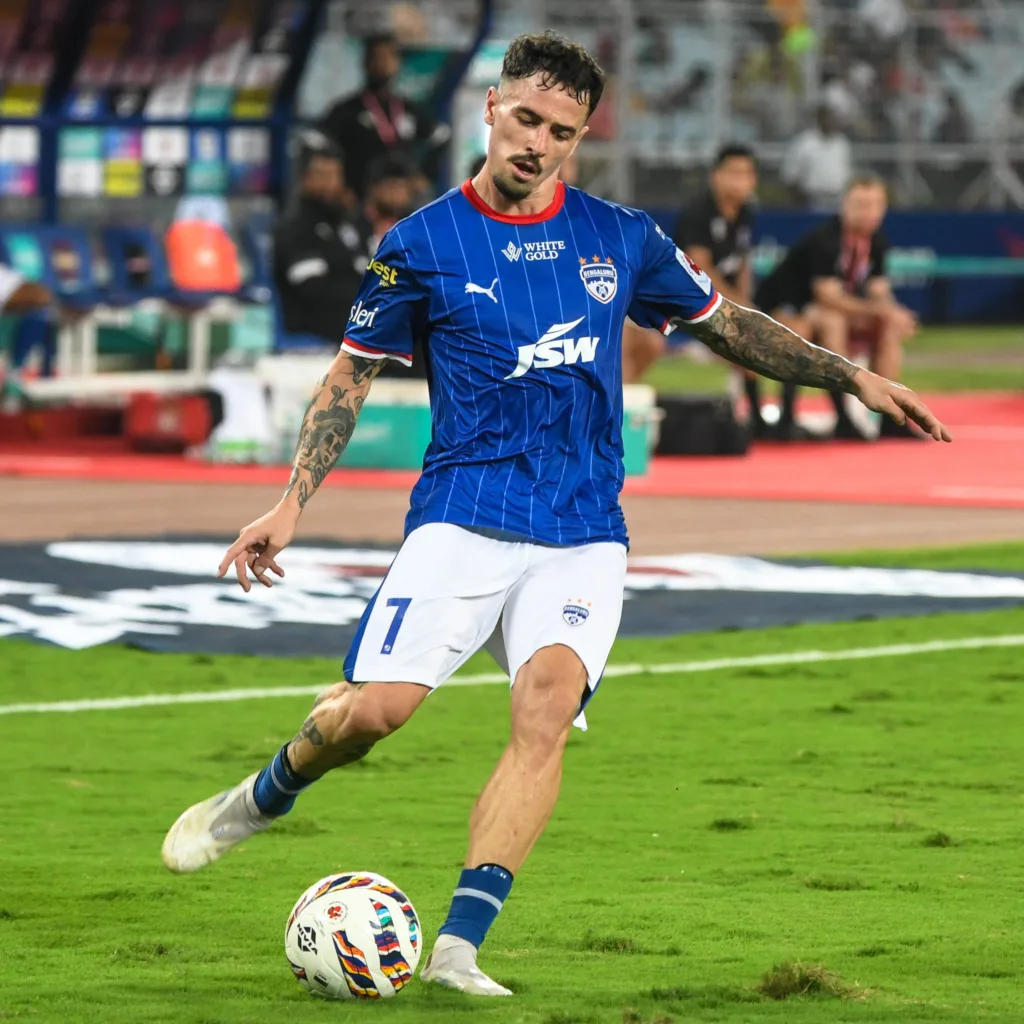
Williams’ addition addresses critical deficiencies in the Indian football team’s attacking arsenal. At 32, he brings experience earned across 14 professional seasons in Australia and England, including stints with Portsmouth, Fulham, Rotherham United, and Perth Glory before joining Bengaluru FC.
Career Highlights & Attributes:
- Pace & Direct Running: Among ISL’s fastest wingers
- Tactical Awareness: Products of English Football League system
- Defensive Tracking: Understands positional responsibilities
- Goal Contribution: 10 goals, 4 assists in 36 ISL appearances
- Professional Standards: Sets high expectations for teammates
- Versatility: Operates as winger or wide forward
His performances at Bengaluru FC established him as one of the ISL’s most consistent performers. In his debut 2023-24 season, Williams scored 3 goals and was named Players’ Player of the Year. His second campaign (2024-25) saw him net 7 goals with 4 assists as Bengaluru reached the ISL Cup final, ultimately losing to Mohun Bagan in extra time. Fans rewarded his contributions by voting him Fan’s Player of the Year.
“He’s mature, efficient, and knows when to make his runs,” a Bengaluru FC assistant coach noted. “He doesn’t just play fast—he plays smart.” This tactical intelligence, developed through years navigating England’s demanding league system, represents a level of professionalism often lacking in domestic Indian attackers who rely heavily on individual brilliance rather than systematic positional play.
Head coach Khalid Jamil, who managed Williams at Bengaluru before taking the national team position, understands precisely what the winger offers. In a 4-3-3 or 4-2-3-1 formation, Williams provides width, penetration on the right flank, and the ability to cut inside onto his stronger foot to either shoot or create chances—tactical flexibility that historically has been a weakness in Indian football team setups.
The Broader Context: AIFF’s Global Talent Initiative
Williams’ naturalization represents the first tangible success of the AIFF’s initiative to integrate Overseas Citizens of India (OCI) and individuals of Indian heritage into the national setup. AIFF President Kalyan Chaubey has described this as “a landmark moment” in Indian football’s evolution, signaling strategic intent to tap into the global diaspora for talent that can immediately impact the senior team.
The policy shift comes at a critical juncture for Indian football. The national team’s results have been “nothing short of atrocious” (as ESPN described them), with recent defeats exposing tactical, technical, and organizational deficiencies. The ISL crisis—which saw the league suspended for months due to commercial rights disputes—further destabilized the domestic ecosystem. Players have borne the brunt of these systemic failures, facing delayed salaries and career uncertainty.
Against this backdrop, Williams’ commitment stands out starkly. “There is shock that he has decided to put his faith in this system,” ESPN noted, highlighting the remarkable nature of a player voluntarily surrendering a more stable Australian passport to join a football structure in crisis. Yet Williams sees opportunity where others see chaos.
“That’s alright,” he said regarding India’s lack of competitive internationals in the near term due to poor qualifying results. “I don’t want to make an impact just on the field.” He envisions himself as a standard-setter—someone whose professional approach and expectations can elevate those around him, both at club and international level.
Comparisons to Other Diaspora Cases
Williams’ journey invites comparison to other players of Indian heritage who have contemplated representing India. England-based footballers Yan Dhanda and Danny Batth have publicly expressed interest in playing for India but have been unwilling to surrender their British passports—a requirement under India’s Citizenship Act of 1955, which prohibits dual nationality.
Williams acknowledged these cases, suggesting his example demonstrates the pathway for anyone genuinely committed: “For the likes of Yan Dhanda and Danny Batth…there is an example to follow. It would only move football in India forward.”
His twin brother, Aryn Williams, actually explored Indian citizenship possibilities earlier. Aryn played for NEROCA FC in India’s lower leagues during the late 2010s and told The New Indian Express in 2017 about his desire to represent India. However, too many people convinced him it wouldn’t be possible, and the COVID-19 pandemic cut short his Indian stint before naturalization could progress. Ryan’s persistence where his brother abandoned the effort underscores his determination.
The only previous successful case was Izumi Arata, a Japan-born player of Indian descent who obtained Indian citizenship in 2012 and made nine appearances for India between 2013-2014. However, Arata’s relatively limited impact meant Williams now carries expectations as the most accomplished foreign-born naturalized player to represent India.
The Bangladesh Match Disappointment
Williams’ FIFA approval came tantalizingly close to enabling his competitive debut. India faced Bangladesh in Dhaka on November 20, 2025, in an AFC Asian Cup 2027 qualifier—a match India desperately needed to win to keep faint qualification hopes alive.
The timing proved cruel. While FIFA’s Players’ Status Chamber delivered their approval on November 19, the NOC from Football Australia had arrived just one day too late to meet the November 17 registration deadline. Without being registered with the Asian Football Confederation for the fixture, Williams could travel with the squad but not appear on the match-day roster.
India subsequently lost to Bangladesh in what marked only the second defeat to their neighbors in history—a result that encapsulated the national team’s struggles. Williams watched helplessly from the stands, his potential impact on the game’s outcome a tantalizing “what if” that will haunt Indian football fans.
“I wished the process of obtaining citizenship went a bit quicker, meaning I could’ve tried to make an impact on some of the games so far,” Williams admitted. India’s dire qualifying performances mean competitive internationals won’t resume for at least two years, denying Williams immediate opportunities to validate his decision on the biggest stage.
What Lies Ahead: Williams’ Indian Football Future
With FIFA approval secured, Williams now enters Indian football team calculations for upcoming fixtures. However, with AFC Asian Cup 2027 qualification effectively over after recent losses, India faces a barren international calendar focused primarily on friendlies and potential SAFF Championship participation.
This reality hasn’t deterred Williams. “I’ve enjoyed my time in the ISL so far, it’s been so well organized,” he told ESPN, praising the professionalism of India’s domestic league despite broader systemic issues. “I’ve looked forward to the calendar coming out. When are we playing Kerala Blasters? When are we playing Mohun Bagan away?“
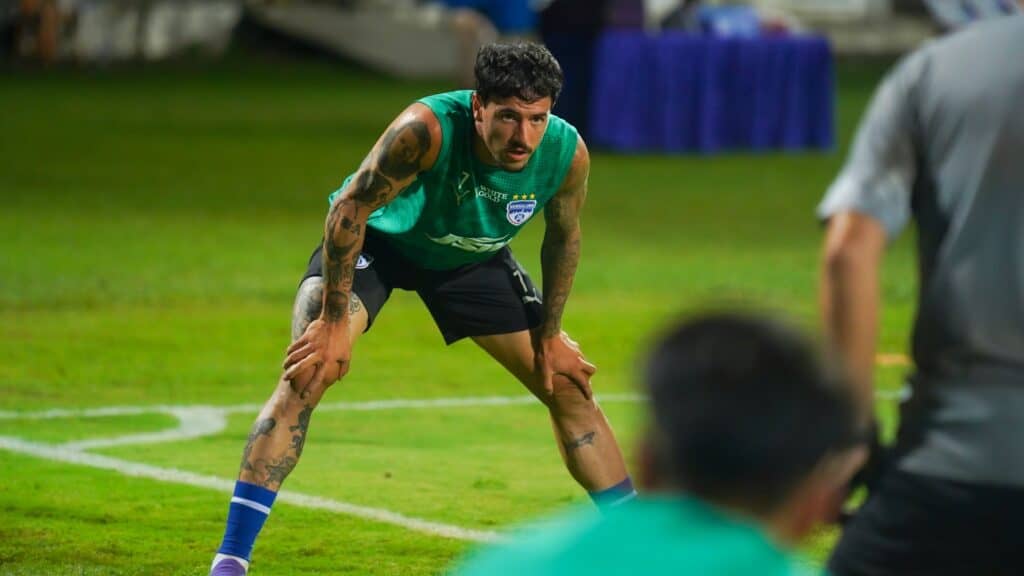
His commitment extends beyond personal ambition. Williams has moved his entire family to Bengaluru, signaling long-term investment in his Indian future. At 32, he realistically has 2-3 productive years remaining at elite level—years he’s chosen to dedicate to elevating Indian football rather than finishing his career in the relative comfort and stability of Australia or England.
“He’s a standard-setter,” observers note. Anyone who watches Bengaluru FC regularly recognizes that Williams demands excellence from teammates and isn’t afraid to let them know on the pitch when standards slip. This mentality—forged through years in English football’s unforgiving environment—represents perhaps his greatest potential contribution to the Indian football team beyond goals and assists.
The Abneet Bharti Parallel
Williams isn’t alone in his journey. Defender Abneet Bharti, currently playing for Bolivian side Academia del Balompié Boliviano (ABB), has also joined the Indian national team camp. Born in Nepal to parents of Indian origin, Bharti has spent most of his career abroad and similarly acquired Indian citizenship to represent the Blue Tigers.
While less prominent than Williams due to playing outside the ISL, Bharti’s addition demonstrates the AIFF’s broader strategy of identifying Indian passport holders and heritage players worldwide to expand the talent pool. Both players participated in India’s closed-door friendly against Bhutan on November 13, 2025—a match designed to assess their integration and match readiness before competitive fixtures.
The twin additions signal that the AIFF views naturalization not as a one-off experiment but as an ongoing recruitment strategy. With India’s domestic player pool offering limited options at elite international level, tapping into diaspora talent provides a pragmatic pathway to immediate squad improvement.
FAQs
When did FIFA approve Ryan Williams to play for India?
FIFA’s Players’ Status Chamber issued its final approval on November 19, 2025, formally clearing Ryan Williams to represent the Indian football team after reviewing his change of association request under RGAS regulations.