NZ
 IND
 NAM
 IRE
 MOZ
 UGA
 Aston Villa
 Man City
 Rayo
 Elche
 GMB
 ZMB
 NGA
 LES
 Cagliari
 Bologna
 IPS1
 NFO1
 ALA1
 MCF1
 TOR3
 MON2
 BRE1
 NICE2
 TAS67/4 (15.4/50 ov, target 305)
 VIC304/7
 NZ-A135/3 (41 ov)
 IND-A113
 DHA
 RAJ
 MYMS
 CHATT
 RAN
 BAR
 SYL
 KHU
 UAE
 NED
 PAK
 ENG
 IND-W
 ZIM-W
 AFG170/3 (34.3/50 ov, target 170)
 ZIM169
 DOLPH56/0 (3.5/8 ov, target 56)
 SWD51/4 (8/8 ov)
 WSW1
 BRI1
 Como
 Sassuolo
 Augsburg
 Union Berlin
 Cologne
 Schalke
 Mainz
 Bremen
 RB Leipzig
 Elversberg
 VFB2
 BMG3
 AHL4
 KHA1
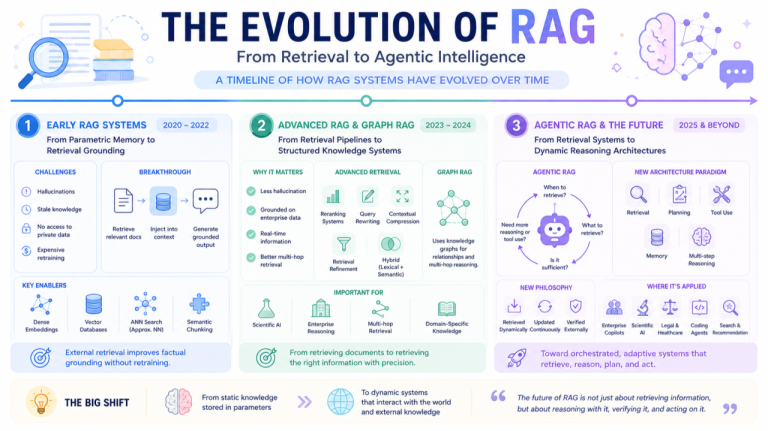
Modern enterprise pipelines now process context windows exceeding 128,000 tokens, a scale popularised by OpenAI’s GPT-4 Turbo launch in November 2023. Until recently, developers assumed that autonomous retrieval systems would remain confined behind basic corporate firewalls.
RAG evolution accelerated rapidly as organisations sought faster ways to navigate massive document repositories. Latency benchmarks for enterprise retrieval phases dropped below 50 milliseconds across major cloud providers like AWS, Google Cloud, and Microsoft Azure by Q1 2026. These figures, based on leaks and supply-chain reports, are not yet officially confirmed. Today, we examine how foundational vector models transformed into rigid enterprise architecture standards over six years.
The Architecture Of RAG Evolution
Early implementations primarily utilised Facebook AI Research’s Dense Passage Retrieval framework released in April 2020. Engineers treated these initial systems as experimental bridges between unstructured text and query databases. The architecture lacked the precision required for mission-critical workflows, forcing teams to rely heavily on manual data curation.
Here’s the thing: the industry required a more robust method to handle massive document repositories without drowning in irrelevant results. Enterprise adoption surged following the integration of hybrid search combining BM25 and vector embeddings into platforms like Elasticsearch 8.0 in February 2022. This dual-mechanism approach allowed systems to balance keyword matching with semantic understanding effectively. Teams began using Markdown Search Data became the default language for modern model interactions. Organisations finally gained the ability to trace answers back to their original source nodes.
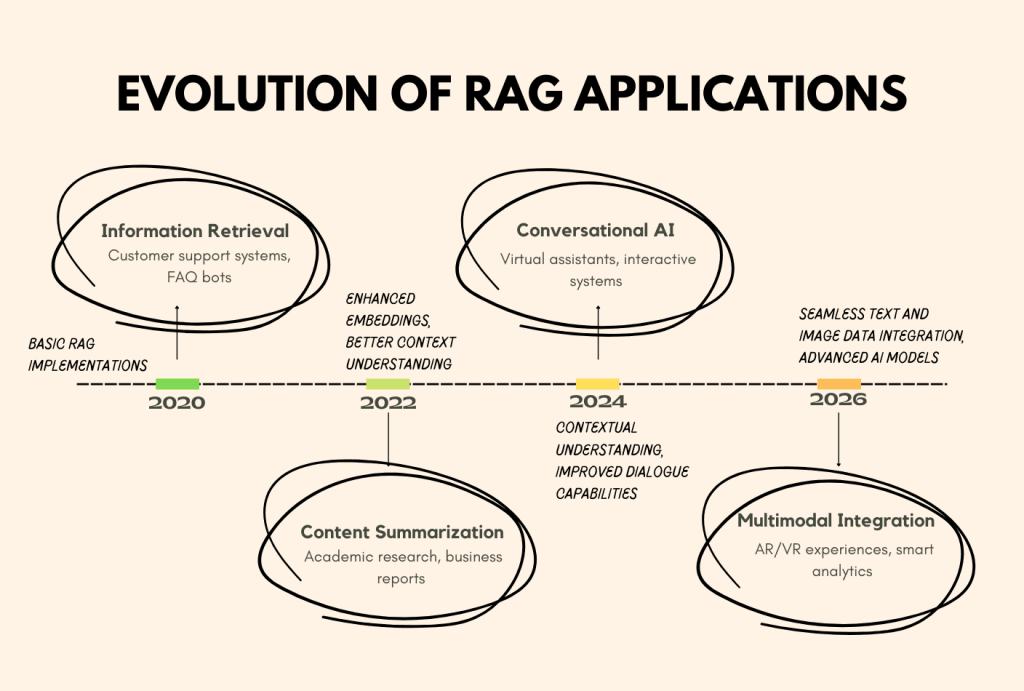
Performance Metrics In RAG Evolution
Engineers previously tolerated slow response times during the early deployment phases of generative search tools. Modern infrastructure has completely eliminated those bottlenecks through optimized distributed computing. Latency benchmarks for enterprise retrieval phases dropped below 50 milliseconds across major cloud providers like AWS, Google Cloud, and Microsoft Azure by Q1 2026. These performance gains enable real-time customer support applications that demand instantaneous answer delivery. Worth noting: achieving sub-50ms speeds requires aggressive caching strategies alongside high-throughput inference engines. For more detail, see OpenAI Blog.
Evaluation frameworks like Ragas and TruLens, established around 2023, became mandatory compliance tools for enterprise deployments under the European Union AI Act enacted in August 2024. Companies can no longer deploy black-box retrieval systems without rigorous testing protocols. Developers must prove that generated responses align strictly with documented organizational policies. The regulatory environment forces engineering teams to adopt a stricter control harness, enterprise protocol to prevent hallucinations. Security remains a persistent concern despite these architectural advancements. Unverified external data sources can introduce vulnerabilities if input sanitization fails. Recent investigations into large language model security exposed critical flaws in how third-party plugins interact with core retrieval layers. Addressing these gaps requires continuous monitoring and automated vulnerability scanning across all connected endpoints.
Compliance And The Future Of RAG Evolution
Regulatory pressure continues to shape the development roadmap for next-generation retrieval systems. Auditors now demand full transparency regarding data provenance and training methodologies. Engineering leaders must balance rapid feature deployment with strict adherence to global privacy standards.
We recommend prioritizing transparent data lineage tracking in all upcoming system upgrades. Organizations that ignore compliance requirements will face severe financial penalties. The future belongs to teams that treat information governance as a core architectural principle rather than an afterthought. Recent studies on Claude Security Enterprise frameworks highlight the urgent need for zero-trust retrieval architectures.
Retrieval-augmented generation moved from experimental academic concepts to mandatory corporate infrastructure within six years.
FAQs:
When did hybrid search become the industry standard?
What role does the European Union AI Act play in RAG deployment?
How have context windows changed since 2020?
Which framework popularized graph-based knowledge retrieval?
Was this article helpful?
Your feedback directly improves future articles on this site.