

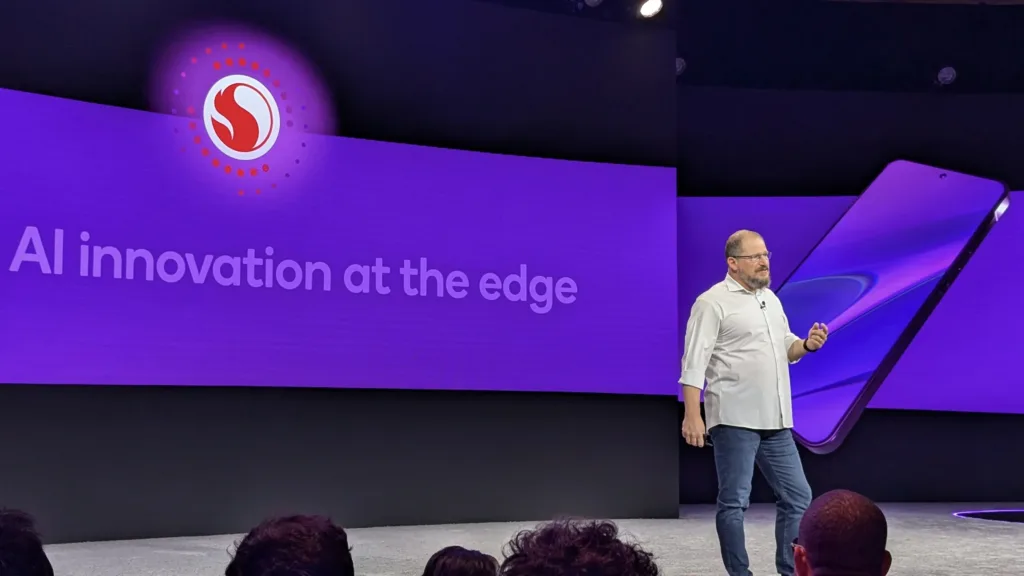
The next smartphone interface won’t be Android or iOS as we know them. At the India AI Impact Summit 2026, Qualcomm President and CEO Cristiano Amon made a sweeping prediction: AI agents will sit at the centre of mobile devices and replace much of what operating systems and apps do today.
What Cristiano Amon Said — and What It Means
Amon’s remarks weren’t vague futurism. He laid out a specific vision for how computing interfaces change — and where India fits into that global shift.
| Theme | Amon’s Position |
|---|---|
| Mobile OS Future | AI agents will replace much of the OS and application layer on smartphones |
| Access Points | Phones, glasses, pendants, wearables — agent accessible from anything worn |
| 6G Role | AI will be central to 6G as a large-scale sensing network |
| Manufacturing | India’s global manufacturing hub status accelerated by AI and smart automation |
| Key Sectors | Smart cities, healthcare, education, agriculture |
| India’s Opportunity | Major tech shifts historically change which countries lead — India positioned to gain |
The core idea is a fundamental restructuring of how people interact with their devices. Instead of opening apps — a model that’s dominated smartphones since 2008 — users will interact with a central AI agent that handles tasks, context, and decisions across the entire device ecosystem. That agent could be accessed from a phone, smart glasses, or even a wearable pendant.

The 6G and India Manufacturing Angle
Amon tied AI agents to two larger trends: 6G infrastructure and India’s manufacturing ambitions. He framed 6G not just as faster connectivity, but as a sensing network at scale — infrastructure that AI can use to interact with the physical world in real time.
On manufacturing, Amon argued India’s move into global production doesn’t need to follow the same slow industrialisation path as previous eras. AI-powered smart manufacturing and automation allow India to “jump into large-scale industrialisation” immediately — skipping legacy industrial stages entirely.
For agriculture, healthcare, and education specifically, Amon described AI as a transformational force — not incremental improvement, but a category-level shift in what’s possible at India’s population scale.
Qualcomm’s $150M India AI fund, announced earlier at the same summit, backs this long-term vision with direct investment across edge AI, automotive, and IoT sectors.
Read the full Qualcomm India AI coverage and our India AI Impact Summit 2026 roundup on TechnoSports and Qualcomm Snapdragon news.


