Picture this: a quiet Tuesday morning near the China-Nepal border, and suddenly a wall of water tears through the valley, snapping bridges, swallowing trucks, and erasing hydropower stations in minutes. That’s not a disaster-movie script — it’s exactly what happened along the Bhote Koshi River in Nepal’s Rasuwa district, and it’s a stark reminder of how fragile mountain ecosystems have become.
What Actually Happened in Nepal?
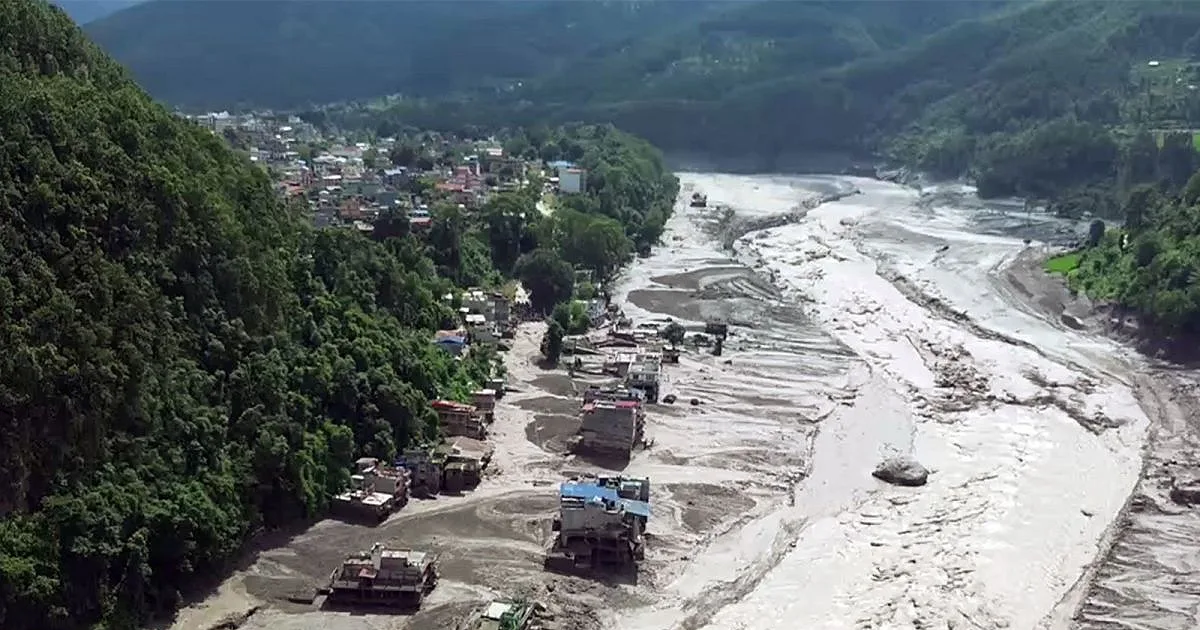
The flood struck in the early hours, triggered not by rainfall alone but by the sudden draining of a supraglacial lake high up in Tibet’s Langtang Himal range. Within moments, the surge swept away the iconic “Friendship Bridge” (Miteri Bridge) connecting Nepal and China, dragged off cargo containers and electric vehicles, and knocked out multiple hydropower plants supplying the national grid.
At least nine people lost their lives, with roughly twenty more — including Chinese nationals and security personnel — reported missing as rescue teams combed the debris downstream.
Why This Keeps Happening
This isn’t a one-off tragedy. Nepal sits at the frontline of a phenomenon scientists call a Glacial Lake Outburst Flood (GLOF) — when meltwater trapped behind unstable ice or moraine suddenly bursts free. As Himalayan glaciers retreat due to climate change, these lakes are multiplying, and so is the risk to everyone living downstream.
| Detail | Information |
|---|---|
| Location | Bhote Koshi River, Rasuwa district, Nepal |
| Trigger | Supraglacial lake drainage in Tibet |
| Casualties | 9+ confirmed dead |
| Missing | ~20 people (incl. Chinese workers) |
| Infrastructure lost | Friendship/Miteri Bridge, 4 hydropower plants |
| Power impact | ~211 MW disrupted |
| Cause category | Glacial Lake Outburst Flood (GLOF) |
The Human Cost Behind the Numbers
Beyond the statistics lie real stories — border traders whose livelihoods depended on that bridge, hydropower workers whose plants vanished overnight, and families still waiting for news of the missing. Nepal’s monsoon season already claims dozens of lives annually from landslides and flash floods, but glacier-driven disasters add a chilling new layer of unpredictability, since they can strike even without heavy local rainfall.
Climate Change Isn’t a Distant Threat Anymore
Experts at the International Centre for Integrated Mountain Development (ICIMOD) have flagged this event as a textbook case of glacial instability accelerated by warming temperatures. For deeper context on how these floods form, you can check the Wikipedia entry on glacial lake outburst floods, which explains the science behind these sudden, devastating surges. yahoo
If you’re someone who follows how climate shifts are reshaping infrastructure and technology responses worldwide, our team at TechnoSports regularly breaks down the tech and innovation angles behind global crises like this — from early-warning satellite systems to disaster-response drones being tested in fragile mountain regions.
What’s Next for the Region
Rescue operations remain ongoing, with rebuilding efforts focused on restoring the critical Nepal-China trade link and power supply. Meanwhile, disaster management authorities are pushing for better glacial lake monitoring systems — because in the Himalayas, the next outburst could be just one warm season away.
FAQs
Q1: What caused the Bhote Koshi flood in Nepal?
A sudden glacial lake outburst in Tibet sent a massive water surge down the Bhote Koshi River, destroying bridges and infrastructure.