NZ121/3 (15.1/20 ov)
 IND
IND NAM49/2 (10.5/50 ov)
 IRE
IRE MOZ
MOZ UGA
UGA AVL
AVL MNC
MNC RAY
RAY ELC
ELC GMB
GMB ZMB
ZMB NGA
NGA LES
LES CAG
CAG BOL
BOL COMO
COMO SAS
SAS FCA
FCA FCU
FCU Ipswich1
 Nottm Forest1
 Alavés1
 Málaga1
 Torino3
 Monza2
 Brest1
 Nice2
Nice2 WA
WA NSW199/3 (31/50 ov)
 DEN
DEN KUW
KUW KENYA
KENYA QAT
QAT SWD-W
SWD-W EPR-W
EPR-W TTN-W
TTN-W WPR-W
WPR-W NZ-A135/3 (41 ov)
 IND-A113
 DHA
DHA RAJ
RAJ MYMS
MYMS CHATT
CHATT RAN
RAN BAR
BAR SYL
SYL KHU
KHU MEX-W
MEX-W ARG-W
ARG-W UAE
UAE NED
NED PAK
PAK ENG
ENG IND-W
IND-W ZIM-W
ZIM-W AFG170/3 (34.3/50 ov, target 170)
 ZIM169
 TAS137 (25.2/35 ov, target 276)
 VIC304/7 (50 ov)
 CHE0
CHE0 DYI0
DYI0 CHO1
CHO1 QIN0
QIN0 HEN1
HEN1 BEI0
BEI0 LIA1
LIA1 ZHE0
ZHE0 QWC1
QWC1 YUN0
YUN0 SHX0
SHX0 Shanghai Shenh0
 TIG0
TIG0 SHP0
SHP0 WTT1
WTT1 SHT3
SHT3 KOE
KOE S04
S04 M05
M05 SVW
SVW RBL
RBL ELV
ELV Stuttgart2
 Gladbach3
 Al Ahli4
 Al Khaleej1
Eight qubits doesn’t sound like much. Then again, the Wright Brothers’ first flight covered just 36 metres. What matters isn’t the number — it’s what those qubits are made of, and how they behave.
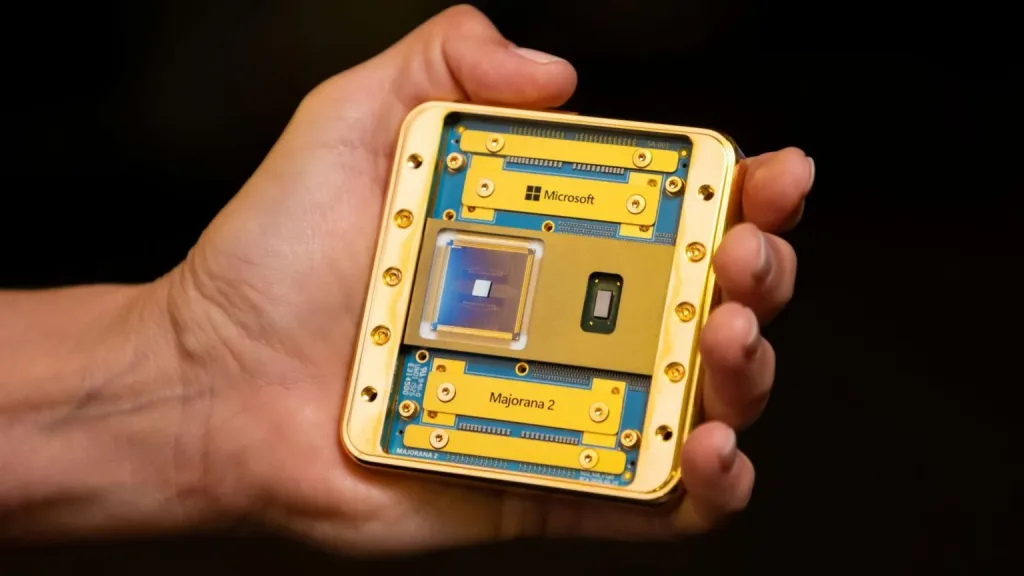
Microsoft has unveiled Majorana 2, its second-generation topological quantum chip — and while the qubit count is deliberately modest, the engineering leap underneath it could be the most significant moment in quantum computing this decade. This isn’t about racing to the biggest number. It’s about solving the problem that has quietly haunted every quantum computing lab on Earth: reliability.
Majorana 2: Key Specs & Breakthroughs at a Glance
| Feature | Detail |
|---|---|
| Topological Qubits | 8 |
| Reliability Improvement | 1,000× over previous generation |
| Average Qubit Lifetime | 20 seconds (some exceeded 1 minute) |
| Operation Speed | Microsecond-scale (millions of ops before decoherence) |
| Materials Stack | Lead + Indium Arsenide (InAs) + Indium Arsenide Antimonide (InAsSb) |
| Topological Gap Improvement | 2× larger than previous generation |
| AI Assistance | Microsoft Discovery agentic AI |
| Target for Practical Quantum Computing | ~2029 |
First, What Even Is a Qubit — And Why Does Fragility Matter?
Before unpacking what Microsoft has achieved, a quick grounding for anyone new to quantum computing.
Today’s processors — the chips inside your phone, laptop, and every server on earth — work by processing information as 0s and 1s through billions of transistors. Fast, reliable, and well understood after 70 years of engineering refinement.
Quantum computers replace transistors with qubits. Unlike a transistor that is either 0 or 1, a qubit can exist in both states simultaneously — a property called superposition. This theoretically allows quantum computers to solve certain classes of problems exponentially faster than any classical machine ever could: drug discovery, cryptography, materials science, climate modelling.
The catch? Qubits are extraordinarily fragile. Vibration, heat, electromagnetic noise — any tiny disturbance can collapse a qubit’s quantum state, destroying the calculation in progress. This is called decoherence, and it’s the central unsolved problem of the entire field.
Most companies — Google, IBM, IonQ — are tackling this by building more qubits and using sophisticated software to detect and correct errors after they happen. Microsoft is taking a fundamentally different path.
For a broader look at how quantum computing fits into the future of technology, explore our emerging technology coverage on TechnoSports.
Microsoft’s Bet: Fix Errors at the Hardware Level
This is the philosophical heart of Majorana 2, and it’s worth understanding clearly.
Topological qubits are a special class of qubit designed to be inherently more stable by encoding quantum information in the physical structure of exotic particles — not in a single fragile point, but distributed across a region of material. Think of it like the difference between writing a note on a single Post-it versus encoding it across 100 interlocking puzzle pieces. Knocking one piece doesn’t destroy the message.
Microsoft’s Majorana 2 achieves this using a carefully engineered new materials stack: Lead, Indium Arsenide (InAs), and Indium Arsenide Antimonide (InAsSb) — a combination developed with significant assistance from Microsoft Discovery, the company’s agentic AI platform built to accelerate materials science and experiment optimisation.
The result of this materials breakthrough:
- A 2× larger topological gap — essentially a wider buffer zone that shields qubits from the noise and interference that cause errors
- A 1,000× improvement in reliability over the previous Majorana generation
- An average qubit lifetime of 20 seconds, with some individual qubits sustaining their quantum state for over one full minute
Why Qubit Lifetime Is the Real Story
That 20-second average lifetime deserves a moment of context — because it’s easy to misread what it means.
This isn’t like RAM or an SSD storing data. It means the qubit can remain in its active quantum state for 20 seconds before decoherence forces an error. Meanwhile, Majorana 2’s operations happen at microsecond scale — meaning millions of calculations can be completed in the window before that qubit degrades.
The ratio is what matters: operations are millions of times faster than the qubit loses its state. That is the gap every quantum computing engineer is trying to widen, and Microsoft has just moved it dramatically in the right direction.
Only 8 Qubits — So Why Does This Matter?
It’s the question every headline will ask, and the answer is important.
Microsoft is not trying to win a qubit count competition. Google’s Willow chip has 105 qubits. IBM has roadmapped thousands. But many of those qubits require extensive error correction overhead — meaning a large chunk of your qubit count is consumed just managing mistakes, not actually computing.
If topological qubits can be made reliable enough at the hardware level, fewer qubits are needed to perform the same useful work. Eight highly stable, error-resistant topological qubits could, in principle, outperform hundreds of noisier conventional qubits on specific tasks.
Microsoft believes that if this approach scales successfully, practical large-scale quantum computers could arrive around 2029.
Curious how this compares to what Google and others are building? Read our AI and computing deep dives on TechnoSports.
The AI Connection: Microsoft Discovery
One detail that deserves more attention: Majorana 2 wasn’t designed purely by human researchers. Microsoft’s Discovery agentic AI played a direct role in materials discovery, experiment optimisation, and accelerating the research cycle that led to this new materials stack.
It’s a preview of what AI-accelerated science looks like in practice — not AI generating text, but AI proposing, testing, and iterating on physical materials that become the hardware underpinning the next generation of computing. This intersection of AI and quantum hardware development could become one of the defining research stories of the late 2020s.
For more on how Microsoft is pushing the boundaries of both AI and computing simultaneously, follow our Microsoft coverage on TechnoSports.
Source: Microsoft Research | All quantum performance claims are based on Microsoft’s internal benchmarks and published research.