

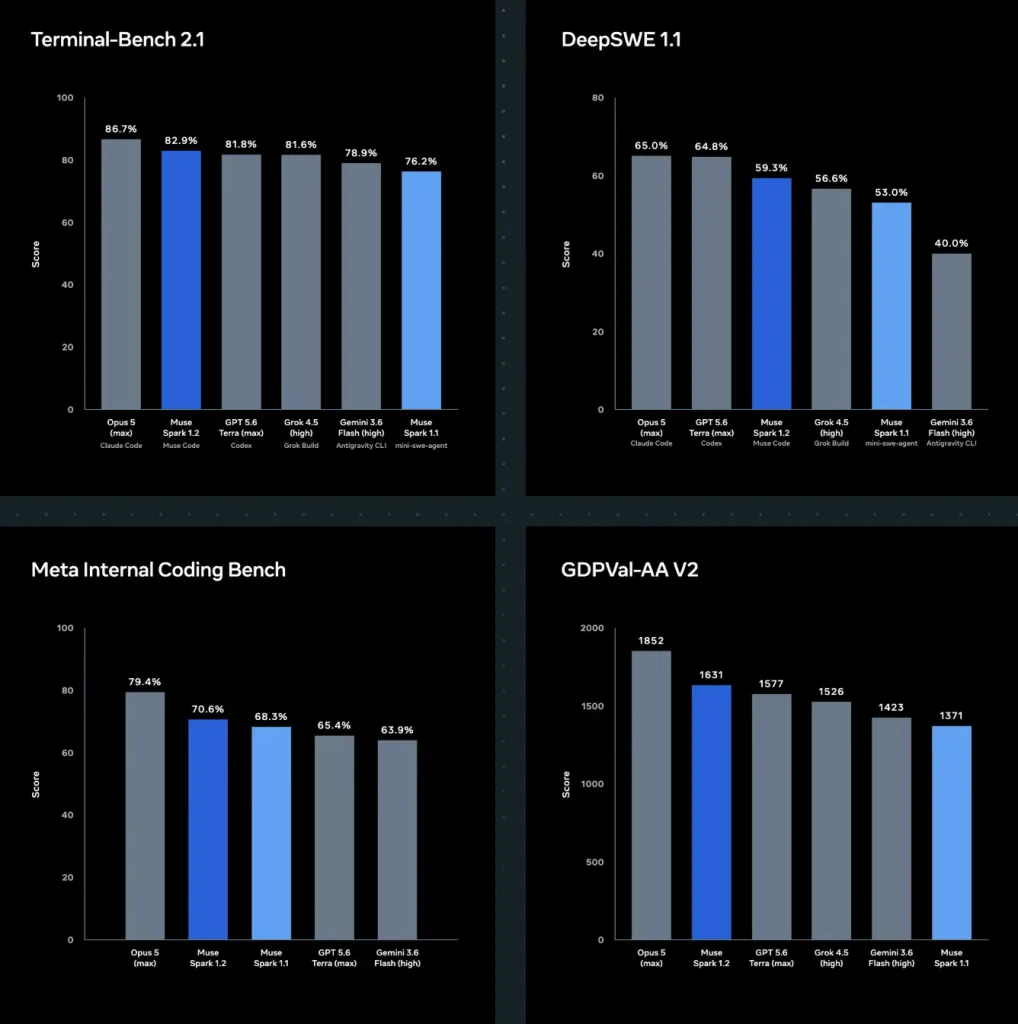
Meta just handed developers a new terminal companion. Muse Code (beta), powered by the freshly upgraded Muse Spark 1.2 model, is designed to plan, write and validate code across massive repositories — often with barely any human hand-holding.
What Makes Muse Code Different
Unlike single-task coding assistants, Muse Code runs a simple agent loop backed by persistent asynchronous background agents that stay active throughout a session. These sub-agents gather context, execute steps independently, and report back to the main agent — cutting down on repetitive prompting and latency.
It also keeps a local event log of every model call, tool run, approval and code edit. That makes sessions “replay-exact and restart-safe,” so a long-running task can resume right where it left off after an interruption — a genuinely useful feature for anyone who’s lost hours to a crashed AI session.
Developers curious about agentic coding tools have been watching this space closely, much like we’ve covered other AI tools and app launches shaping how software gets built today.

Key Features at a Glance
| Feature | Details |
|---|---|
| Tool name | Muse Code (beta) |
| Underlying model | Muse Spark 1.2 |
| Platforms | macOS, Linux |
| Built-in commands | /plan, /grill, /goal |
| Context window | 1M tokens |
| Install method | Terminal script via dev.meta.ai |
Muse Spark 1.2: Built for Long-Horizon Engineering
Muse Spark 1.2 was co-trained with Muse Code itself, using rejection-sampled trajectories and context compaction to handle whole-repository code generation. Meta says it tested the model on GPU kernel optimization tasks involving over 1,000 tool calls across sessions lasting up to 24 hours, where it iteratively wrote, compiled and profiled kernels for NVIDIA Hopper GPUs.
That’s a serious real-world stress test, and it puts Muse Spark 1.2 in the same conversation as other frontier coding models — a race we’ve been tracking in our broader AI and technology news coverage.
Pricing and Availability
Muse Code is free to install via a simple curl command, while Muse Spark 1.2 access through the Meta Model API is priced per variant:
| Variant | Input | Output |
|---|---|---|
| muse-spark-1.2-contributor | $0.10/M tokens | $0.20/M tokens |
| muse-spark-1.2 | $1.25/M tokens | $4.25/M tokens |
The contributor tier feeds data back to improve Meta’s products; the standard tier does not.
Why It Matters
Meta is clearly positioning Muse Code as a long-term bet on agentic software engineering, not a one-off demo. For developers exploring AI-assisted workflows, it’s worth testing alongside the tools already covered in our AI apps roundup — bigger models are reportedly already on the way.


