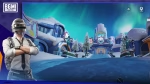
Reliance Jio and Tencent are gearing up to launch a new cloud gaming platform in India by 2026. Their goal? To deliver high-end gaming experiences to millions of users.
This partnership taps into Jio’s vast 5G network, which aims to roll out 1 million 5G base stations by 2025 , combined with Tencent’s expertise in streaming technology. While this collaboration is still, it has the potential to reshape the Indian esports and gaming scene.
In many ways, this move reflects the success of Tencent‘s START cloud gaming engine, launched in China in 2019. It offered low-latency access to graphically demanding games on mobile devices and entry-level hardware.

Strategic Synergy: Jio and Tencent’s Market Entry
This partnership focuses on making AAA gaming accessible to more people. By pairing Jio’s impressive subscriber base—over 400 million as of 2024 [UNCONFIRMED]—with Tencent’s reliable infrastructure, they aim to overcome the hardware limitations that currently hinder high-quality gaming in India.
It poses a direct challenge to traditional console and PC gaming, which often come with steep upfront costs.
Leveraging Jio’s 5G Network Dominance in India
Jio’s infrastructure forms the backbone of this initiative. Cloud gaming needs stable, high-speed connections, typically requiring 15-25 Mbps for consistent HD streaming. With 5G becoming more common across India, Jio is perfectly positioned to support the data-heavy demands of real-time game streaming.
Integrating Tencent’s START Cloud Gaming Engine
With Tencent’s proprietary START engine in the mix, they can handle server-side rendering, which takes the heavy computational load off the user’s device. For someone using a budget smartphone, this setup means they can enjoy graphically rich games without needing an expensive GPU or console.
Subscription-Based Access Models for Mass-Market Reach
They’re likely to introduce a tiered subscription model similar to what you see with existing services like NODWIN Gaming. By charging a monthly fee for access to a library of games, Jio and Tencent can attract price-sensitive Indian consumers, making high-end gaming as easy as streaming a movie.
Technological Infrastructure and User Experience
The success of this platform will depend on closing the gap between users and servers. Unlike video streaming, gaming is sensitive to input delays; even a slight lag can spoil the fun. To tackle this, the partnership plans to set up edge computing units in major cities across India. This way, data packets can take the shortest route, as mentioned in recent coverage by TechCrunch.
Reducing Hardware Barriers for Mobile-First Gamers
Mobile gaming is huge in India, and this platform aims to directly reach that audience. By eliminating the need for dedicated hardware, they hope to transform casual mobile gamers into serious enthusiasts. It’s an ambitious strategy to engage the vast Indian launch MMORPG crowd that currently lacks the necessary gear to run global titles.
Latency Optimization and Edge Computing Integration
Latency can ruin the cloud gaming experience. By utilizing edge computing, the platform will handle game inputs closer to users. This strategy minimizes the delay between a button press and the corresponding action on screen, creating a responsive experience similar to local hardware, as noted in recent coverage by The Verge.
Expanding the Library of AAA Titles to Low-End Devices
The real game-changer here is the content. Tencent’s extensive portfolio, including stakes in companies like Riot Games and Epic Games, offers a treasure trove of potential titles. This platform could theoretically bring top-tier games to devices that previously couldn’t support them.
FAQs
When will the Jio and Tencent cloud gaming platform launch?
The platform is currently [UNCONFIRMED] for a 2026 launch, pending more details from both companies.
Which devices will be compatible with the service?
The service is expected to support a variety of devices, including Android smartphones, tablets, and possibly Smart TVs, focusing on low-end hardware that benefits from cloud rendering.
What are the data consumption requirements for the service?
Users will need a stable connection of at least 15-25 Mbps to maintain HD streaming quality, which could result in significant data usage during extended gaming sessions.
Will there be different pricing tiers?
While details are still [UNCONFIRMED], industry trends suggest a subscription model with different tiers to cater to both casual and competitive gamers. Cloud Gaming