NZ
NZ IND
IND NAM
NAM IRE
IRE MOZ
MOZ UGA
UGA Aston Villa
 Man City
 Rayo
Rayo Elche
Elche GMB
GMB ZMB
ZMB NGA
NGA LES
LES Cagliari
 Bologna
 IPS1
IPS1 NFO1
NFO1 ALA1
ALA1 MCF1
MCF1 TOR3
TOR3 MON2
MON2 BRE1
BRE1 NICE2
NICE2 TAS129/7 (23.3/35 ov, target 276)
 VIC304/7 (50 ov)
 WA
WA NSW38/1 (9/50 ov)
 NZ-A135/3 (41 ov)
 IND-A113
 DHA
DHA RAJ
RAJ MYMS
MYMS CHATT
CHATT RAN
RAN BAR
BAR SYL
SYL KHU
KHU MEX-W
MEX-W ARG-W
ARG-W UAE
UAE NED
NED AFG170/3 (34.3/50 ov, target 170)
 ZIM169
 IND-W200/1 (27.1/50 ov, target 198)
 ZIM-W197
 DOLPH56/0 (3.5/8 ov, target 56)
 SWD51/4 (8/8 ov)
 WSW1
WSW1 BRI1
BRI1 Como
Como Sassuolo
 Augsburg
 Union Berlin
 Cologne
 Schalke
 Mainz
Mainz Bremen
 RB Leipzig
 Elversberg
 VFB2
VFB2 BMG3
BMG3 AHL4
AHL4 KHA1
KHA1
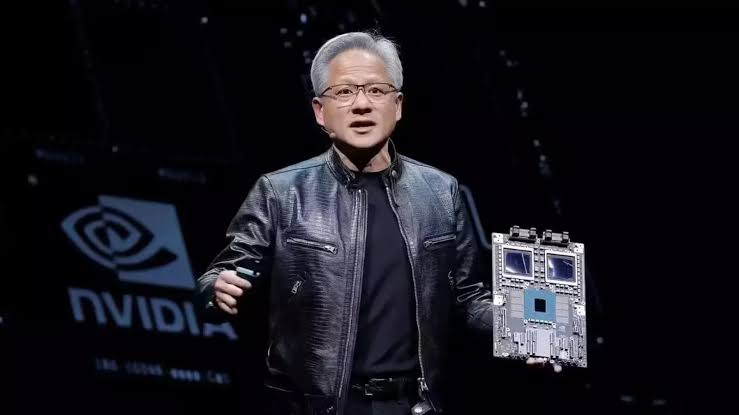
Nvidia’s Jensen Huang AI growth projections have dominated tech headlines this week, with the CEO forecasting the company will “sell twice as many chips next year,” backed by a historic OpenAI infrastructure commitment and record quarterly results.
Jensen Huang AI Growth Forecast: The Numbers
Huang is targeting roughly 70% revenue growth through fiscal 2028, projecting revenue near $673 billion. That forecast comes alongside Nvidia’s latest quarterly results, which showed $96.2 billion in revenue with data-center revenue up 117% year-over-year.
| Metric | Figure |
|---|---|
| Quarterly revenue | $96.2 billion |
| Data-center revenue growth | +117% year-over-year |
| Projected FY2028 revenue | ~$673 billion |
| OpenAI infrastructure commitment | ~$856 billion through 2030 |
OpenAI’s roughly $856 billion commitment to computing infrastructure through 2030 is largely tied to Nvidia systems, underscoring just how central Nvidia’s hardware has become to the broader AI buildout across the industry.
Big Tech’s AI Infrastructure Bet
Major technology companies, including Nvidia itself, are backing up to $300 billion in AI data-center and chip debt guarantees, a sign of how much capital is being committed to sustaining the current AI infrastructure boom.
Nvidia has also expanded partnerships with Cisco, Pinterest, and CoreWeave, alongside committing $2 billion to a Brookfield-managed AI fund and expanding its CUDA-Q quantum computing initiatives.
Why the Jensen Huang AI Growth Story Matters
Nvidia stock has responded positively to this growth narrative, trading near $225 with a roughly 2.17% rise as of late September 2026. For investors and industry watchers, Huang’s projections effectively set the tone for how the entire AI hardware sector is expected to scale over the next two years.
Skeptics have pointed out that such aggressive growth targets depend heavily on continued mega-scale spending commitments from a relatively small number of AI labs and cloud providers, concentrating risk even as revenue figures climb.
Nvidia’s dominant position in AI accelerator chips means its forecasts are often treated as a bellwether for the broader technology sector’s health, well beyond just semiconductor investors.
TechnoSports will continue tracking Nvidia’s growth trajectory as more details on its FY2028 targets and partnership commitments emerge.
For more AI and semiconductor coverage, see TechnoSports’ Nvidia section.
Nvidia’s dominance in AI accelerator chips has made the company a central figure in nearly every major cloud provider’s infrastructure roadmap, which is part of why Huang’s projections carry so much weight across the industry.
The scale of OpenAI’s committed spending highlights just how concentrated AI infrastructure investment has become among a handful of major labs and hyperscalers.
Analysts have noted that sustaining 70% growth over multiple years would be a historically rare feat for a company already operating at Nvidia’s massive revenue base.
Competitors including AMD and various custom silicon efforts from cloud providers are watching Nvidia’s guidance closely as they plan their own AI hardware roadmaps.
The Jensen Huang AI growth narrative also ties into broader questions about power grid capacity, since data centers running Nvidia’s chips at this scale require enormous, sustained electricity supply.
TechnoSports will continue tracking Nvidia’s quarterly results and infrastructure partnerships as this AI hardware growth story develops further.
Some economists have flagged the broader AI capital-spending cycle as a potential bubble risk, though Nvidia’s actual revenue and profit figures so far have consistently outpaced even bullish analyst estimates.
For everyday consumers, the ripple effects of this AI growth story show up indirectly through memory chip shortages and higher prices on consumer electronics competing for the same manufacturing capacity.
Whatever the long-term outcome, Nvidia’s current position at the center of the AI infrastructure boom makes its next few quarterly earnings reports some of the most closely watched numbers in the entire technology sector.
Investors and rivals alike will be parsing every detail Nvidia releases for clues on whether this growth pace can genuinely hold.
Source: StocksToTrade