UDI0
UDI0 MIL2
MIL2 BAR0
BAR0 RMA1
RMA1 SCP0
SCP0 ACV1
ACV1 Mohun Bagan
 Chennaiyin
 PSG
PSG Lyon
Lyon Sevilla
 Osasuna
 NED
NED OMA
OMA NZ
NZ IND
IND NAM
NAM IRE
IRE PAK
PAK SL
SL SA
SA AUS
AUS RSO2
RSO2 LEV1
LEV1 LEC0
LEC0 JUV2
JUV2 SUN0
SUN0 LEE0
LEE0 SCF1
SCF1 MUN3
MUN3 LIMWn
LIMWn NW-W
NW-W NCWmn
NCWmn FsWm
FsWm NWEST22/3 (3.1/20 ov, target 181)
 NCAPE180/3
 BOL137/9 (20 ov)
 TITNS137/8
 NZ-A317
 IND-A113 & 106/2 (36 ov)
 SYL280/2 (84 ov)
 KHU
KHU MYMS465/7d
 CHATT134/2 (40 ov)
 DHA521
 RAJ103/6 (26 ov)
 RAN402
 BAR179/3 (56.1 ov)
 BRB
BRB MOW
MOW LUL
LUL SPR
SPR TOK
TOK MEX-W51 (12.5/20 ov, target 187)
 ARG-W186/7
 NGA148
 UGA147/9 (20 ov, target 149)
 GMB112/9
 LES109 (19.5/20 ov, target 113)
 MOZ110/7 (19/20 ov, target 110)
 ZMB109/9
 IND-W328/6
 ZIM-W207 (48.5/50 ov, target 329)
 ENG241
 LAFC
LAFC LA
LA Neftchi Fergana
 Al Ittihad
 Besiktas
 Istanbul BB
 Caykur Rizespor
 Trabzonspor
 Al Ahli
 Al-Gharafa
 AUX1
AUX1 MNS1
MNS1 ANG0
ANG0 LOR0
LOR0
India’s recent leadership in global rice production is a celebrated agricultural milestone — but it comes with serious environmental challenges. As the country produces and exports record amounts of rice, concerns over unsustainable groundwater use and worsening water stress are intensifying, particularly in northern farming states.
Here’s a compact, engaging breakdown of this issue with key facts, a simple info table, and clear takeaways you’re likely searching for on India’s booming rice sector and water crisis.
Rice Production & Water Use
| Indicator | Data / Insight |
|---|---|
| Global Rank | India is the largest rice producer and exporter in the world. |
| Annual Output | Over 140 million tonnes (recent years). |
| Export Share | ~40% of global rice exports. |
| Water Requirement | 3,000–4,000+ litres per kg of rice — 20–60% above global norms. |
| Key Water-Stressed States | Punjab & Haryana (aquifers over-exploited). |
| Groundwater Decline | Borewells now 80–200 ft vs. 30–40 ft a decade ago. |
🌍 Why India’s Rice Boom Affects Water Sustainability
🌱 India’s Rice Leadership
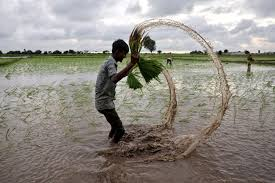
India recently overtook China to become the world’s top rice producer, with exports nearly doubling over the past decade. Rice has become central to India’s agricultural economy and global food markets, supplying demand in over 170 countries.
💧 High Water Demand of Rice
Rice is one of the most water-intensive crops, requiring roughly 3,000–4,000 litres of water per kilogram — much more than many other staples. This heavy demand puts pressure on freshwater resources, especially in regions without abundant surface water.
🛑 Groundwater Depletion in Punjab & Haryana
In rice-producing belts like Punjab and Haryana, farmers rely on groundwater for irrigation. Over the past decade, aquifer levels have plummeted — historically reachable at 30–40 ft, water now often lies 80–200 ft below ground. This signals unsustainable extraction far above natural recharge rates.
💸 Subsidies & Crop Choices
Government incentives — including minimum support prices (MSP) and subsidised electricity — make rice farming economically attractive even in water-stressed areas. These policies discourage farmers from shifting to less water-intensive crops like millets or pulses, compounding the water crisis.
🌱 Broader Implications of the Water Crisis
- Farmer Costs: Deeper borewells and stronger pumps raise production costs and risk indebtedness.
- Food Security vs. Sustainability: While rice ensures export strength and domestic food supply, its water footprint challenges long-term ecological balance.
- Climate Vulnerability: Reliance on groundwater makes rice cultivation particularly vulnerable to erratic monsoons and droughts. Wikipedia
India’s water scarcity issue isn’t limited to agriculture — many regions face broader water stress due to over-extraction, climatic shifts, and resource mismanagement. Wikipedia
🐒 Delhi Assembly’s Langur Mimicry Plan: A Creative Fight Against Monkey Menace
❓FAQs
Q1: Why is rice farming such a big water issue in India?
Q2: Does India export more rice than it needs?
Yes — India exports a large portion of its rice output, accounting for around 40% of global rice exports, and this export-oriented cultivation intensifies water use.