NZ180/5
 IND56/2 (8.3/20 ov, target 181)
 NAM156/2 (32/50 ov)
 IRE
IRE AVL
AVL MNC
MNC RAY
RAY ELC
ELC GMB
GMB ZMB
ZMB NGA
NGA LES
LES CAG
CAG BOL
BOL COMO
COMO SAS
SAS FCA
FCA FCU
FCU KOE
KOE S04
S04 MOZ19
MOZ19 UGA23/0 (0.5/20 ov, target 20)
 Ipswich1
 Nottm Forest1
 Alavés1
 Málaga1
 Torino3
 Monza2
 WA
WA NSW371/8 (50 ov)
 DEN
DEN KUW
KUW KENYA
KENYA QAT
QAT SWD-W
SWD-W EPR-W
EPR-W TTN-W
TTN-W WPR-W
WPR-W NZ-A135/3 (41 ov)
 IND-A113
 DHA
DHA RAJ
RAJ MYMS
MYMS CHATT
CHATT RAN
RAN BAR
BAR SYL
SYL KHU
KHU MEX-W
MEX-W ARG-W
ARG-W UAE
UAE NED
NED PAK
PAK ENG
ENG IND-W
IND-W ZIM-W
ZIM-W AFG170/3 (34.3/50 ov, target 170)
 ZIM169
 CHE0
CHE0 DYI0
DYI0 CHO1
CHO1 QIN0
QIN0 HEN1
HEN1 BEI0
BEI0 LIA1
LIA1 ZHE0
ZHE0 QWC1
QWC1 YUN0
YUN0 SHX0
SHX0 Shanghai Shenh0
 TIG0
TIG0 SHP0
SHP0 WTT1
WTT1 SHT3
SHT3 M05
M05 SVW
SVW RBL
RBL ELV
ELV Brest1
 Nice2
Nice2 Stuttgart2
 Gladbach3
 Al Ahli4
 Al Khaleej1
When the World Cup 2026 draw was made, Spain vs Cabo Verde was widely tipped as one of the most lopsided fixtures of the group stage. The European champions, ranked second in the world, against a nation of half a million people making their World Cup debut, sitting 67th in the FIFA rankings — it looked like a foregone conclusion.
A day earlier, Germany had put seven past Curaçao, fuelling expectations that this match could be equally one-sided. Instead, Cabo Verde produced one of the most disciplined, courageous, and historic performances in World Cup history — holding Spain to a goalless draw and silencing every doubter who questioned the expanded 48-team format.
Spain Dominated Everything — Except the Scoreboard
Spain did everything a top-two ranked side was supposed to do. They controlled the ball, pushed forward relentlessly, and created chances. Yet for all their dominance, they couldn’t find a way through.
| Statistic | Spain | Cabo Verde |
|---|---|---|
| Possession | 74.2% | 25.8% |
| Field Tilt | 96.7% | 3.3% |
| Total Passes | 734 | — |
| Total Shots | 27 | 4 |
| Expected Goals (xG) | 2.29 | 0.07 |
| Shots on Target Saved | 7 | — |
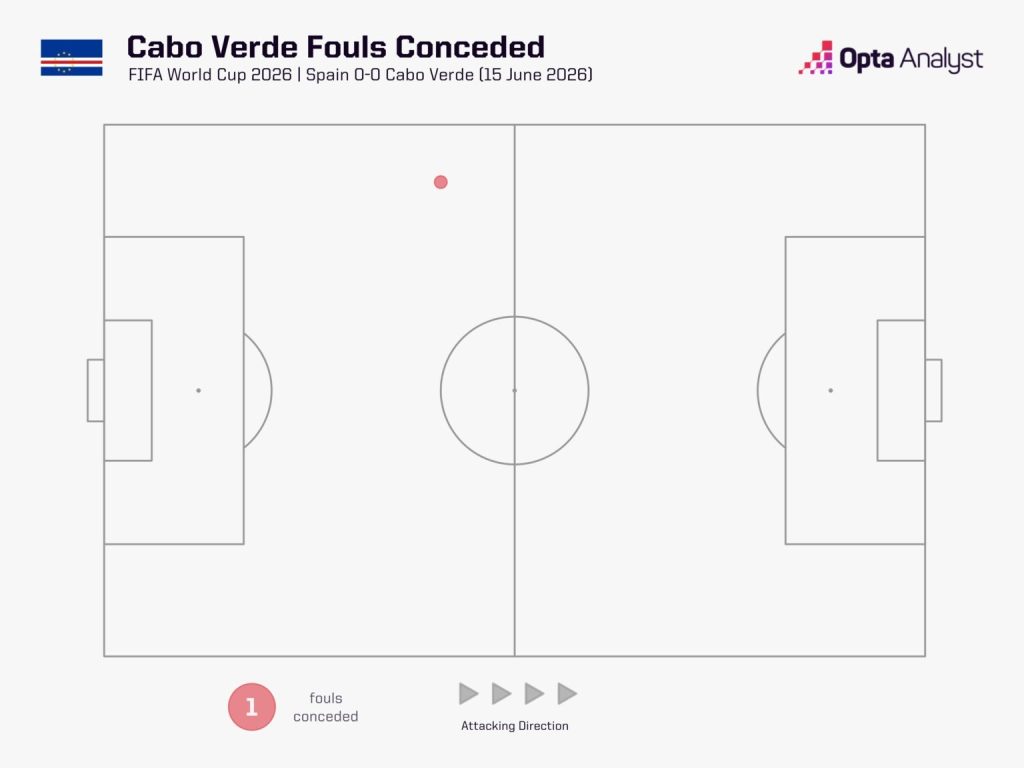
| Fouls Committed | — | 1 |
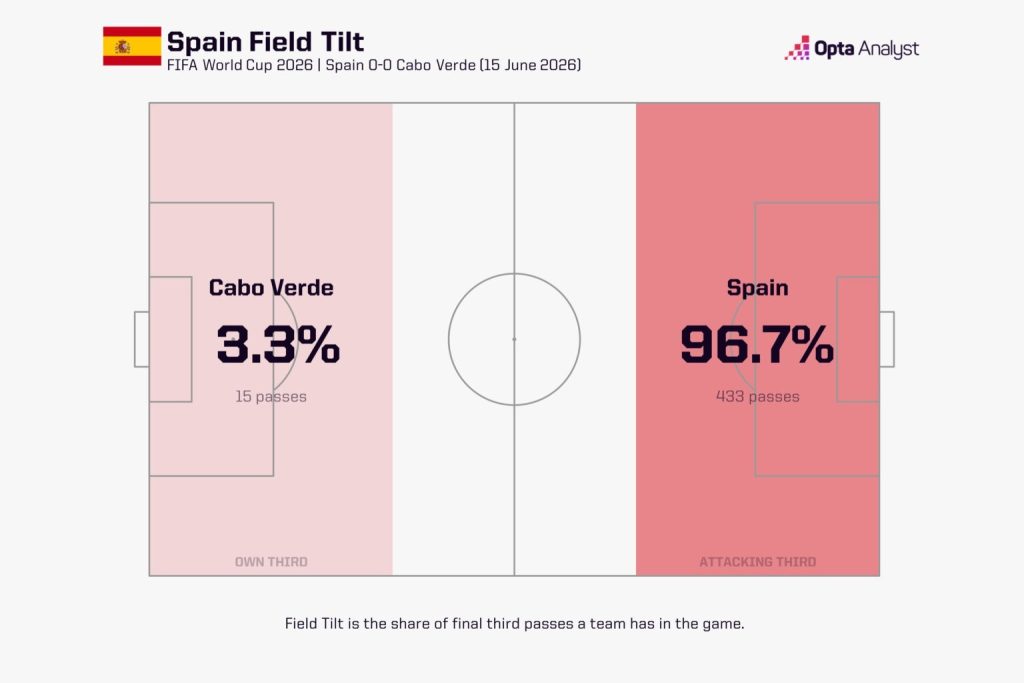
Spain’s pass map told the full story — relentless movement through and around the Cabo Verde half, yet almost nothing cutting through to cause real danger. Centre-forward Mikel Oyarzabal became the first player since 1966 to go the first 30 minutes of a World Cup match without touching the ball. He eventually got more involved, but both he and Ferran Torres were guilty of poor finishing when clear opportunities arose.
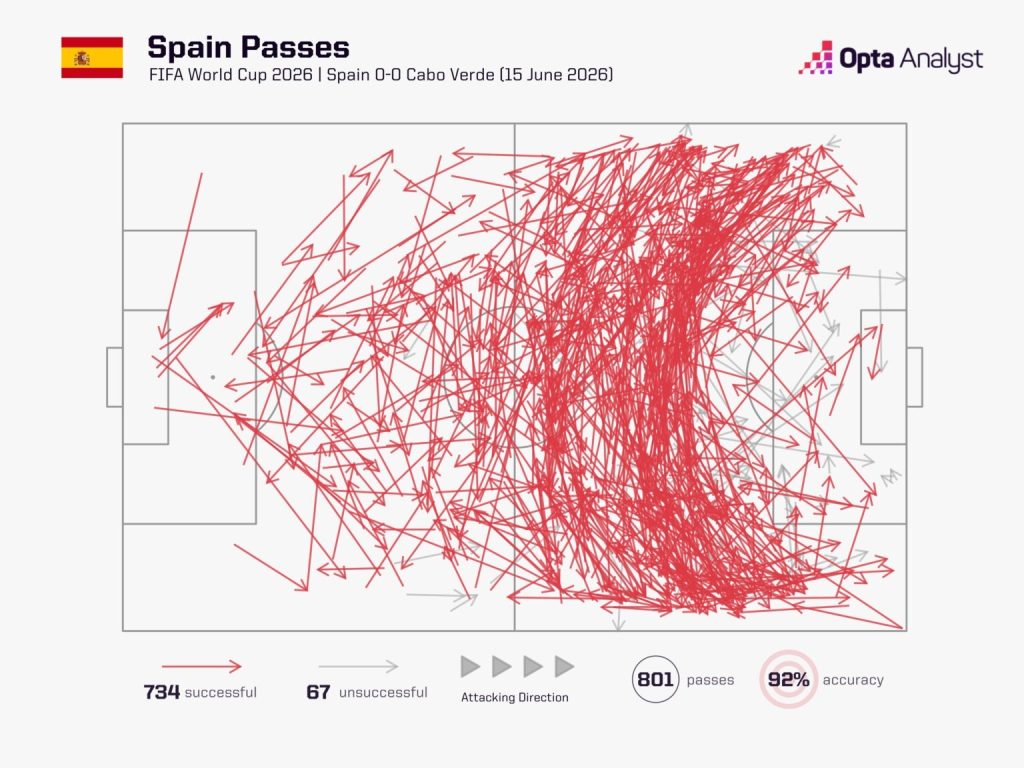
This result extended Spain’s goalless run at the World Cup to the equivalent of nearly three full matches. Their last goal came 11 minutes into their penultimate group game at the 2022 World Cup against Japan. They then failed to score against Morocco in the last 16, and now against Cabo Verde — meaning 49 shots and 2,500 passes without a World Cup goal.
Cabo Verde’s Defensive Masterclass
This result was not simply a case of Spain having a bad day. Cabo Verde were magnificent — organised, disciplined, and utterly fearless throughout.
| Defensive Highlight | Player | Stat |
|---|---|---|
| Tackles | Diney Borges | 5 (match-high) |
| Clearances | Pico Lopes | 11 (match-high) |
| Team Fouls Committed | Cabo Verde | 1 (World Cup record since 1966) |
That single foul figure is extraordinary. Despite being under siege for 90 minutes with Spain controlling nearly three-quarters of the ball, Cabo Verde’s players stayed composed and disciplined throughout — a remarkable collective achievement.
Centre-back Diney Borges was everywhere, winning challenges and putting his body on the line. His partner Pico Lopes was a wall, clearing danger time and again. And when Spain threw every player forward in desperate search of a winner deep into stoppage time, it was Borges himself who nearly turned the game on its head — rising to meet a last-gasp corner, only to head his effort straight at goalkeeper Unai Simón. It summed up the evening perfectly: Cabo Verde had not only survived but had come agonisingly close to stealing all three points.
That single foul figure is also a record — the fewest fouls committed by any team in a World Cup match since 1966. Extraordinary discipline from a side that had everything to lose.
Vozinha: The 40-Year-Old Hero
While Borges and Lopes were outstanding, the man who truly made history was goalkeeper Vozinha. He saved all seven shots on target he faced, producing a performance that will live long in World Cup 2026 memory.
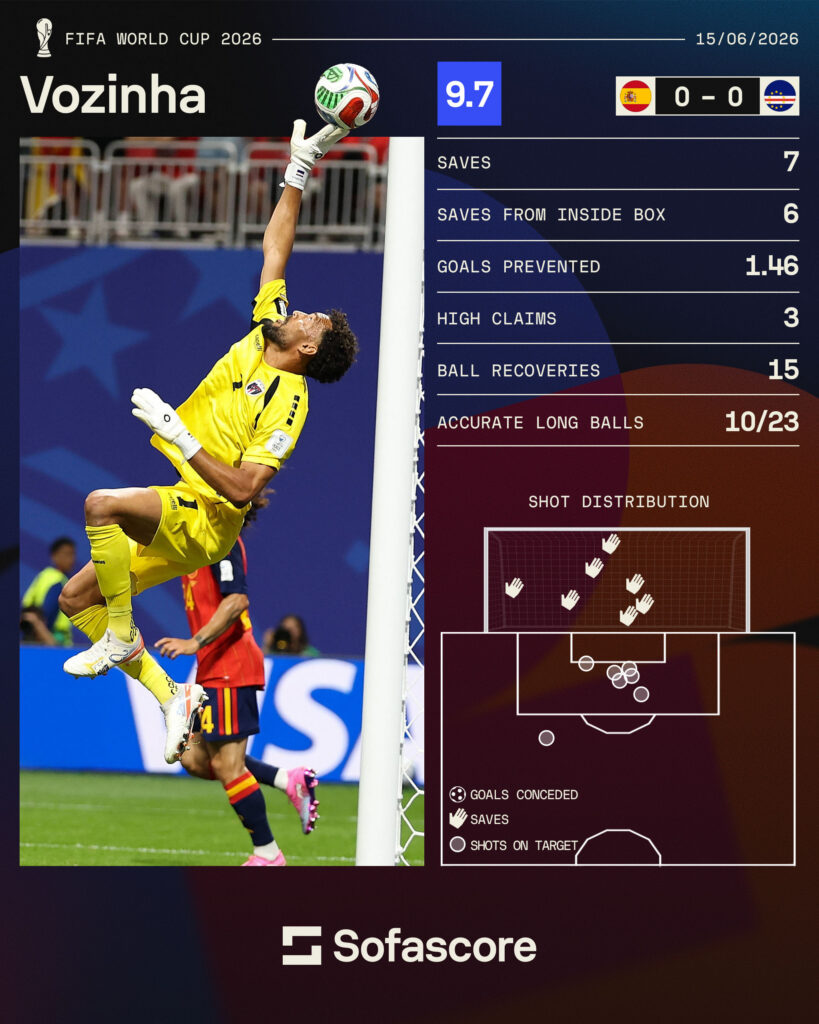
At 40 years and 12 days old, Vozinha became the third-oldest goalkeeper to keep a clean sheet in a World Cup match, joining legendary company:
| Goalkeeper | Age at Clean Sheet | Tournament |
|---|---|---|
| Peter Shilton | 40 years, 281 days | 1990 |
| Dino Zoff | 40 years, 130 days | 1982 |
| Vozinha | 40 years, 12 days | 2026 |
The only goalkeeper aged 40 or over to make more saves in a single World Cup game on record was Pat Jennings — on his 41st birthday — for Northern Ireland against Brazil in 1986, with 10 saves. Vozinha’s seven were more than enough to rewrite history and cement his place among the World Cup’s most remarkable stories.
The Biggest Ranking Gap in World Cup History
The 65-place difference between Spain (ranked 2nd) and Cabo Verde (ranked 67th) is the largest recorded gap for any team that avoided defeat in a World Cup match, since FIFA rankings were first published in 1993.
Cabo Verde also hold the distinction of being the second-least populous nation ever to qualify for a World Cup — a nation of roughly 500,000 people, a record they held until Curaçao later entered the equation.
Why This Result Matters for World Cup 2026
One of the loudest criticisms aimed at the expanded 48-team format was that it would produce too many mismatches — blowout results that would drain the group stage of genuine competition. Germany’s 7-0 win over Curaçao appeared to validate those fears.

Cabo Verde answered every one of those concerns in 90 minutes. Their performance proved that smaller nations, when well-organised and tactically sharp, can absolutely compete at the highest level. The result wasn’t a fluke — it was earned through extraordinary effort, elite goalkeeping, and a defensive structure that never buckled.
World Cup 2026 has its defining shock. And Cabo Verde are at the very heart of it.
Read More: World Cup: Five Numbers That Explain Germany’s 7-1 World Cup Rout of Curaçao