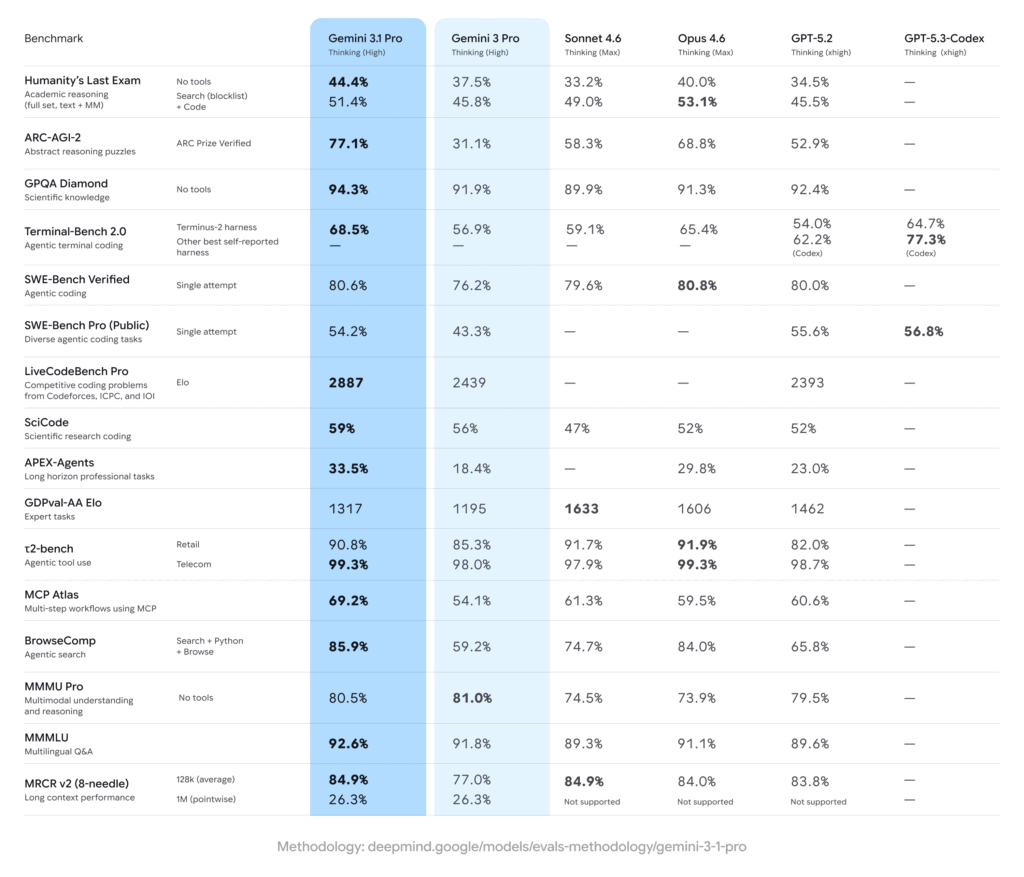
Google isn’t playing catch-up anymore — it’s setting the pace. On February 19, 2026, Google announced Gemini 3.1 Pro, an upgraded core intelligence model that’s rolling out across the entire Gemini ecosystem. The headline number? A 77.1% score on ARC-AGI-2 — more than double the reasoning performance of its predecessor, Gemini 3 Pro.
For context, ARC-AGI-2 isn’t some synthetic benchmark designed to make AI look good. It tests whether a model can solve completely new logic patterns it’s never seen before — the kind of abstract reasoning that separates genuine intelligence from pattern-matching parrots. And Google just lapped the field.
Where You Can Use It Right Now
Unlike vaporware announcements that take months to reach users, Gemini 3.1 Pro is live today across multiple platforms:
| Access Point | Availability | Who Gets It |
|---|---|---|
| Gemini API | Preview | Developers via AI Studio & Gemini CLI |
| Vertex AI | Available now | Enterprise customers |
| Gemini Enterprise | Available now | Business users |
| Gemini App | Rolling out | Pro & Ultra subscribers (higher limits) |
| NotebookLM | Available now | Pro & Ultra subscribers exclusively |
| Android Studio | Preview | Android developers |
| Google Antigravity | Preview | Agentic development workflows |
The strategic play here is obvious: Google is shipping a production-grade reasoning model to consumers and developers simultaneously, rather than gatekeeping it behind waitlists or enterprise-only access.
What Makes 3.1 Pro Different?
Google describes 3.1 Pro as “designed for tasks where a simple answer isn’t enough.” That’s not marketing fluff — the model’s architecture prioritizes multi-step reasoning over quick responses. This shows up in practical applications that previous models simply couldn’t handle reliably.
Code-Based Animation: Gemini 3.1 Pro generates website-ready animated SVGs directly from text prompts. These are built in pure code rather than pixels, meaning they scale infinitely and maintain tiny file sizes compared to traditional video.
Complex System Synthesis: The model successfully configured a public telemetry stream to visualize the International Space Station’s orbit in real-time — bridging the gap between complex APIs and user-friendly dashboards without hand-holding.
Interactive 3D Design: When asked to code a 3D starling murmuration, 3.1 Pro didn’t just generate visuals. It built an immersive experience with hand-tracking controls and a generative musical score that shifts based on the birds’ movement patterns.
Creative Coding with Literary Understanding: Given the prompt to build a modern portfolio for Emily Brontë’s “Wuthering Heights,” Gemini 3.1 Pro reasoned through the novel’s atmospheric tone to design a sleek, contemporary interface that captures the protagonist’s essence — not just a text summary.
These aren’t cherry-picked demos. They’re examples of a fundamental shift in how AI models approach creative and technical problem-solving.
The Benchmark That Actually Matters
Forget GPT-5 rumors and Claude Opus comparisons. The ARC-AGI-2 benchmark is the one evaluation that AI researchers genuinely respect, because it measures abstract reasoning rather than memorised patterns.
Gemini 3.1 Pro: 77.1%
Gemini 3 Pro (previous): ~35%
Most other models: Far below 50%
That 2x improvement isn’t incremental — it’s the kind of leap that changes what’s possible in production deployments. For developers building AI-powered applications, this means fewer edge-case failures, better handling of novel problems, and significantly reduced prompt engineering overhead.
The Agentic AI Play
Google isn’t burying the lede here: this release is explicitly about advancing agentic workflows. The company is releasing 3.1 Pro in preview specifically to validate these updates before general availability, with a clear focus on ambitious multi-step AI agent tasks.
The timing aligns perfectly with the broader industry shift. OpenAI is pushing agents via Operator, Anthropic is shipping Claude with computer use, and Google just handed developers a reasoning engine powerful enough to compete — wrapped in the infrastructure reliability only Google can provide at scale.
For enterprises already on Vertex AI, this is a no-brainer upgrade. For startups and Indian developers building AI products, the Gemini API pricing combined with 3.1 Pro’s reasoning capabilities suddenly makes previously impossible workflows economically viable.
What Pro and Ultra Subscribers Get
If you’re paying for Google AI Pro or Ultra, you’re getting immediate access to 3.1 Pro with higher usage limits in the Gemini app. More importantly, you get exclusive access to 3.1 Pro in NotebookLM — Google’s sleeper hit AI research assistant that’s become indispensable for writers, researchers, and students.
NotebookLM powered by 3.1 Pro means synthesizing 50-page research papers, identifying contradictions across sources, and generating structured outlines with genuinely sophisticated reasoning — not just keyword matching.
The Competitive Landscape
Let’s be blunt: Google was behind. OpenAI owned the mindshare, Anthropic had the best reasoning model, and Google’s own launches felt defensive. Gemini 3.1 Pro changes that calculation.
With 77.1% on ARC-AGI-2, Google is now competitive with or ahead of Claude Opus on pure reasoning tasks. With same-day consumer and enterprise rollout, it’s executing faster than OpenAI’s typical launch cadence. And with Vertex AI integration, it’s offering infrastructure maturity that neither competitor can match.
The AI race just got a lot more interesting — and Google’s finally playing offense again.
Follow the latest AI model releases, Google AI updates, and developer tools coverage at Technosports.