Google DeepMind has launched Genie 3, a revolutionary AI world model that generates interactive, navigable 3D environments from simple text descriptions in real-time at 24 frames per second. Available now through Project Genie for Google AI Ultra subscribers ($250/month) in the US, the technology represents a glimpse into the future of AI-generated gaming experiences—potentially previewing what technologies like Nvidia’s theoretical “DLSS 10” might accomplish.
Table of Contents

Real-Time World Generation at 720p
Genie 3 creates dynamic worlds that users can explore at 720p resolution, maintaining visual consistency for several minutes while responding to player actions. Unlike static AI-generated images or pre-rendered video, these environments react in real-time as you navigate, with persistent objects, terrain deformation, and environmental interactions.
| Capability | Specification |
|---|---|
| Frame Rate | 24 fps real-time generation |
| Resolution | 720p (1280×720) |
| Consistency Duration | Several minutes of coherent world state |
| Prompt Types | Text descriptions + optional images |
| Perspectives | First-person, third-person, isometric |
| Movement Modes | Walking, flying, driving, swimming, custom |
Three Modes of Interaction
Project Genie offers three creation approaches:
World Sketching: Describe your environment and character, choose perspective (first-person/third-person), and preview via Nano Banana Pro before entering. The AI generates a source image you can refine before final world creation.
Exploration: Navigate generated environments in real-time as Genie 3 renders the path ahead based on your actions. Adjust camera angles while traversing through dynamically generated terrain.
Remixing: Build upon existing worlds created by others, modifying prompts to generate new interpretations and variations.
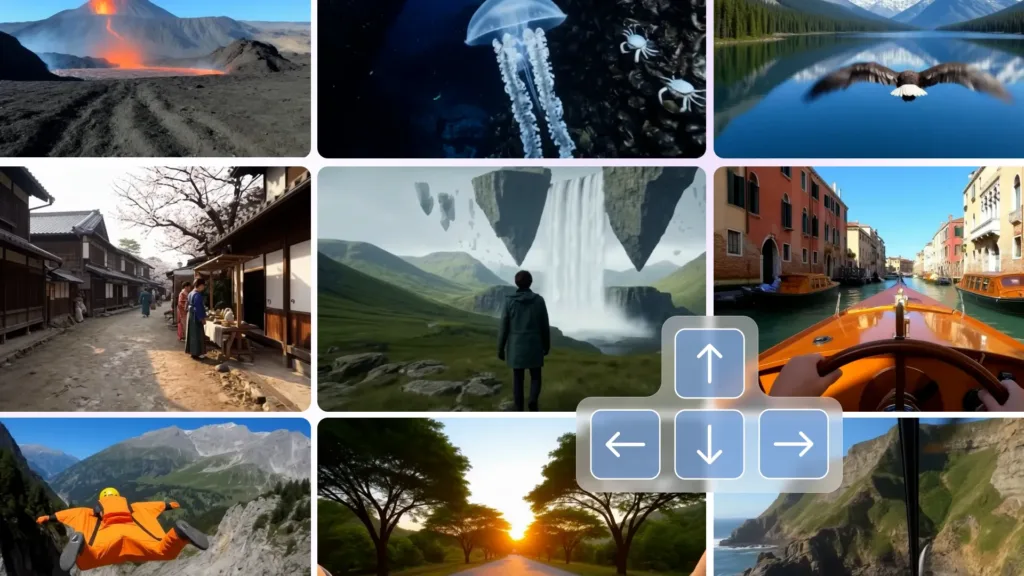
Prompt Examples and Capabilities
Google showcases impressive examples including:
- Oceanic surfing: Endless waves with turquoise barrels, sun flares, and seagull swarms
- Alpine mountaineering: Deformable snow terrain with omni-directional movement
- Amazon rainforest: Dynamic lighting through canopies with playable parrots
- Volcanic exploration: Robot POV navigating lava flows and blackened rock
- Deep sea diving: Following jellyfish through bioluminescent underwater canyons
The model generates realistic physics for water dynamics, snow deformation, atmospheric effects, and wildlife behaviors—creating vibrant ecosystems from text alone.
Technical Architecture and Limitations
Genie 3 uses an autoregressive architecture trained on simulated environment data to understand physical rules and generate coherent 3D spaces. The system predicts both environmental evolution and action consequences, enabling agents to navigate unlimited procedural worlds.
Current limitations include:
- Worlds may not look completely photorealistic
- Characters can be less controllable with occasional latency
- Not all announced features (like promptable world-changing events) are implemented yet
- Consistency degrades after several minutes of exploration
Gaming and Training Applications
Beyond entertainment, Genie 3 enables:
- Robotics training: Generating diverse navigation scenarios for autonomous agents
- Game development: Rapid prototyping of levels and environments
- Educational simulations: Interactive historical reconstructions or space exploration
- Creative experimentation: Artists and designers testing concepts without coding
The technology mirrors Google DeepMind’s decade-long research in simulated environments, from training agents in real-time strategy games to developing robotic learning systems.

The “DLSS 10” Connection
The comparison to “DLSS 10” references Nvidia’s Deep Learning Super Sampling technology, which uses AI to upscale lower-resolution frames. Genie 3 takes this concept exponentially further—not just enhancing existing graphics but generating entire interactive worlds from scratch using AI inference.
If future GPU architectures integrate similar world-modeling capabilities, games could dynamically generate unlimited content tailored to player actions, text commands, or emotional states—a radical departure from pre-designed levels and scripted interactions.
Availability and Pricing
Project Genie requires a Google AI Ultra subscription ($250/month), 18+ age verification, and US residency at launch. Google plans to expand access to additional territories in the future, building on feedback from trusted testers.
The rollout began January 29, 2026, representing Google DeepMind’s most ambitious consumer-facing AI product since Gemini. Early adopters can access the prototype immediately through their AI Ultra dashboard.
For more AI gaming news and generative technology updates, visit TechnoSports.
FAQs
What is Google Genie 3 and how does it work?
AI world model generating interactive 720p 3D environments at 24fps from text prompts, maintaining consistency for minutes.
How much does Project Genie cost?
Requires Google AI Ultra subscription ($250/month), currently US-only for ages 18+, expanding to more territories soon.