SA329 & 387 (134.4 ov)
 AUS429
 BAN272 & 79/6 (29 ov)
 WI245
 UAE
 NED
 PAK
 SL
 Chennaiyin
 Kerala
 Chelsea
 Man Utd
 Levante
 Atlético
 Al Taawoun
 Al Ettifaq
 Bologna
 Monza
 Mohun Bagan
 Punjab FC
 LILL1
 RCL0
 VIL0
 ESP1
 ELV4
 M051
 HAC1
 PSG5
 ND
 AUCK
 OTAGO
 CD
 WELL
 CANT
 SOA154 & 182/1 (48 ov, target 422)
 WA406/5d & 169
 TAS335/5 (96 ov)
 NSW
 NZ-A
 IND-A21/1 (9.5 ov)
 NZ
 IND
 NAM
 IRE
 AS-W
 MS-W
 PS-W
 MR-W
 ST-W
 BH-W
 SS-W
 HH-W
 AFG221/7
 ZIM202/5 (20 ov, target 222)
 BRB186/9 (20 ov, target 200)
 VAG199/6
 ENG121/0 (6 ov, target 160)
 PER1
 COR0
 MER0
 CofC0
 VT1
 SYR1
 AAE0
 GLP1
 HUR0
 TIG0
 COL4
 UdeC0
 COQ0
 ULC0
 RPO0
 CIP0
 UVA0
 PITT0
 NJIT0
 BRY2
 ARMY1
 L-MD0
 LEH1
 COLG0
 Leverkusen
 Stuttgart
 Gladbach
 Paderborn
 NICE5
 REN2
 SHA6
 AHL1

Football is an ever-evolving sport, and while it may seem the same at first glance, there are constant changes happening, especially in recent years. These changes extend beyond the shape of the ball or the goal itself. Coaches and managers are continually seeking tactical advancements that can turn a struggling team into a successful one or elevate a great team to excellence.
One of the most notable developments in football this century relates to the role of goalkeepers. In the past, goalkeepers were often viewed as primarily responsible for keeping the ball out of the net and then launching it as far away from danger as possible. However, this perception has evolved significantly.
Today, goalkeepers are becoming increasingly influential in outfield play with each passing year. They are no longer merely the last line of defense. Fabian Otte, the first-team goalkeeper coach at Borussia Mönchengladbach, emphasizes the idea of using a goalkeeper as the 11th outfield player. This approach is supported by statistics. For instance, in the Bundesliga, goalkeepers from Gladbach had the most touches in single matches last season, highlighting their involvement in the team’s possession-based style of play.
This shift makes sense, especially for teams aiming to dominate possession. Having a goalkeeper who is comfortable with the ball at their feet contributes to in-possession efficiency. However, there’s another crucial element to consider: pressing. While pressing is not a new tactic in football, it has gained prominence in recent years.
The prevalence of pressing tactics in modern football has brought the term “high turnover” into everyday football conversations. Many top European clubs implement pressing strategies, but they are not without flaws. A courageous goalkeeper with excellent passing abilities, like Ederson or André Onana, can help teams play through or around a high press, quickly bypassing multiple opponents and launching counter-attacks.
This modern goalkeeper doesn’t conform to the traditional model. In the 1990s, goalkeepers like Peter Schmeichel and Oliver Kahn were renowned for their shot-stopping abilities but contributed little in attack. This contrasts with today’s goalkeepers, who are expected to excel in passing and playing the ball.

In the past, young players aspiring to be goalkeepers often lacked technical skills. However, this has changed over time. The evolution of goalkeeping has led to a new generation of keepers like Ederson. The reasons behind these changes are complex and multifaceted, but they reflect the ongoing transformation of football tactics and player expectations in the sport.
Before delving into the questions about the evolution of the goalkeeper role, it’s essential to address the need for evidence to support this assertion. While it’s common to believe that the role of goalkeepers has evolved, it’s crucial to verify whether this perception is based on actual data or merely confirmation bias. To address this, passing data for goalkeepers who played at least 1,000 minutes in the top five football leagues since the 2007-08 season was examined. The findings from this analysis should provide concrete evidence to either confirm or challenge the notion of goalkeeper evolution.

Analyzing the Quantitative Shift: How Goalkeepers Passing Metrics Reflect Their Evolving Role
The data on passing accuracy and distribution by goalkeepers across the top five football leagues indeed confirms the evolution of their role:
Passing Accuracy: In each of the top five leagues, the average passing accuracy of goalkeepers has significantly increased. For example, in Serie A, the completion rate has risen from 51% to 69.7% in the 2022-23 season, marking a substantial improvement. Similarly, La Liga has also witnessed a notable increase, from 46.9% in 2007-08 to 65.4% in the last season.
Passes in Their Own Half: The percentage of goalkeepers’ passes that remain in their own half has also shifted. In the 2007-08 season, the Premier League had the lowest share of passes ending before the halfway line at 23.3%, whereas the Bundesliga had the highest at 37.4%. However, in the most recent season, La Liga was the only league among the top five with a percentage below 61.7%, which was the Premier League’s rate. This demonstrates a trend towards goalkeepers playing a more active role in distributing the ball throughout the pitch.
Goal-Kick Accuracy: The accuracy of goal kicks has seen substantial improvements as well. In each of the top five leagues, goal-kick accuracy has increased by at least 11 percentage points. Notably, the Premier League’s accuracy has gone up by a significant 23.2 percentage points. This suggests that goalkeepers are now more deliberate in their distribution, opting for precision over simply launching the ball as far as possible during goal kicks.

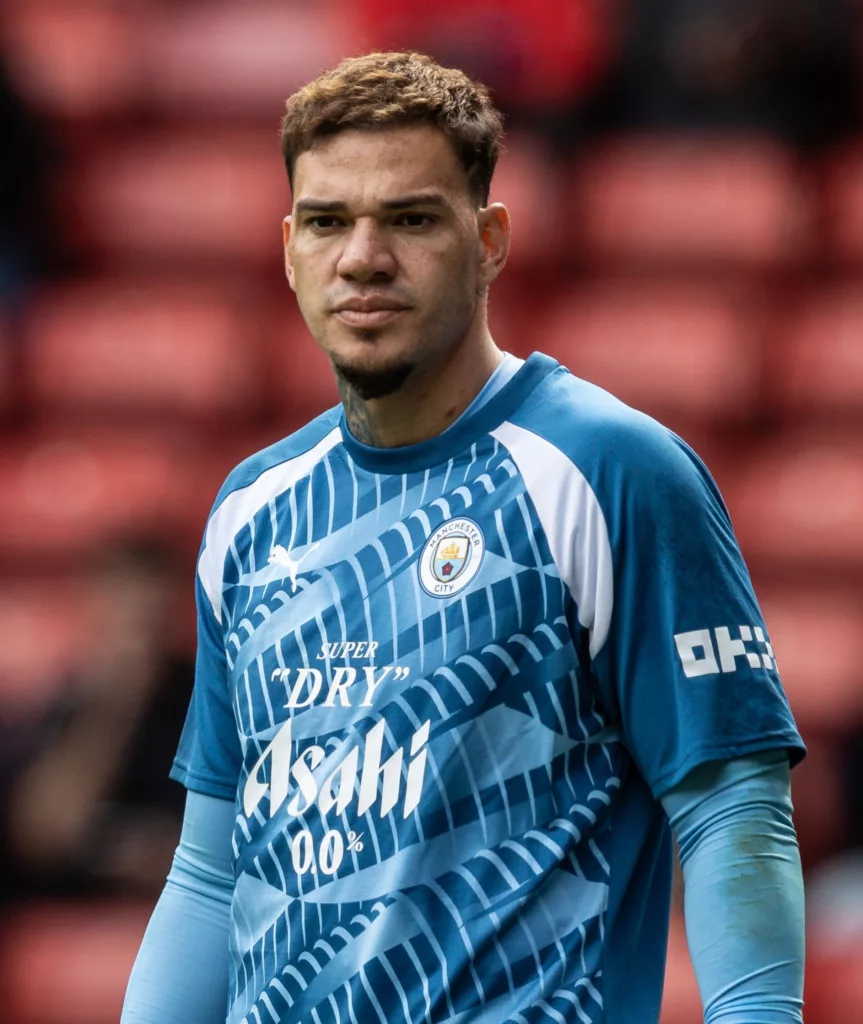
Goalkeepers now frequently opt for shorter passes, with the frequency of such passes being two to three times higher than it was 16 years ago. This emphasizes a notable change in distribution tendencies among top-level goalkeepers.
These statistics provide strong empirical evidence that the role of goalkeepers in modern football has evolved significantly. They are now expected to not only make crucial saves but also contribute actively to the team’s possession and build-up play, showcasing their adaptability and versatility on the field.
Now, Let’s Explore the Reasons Behind this Transformation
Certainly, every player’s journey is unique, but youth development undeniably plays a pivotal role. Consider the case of Ederson, who initially played as an attack-minded left-back during his childhood but transitioned to goalkeeping because he humorously admitted to being “lazy” outfield. However, his prior experience as an outfield player had already equipped him with the technical skills required for goalkeeping.
Fabian Otte emphasizes that fixating on specific positions at a very young age, such as under-9s, under-10s, or under-11s, might not be ideal. Instead, he suggests that during these early stages of youth development, everyone should have the opportunity to be both a goalkeeper and an outfield player. This approach allows children to naturally develop essential skills by simply playing football and having plenty of ball touches.
This perspective aligns with the beliefs of Frans Hoek, who asserted that children don’t need to specialize as goalkeepers at the age of six. Such early specialization can be limiting. Ederson’s journey illustrates this point vividly, as he shifted from his original path and ultimately became one of the world’s top-rated goalkeepers due to his diversified skills.
Coaching also plays a crucial role in this evolution. As Fabian Otte explains, young goalkeepers are now more accustomed to being involved in play with their feet from an early age. Academy coaches increasingly incorporate goalkeepers into build-up play and team sessions, teaching them to navigate situations like playing out from the back against high-pressing opponents. This indicates significant advancements in training methods, particularly in the academy setting, over the years.


Changing Landscape of Goalkeeper Development: A Shift Towards Versatile ‘Ball-Playing’ Keepers
Aidan Reagh, a technical analyst, scout, and coach who primarily focuses on goalkeepers from grassroots to professional levels, believes that a significant shift has occurred in the appreciation and adoption of new methods in goalkeeper development. Over the past decade, as sweeper keepers became more popular, there has been a noticeable increase in training and coaching curriculum emphasis on various aspects of goalkeeping.
This evolution includes training in intercepting passes, one-on-one defensive abilities, and particularly, ball-playing skills. Aidan observes that most goalkeepers aged between 18 and 21 now profile much closer to the “ball-playing goalkeeper” archetype. While they may not reach the level of players like Ederson or Onana, their strengths align with this category. This transformation offers young goalkeepers a better chance of succeeding at the professional level.
Aidan points out that it’s becoming increasingly rare for players to remain one-club professionals throughout their careers. Players typically move on from the academy, either to higher or lower divisions. As more teams seek technically gifted players who are comfortable with the ball at their feet, those goalkeepers who lack this skill may find their opportunities limited. Even if they excel in shot-stopping and reading the game, the demand for goalkeepers who can contribute to build-up play is on the rise, which may influence the career paths of young goalkeepers.
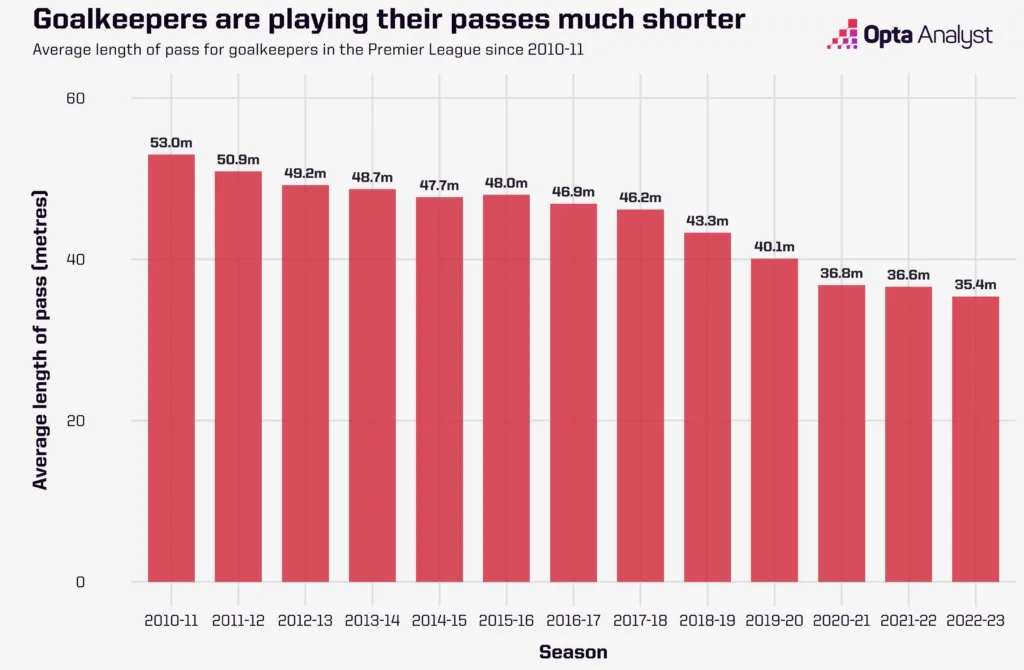
“I genuinely believe that Manchester City wouldn’t have signed Ederson if he were solely a ball-playing goalkeeper,” Fabian remarks with a smile, underscoring an important point. It’s crucial to remember that these players are fundamentally goalkeepers first and foremost. “A goalkeeper must excel in goalkeeping tasks; that’s the primary responsibility,” he emphasizes.
Examining the Premier League as an example over the period of passing data studied, there hasn’t been a substantial decrease in saves made by goalkeepers. In 2007-08, keepers faced an average of 3.05 shots per 90 minutes, and last season, it was 2.90. While there’s a slight decrease, the need to be a proficient shot-stopper remains a significant aspect of the role.

Being a good ball-playing goalkeeper extends beyond simply picking a pass. Practically all top-level goalkeepers possess some level of technical ability; they are professional footballers, after all. If asked to execute a 40-yard pass in a controlled training-ground setting, they would outperform the average person.
However, Fabian emphasizes the complexity of being a world-class ball-playing goalkeeper. It involves considering multiple factors such as positioning, creating space, and decision-making. Goalkeepers must assess the bigger picture, including their proximity to center-backs, the positioning of attackers pressing them, and the marking of midfielders by attackers. Information perception and decision-making play a crucial role in their success, as they must decide how to distribute the ball effectively.
Team training that replicates match scenarios is key to mastering these skills. Fabian commends academies for seamlessly integrating goalkeeper training into broader drills, enhancing a player’s ability to handle pressure and make informed decisions.

This transformation in goalkeeping skills is not a passing phase. Aidan believes that players like Ederson, Alisson, Ter Stegen, and Onana have inspired a new generation of goalkeepers. Consequently, more goalkeepers are entering senior-level football with well-rounded technical abilities in addition to their unique goalkeeping strengths. Data supports this shift, and Fabian wholeheartedly agrees, seeing it as the beginning of a new era for goalkeeping.
In this evolving landscape, goalkeepers must adapt or face challenges, as seen in the case of David de Gea.
Read More: Manchester United delay Antony’s return to first team after domestic violence allegations