Mohun Bagan
 Chennaiyin
 PSG
PSG Lyon
Lyon Sevilla
 Osasuna
 NED
NED OMA
OMA NZ
NZ IND
IND NAM
NAM IRE
IRE PAK
PAK SL
SL SA
SA AUS
AUS BAR1
BAR1 RMA2
RMA2 UDI0
UDI0 MIL2
MIL2 RSO2
RSO2 LEV1
LEV1 LEC0
LEC0 JUV2
JUV2 BRB60/3 (7.3/15 ov)
 MOW
MOW NZ-A317
 IND-A113 & 234/4 (67.3 ov)
 SYL280/2 (84 ov)
 KHU
KHU MYMS465/7d
 CHATT134/2 (40 ov)
 DHA521
 RAJ103/6 (26 ov)
 RAN402
 BAR179/3 (56.1 ov)
 LUL
LUL SPR
SPR TOK
TOK MIS
MIS MEX-W51 (12.5/20 ov, target 187)
 ARG-W186/7
 NGA148
 UGA147/9 (20 ov, target 149)
 GMB112/9
 LES109 (19.5/20 ov, target 113)
 MOZ110/7 (19/20 ov, target 110)
 ZMB109/9
 IND-W328/6
 ZIM-W207 (48.5/50 ov, target 329)
 ENG241
 Abha
Abha Al Faisaly
 LAFC
LAFC LA
LA Neftchi Fergana
 Al Ittihad
 Besiktas
 Istanbul BB
 Caykur Rizespor
 Trabzonspor
 SUN0
SUN0 LEE0
LEE0 SCF1
SCF1 MUN3
MUN3
Ten years and one month ago, Thomas Tuchel was sitting in the dugout at the Olympiastadion in Berlin, having just watched his Borussia Dortmund side draw 0-0 with Pep Guardiola’s Bayern Munich after 120 minutes of the DFB-Pokal final.
He was 42 years old, in his first season at Dortmund, desperate to prove himself as one of football’s sharpest young managers. The tactical battle with Guardiola had been everything he had hoped for — a chess match of constant adjustment, structural shifts and counter-moves that left both teams exhausted. “We prepared everything in this match,” Tuchel would later recall. “We needed to twist the tactics, they twisted the tactics. We twisted the structure, he twisted the structure. It was like a fight.”
There was just one problem.
“The whistle went and I was just not prepared,” he said. “I forgot to prepare for a penalty shoot-out.”
What followed was a frantic scramble. Tuchel, one of the most meticulous tactical minds in European football, was reduced to asking his exhausted players whether they would take a penalty, and if so, in what order. Bayern, on the other hand, had a clear list: Vidal, Lewandowski, Kimmich, Müller, Costa. They knew exactly what to do.
Sven Bender and Sokratis Papastathopoulos both missed. Dortmund lost. Tuchel was devastated.
“A very painful experience and a big, big scar on me, because I felt really, really badly that I had let myself down,” he said. “It was the first time. It will never happen again. So from there, we started our own programme, our own preparation.”
A Decade Later: The Same Spectre, a Very Different Situation
A decade on from Berlin, the spectre of penalties looms over Tuchel again at World Cup 2026. He is no longer a 42-year-old proving himself at a German club. He is a 52-year-old at the top of the game, trying to guide England to a second World Cup triumph.
On the evening before England flew to Atlanta for their last-32 meeting with DR Congo, both Germany and the Netherlands were eliminated from World Cup 2026 on penalties. The reminder was vivid. Shootouts are not a theoretical risk at this stage of the tournament. They are a live and constant possibility.
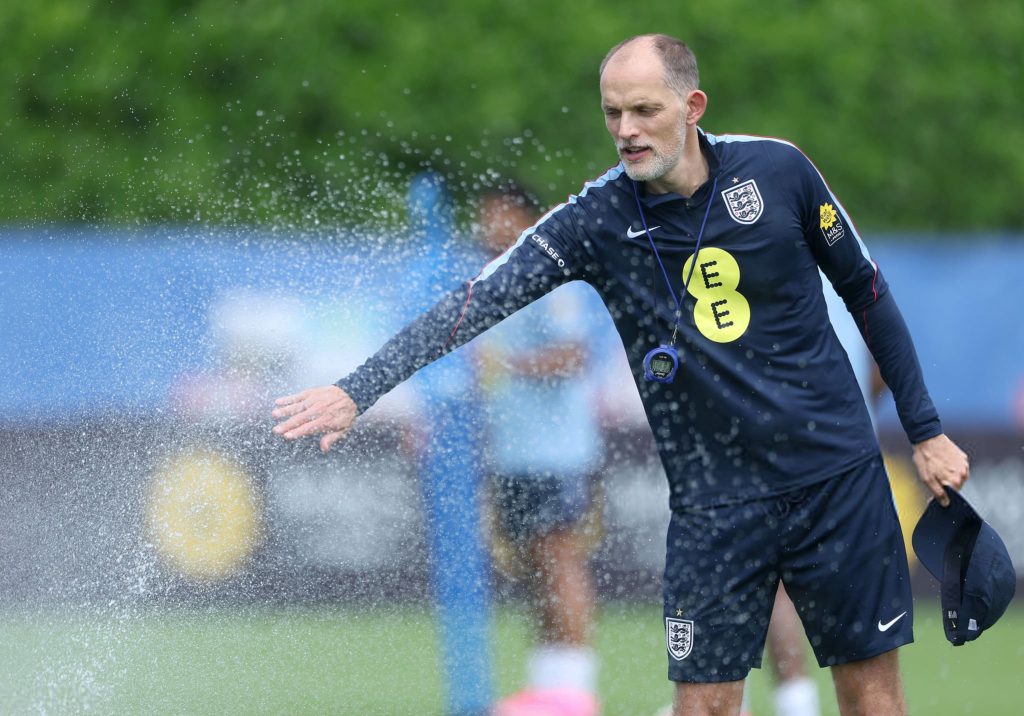
The difference now, Tuchel is at pains to point out, is that he is not relying on himself alone. When he took over the England job, he inherited something he had never had access to before: a well-established, high-functioning, institutionally embedded penalties programme — built by the Football Association over the best part of a decade.
“Now I go into the FA and I have — on the highest level, since years and years — a penalty programme that is so easy just to pick up and wait for people to tell me who are the best shooters,” he said. “We trained it. We have a process in place. So we are prepared.”
England’s Penalty Turnaround: From Trauma to Process
The transformation in England’s penalty record over the past decade has been one of the quiet but significant success stories of the national team’s recent history.
England’s Penalty Shootout Record at Major Tournaments
| Year | Tournament | Opponent | Result |
|---|---|---|---|
| 1990 | World Cup SF | West Germany | Lost |
| 1996 | Euro SF | Germany | Lost |
| 1998 | World Cup R16 | Argentina | Lost |
| 2004 | Euro QF | Portugal | Lost |
| 2006 | World Cup QF | Portugal | Lost |
| 2012 | Euro QF | Italy | Lost |
| 2018 | World Cup R16 | Colombia | Won |
| 2019 | UEFA Nations League | Switzerland | Won |
| 2021 | Euro Final | Italy | Lost |
| 2024 | Euro QF | Switzerland | Won |
The losses accumulated over decades created a national mythology around England and penalties — the idea that they were constitutionally incapable of winning shootouts. What changed that narrative was not luck. It was process.
The 2018 win over Colombia in Moscow remains a watershed moment. Jordan Pickford’s save from Carlos Bacca — still considered one of England’s greatest World Cup moments — combined with Eric Dier’s decisive conversion to end a 22-year wait for a penalty shootout win at a major tournament. The FA had done the groundwork. The players had practised, prepared and arrived at that moment with a clear plan.
Tuchel acknowledged the institutional depth he inherited. “We have assistant coaches, we have background staff who just set one of the best programmes in place that I have witnessed. So we know exactly what is going to happen. And the platform is there.”
Declan Rice: “The Best Crop of Penalty-Takers England Have Ever Had”
Speaking to reporters at England’s Kansas City training camp, Declan Rice was unambiguous in his assessment of where this squad stands.
“I look at this group now, I don’t think there’s a better crop of penalty-takers that England have probably ever had,” he said.
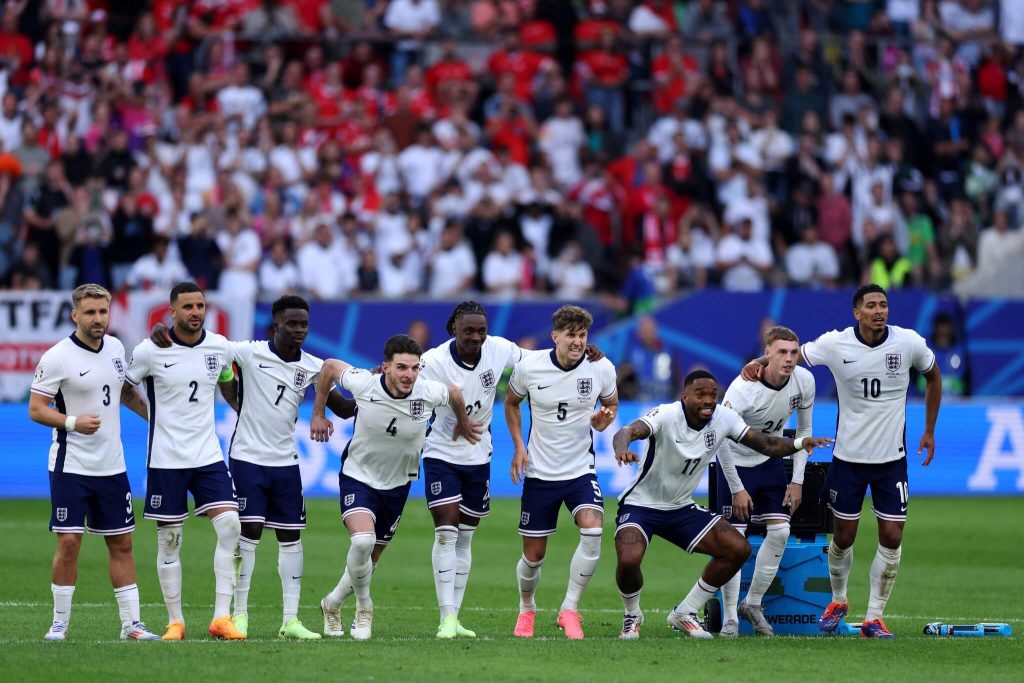
He rattled off names: Harry Kane, Ivan Toney, Marcus Rashford, Anthony Gordon, Bukayo Saka, Jude Bellingham and himself. It is a list that, on paper, compares favourably with any England squad in recent memory.
England’s Likely Penalty Takers at World Cup 2026
| Player | Club | Notable Penalty Record |
|---|---|---|
| Harry Kane | Bayern Munich | Prolific from the spot; among the most reliable in world football |
| Ivan Toney | Club | Brought to the squad primarily for shootout scenarios |
| Marcus Rashford | Manchester United | Experienced at club level; missed at Euro 2020 final |
| Bukayo Saka | Arsenal | Missed at Euro 2020; has since rebuilt his record |
| Jude Bellingham | Real Madrid | Technically accomplished; physically dominant |
| Declan Rice | Arsenal | Confident taker; part of England’s rehearsed order |
| Anthony Gordon | Newcastle United | Club-level record supports inclusion |
Rice spoke specifically about Kane’s approach from the spot — the repetitions he puts in during training, the certainty he carries into the moment. “It’s the confidence he goes in with,” Rice said, emphasising that Kane’s penalty-taking is not a casual addition to his game but a practised and refined skill.
Rice also raised an interesting technical detail about the Trionda ball being used at World Cup 2026. “With these balls as well, from 12 yards, if you hit it hard and well, I feel like, for keepers, it’s tough to save. If you put them in the corners, it’s really tough.” The implication is that England’s takers have done their homework on the specific characteristics of the tournament ball — another layer of preparation that earlier England sides would not have had access to.
Pickford: Confidence From Both Sides of the Ball
For Jordan Pickford, the shootout presents a different kind of challenge. England’s first-choice goalkeeper joked after the 2-0 win over Panama that he was now “down the pecking order” for taking a penalty — a reference to the depth of reliable takers ahead of him.
But his role in any shootout is clear, and he carries genuine belief in his ability to perform it.
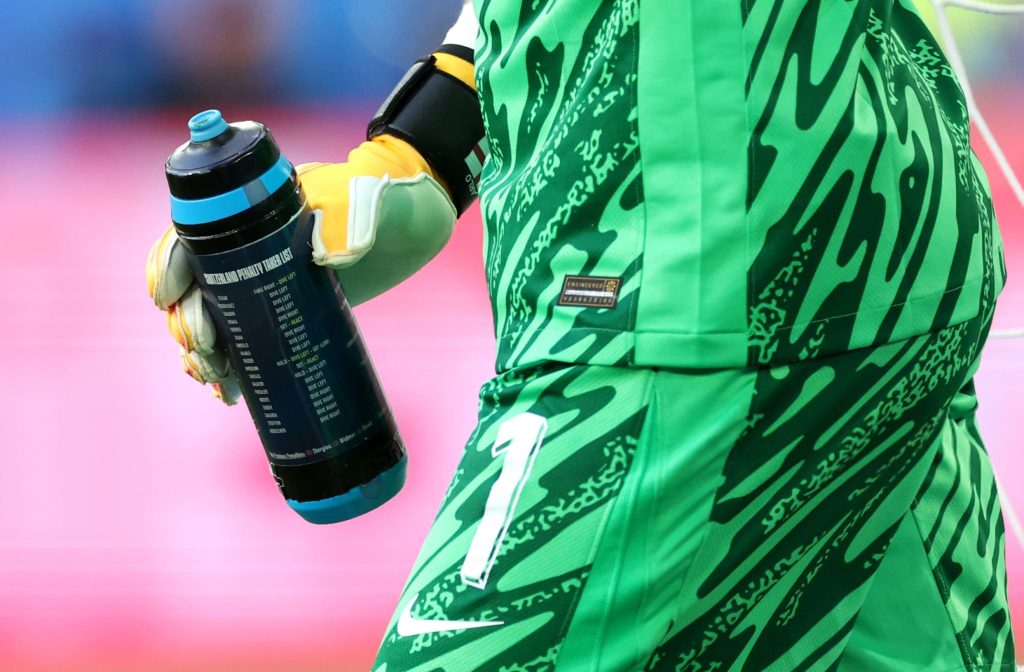
His save from Carlos Bacca in Moscow in 2018 is the reference point — a stop made possible partly by research into Bacca’s tendencies and partly by Pickford’s own athleticism and composure under pressure. The preparation that went into that save was not accidental. It reflected the same institutional approach that England have continued to develop in the years since.
“It’s all about belief and believing in each other,” Pickford said. “They have confidence I can save a penalty. I have confidence they can score them. But we want to be winning the game, we don’t want to go to penalties.”
That last sentence matters. England’s confidence in their shootout preparation does not reflect a desire to reach one — it reflects a determination to be ready if the tournament forces the issue.
Tuchel’s Own Shootout History: A Story of Growth
Tuchel’s honesty about the 2016 DFB-Pokal final has become the defining story of his penalty evolution. But it is not the only chapter.
His Chelsea side were involved in two memorable shootouts in the 2021-22 domestic cup finals against Jürgen Klopp’s Liverpool, and both were lost. The Carabao Cup shootout in particular was an extraordinary affair — every single outfield player scored until goalkeeper Kepa Arrizabalaga stepped up and missed, handing Liverpool an 11-10 win.
Tuchel’s Penalty Shootout Record as a Manager
| Year | Competition | Clubs | Result | Notable Detail |
|---|---|---|---|---|
| 2016 | DFB-Pokal Final | Dortmund vs Bayern | Lost | Tuchel forgot to prepare; two misses |
| 2022 | Carabao Cup Final | Chelsea vs Liverpool | Lost | Every player scored until Kepa missed; 11-10 |
| 2022 | FA Cup Final | Chelsea vs Liverpool | Lost | Second domestic cup final lost on penalties in same season |
The experience was not wasted. “I had crazy penalty shootouts,” Tuchel acknowledged. “So it is what it is. But now, it is on the highest level at the moment, thanks to the FA of course, and thanks to my development. It is just another example that you sometimes have to have a painful experience to understand where to get better.”
That progression — from scrambling to ask players whether they wanted to take a penalty in Berlin to inheriting and building upon one of the most sophisticated shootout programmes in international football — is a genuine evolution.
What “Being Prepared” Actually Means
The phrase “penalty programme” can sound abstract. In practice, England’s preparation operates across several concrete dimensions.
Takers practise their penalties repeatedly in training, under conditions designed to replicate the pressure of a shootout as closely as possible. The order is established in advance, not decided in the moment of exhaustion after 120 minutes. Background staff — analysts, sports psychologists and coaching assistants — contribute data on opposition goalkeepers: their tendencies, their preferred sides, their movement patterns.
The Trionda ball used at World Cup 2026 has been incorporated into that preparation. England’s takers know how it behaves at pace. They know the corners. They have rehearsed the execution specific to this tournament.
None of it is a guarantee. Tuchel knows that better than most. “Even the best penalty process in the world, or the best penalty takers, is no guarantee of anything,” he said plainly.
But the gap between going into a shootout with a clear, practised, data-informed plan and going into one without — as Tuchel did in Berlin in 2016 — is enormous. England are firmly on the right side of that gap at World Cup 2026.
The Bigger Picture: Process Over Fate
For much of England’s penalty history, shootouts felt like something that happened to them — a force of nature, random and cruel, against which preparation was irrelevant. The narrative of the cursed nation was self-reinforcing. Players stepped up carrying the weight of decades of failure.
The work done by the FA over the past decade has systematically dismantled that narrative. The wins over Colombia in 2018 and Switzerland in 2024 were not flukes. They were the product of a programme that treats penalty-taking as a coachable, trainable and improvable skill rather than a matter of nerve and fortune.
Tuchel has arrived at the top of that programme at a moment when the squad’s technical quality from the spot may be the strongest it has ever been. Whether England need to use it at World Cup 2026 remains to be seen. But for the first time in a long time, the answer to the question of whether England are ready is an unambiguous yes.
Read More: Why Harry Kane and Jude Bellingham Remain England’s Most Important Partnership