ST-W
 BH-W178/5 (20 ov)
 NZ
 IND
 NAM
 IRE
 Como
 Venezia
 Mumbai City
 SC Delhi
 Getafe
 Sevilla
 WI-A
 LIONS
 Frosinone
 Torino
 Lazio
 Cagliari
 AVL1
 FUL1
 BAR6
 ALA1
 MIL3
 INT1
 TRY2
 MNS0
 ENG95/6 (6 ov)
 SA
 NZ-A218/3 (62 ov)
 IND-A346
 QLD152/4 (54.1 ov)
 VIC307
 DHA
 BAR
 SYL218
 CHATT64/1 (15 ov)
 MYMS
 KHU280/8 (82 ov)
 RAN
 RAJ155/6 (59 ov)
 AFG
 ZIM
 NED
 OMA
 SS-W
 HH-W
 MS-W
 PS-W
 PAK
 SL325/8
 UAE266/5 (49/50 ov, target 264)
 MR-W136/6
 AS-W185/2
 SCOT135/1
 HKG119/0
 Strasbourg
 Auxerre
 Inter Kashi
 GOA
 Union Berlin
 Cologne
 HIL2
 FAT0
 TOT2
 CRY0
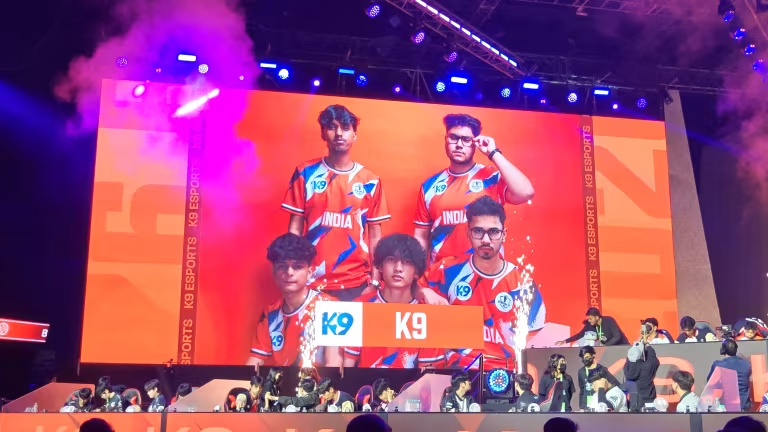
India has six teams at BMIC 2026: K9, OR, GDR, SOUL, 8BIT, and BLEC. Between them they have won four of the 12 chicken dinners played so far, and none of them sit above fifth on the overall table. The talent is visible in individual performances and in several strong matches. What the event has exposed is a gap in finishing games: keeping the lead through the endgame, converting late-game fights into placement, and playing with the patience that wins matches.
BMIC 2026: Where the Indian Teams Stand
| Team | Wins (WWCD) | Finish Points | Position Points | Total | Overall Rank |
|---|---|---|---|---|---|
| OR | 1 | 55 | 28 | 83 | 5 |
| GDR | 1 | 58 | 21 | 79 | 6 |
| K9 | 2 | 51 | 27 | 78 | 7 |
| SOUL | 0 | 55 | 17 | 72 | 9 |
| 8BIT | 0 | 45 | 25 | 70 | 10 |
| BLEC | 0 | 31 | 15 | 46 | 14 |
Three Indian teams sit in the top seven, which shows real competitiveness. But the table also shows the gap. None of the six is in the top four, and the Korean teams above them have far more position points. OR’s 28 position points are the most of any Indian team, and that is less than half of NS’s 53.
Indian teams have four chicken dinners, which puts them ahead of Japan’s one but well behind Korea’s seven. The Indian wins came from K9 on Rondo in Match 7 and on Miramar in Match 5, OR on Erangel in Match 2, and GDR in Match 10 or 11. Every other Indian team is still waiting for its first chicken dinner.
Strong Moments That Did Not Turn Into Wins
Several Indian teams have shown they can compete with the best. K9 finished second in Match 9 with nine finishes and 14 points and went on to win Match 7 with seven finishes and 1,172 damage. Their Match 7 squad had strong damage spread across all four players, with K9XSAUMRAJJ at 383 and K9XTAURUSS06 at 358.
SOUL have the second-highest finish total among the Indian teams at 55, and their Match 12 performance (two finishes, six position points, eight total points) showed they can place well when they survive. 8BIT produced seven finishes in Match 12 and seven in Match 7, a sign of aggressive play. The problem was that those finishes did not convert into position points: 8BIT managed only one position point in Match 12.
Individual players have also stood out. Among the top five players of Match 7, Indian players appeared on the board with strong damage and finishes, and K9XTAURUSS06 sits fifth on the MVP ranking with a rating of 2.41, 21 finishes, and 4,270 damage.
The Endgame Problem
The clearest pattern across Indian teams is the endgame. A team can finish many players in a match and still lose the chicken dinner. Finishing a game means staying alive until the last circle, and the position points show who managed it.
Compare two teams in Match 12. 8BIT had seven finishes and one position point, which left them with eight points. SOUL had two finishes and six position points, which put them third on the match table. SOUL’s approach collected more value from fewer kills because they stayed alive and placed well. 8BIT’s approach produced more finishes but did not hold the late game.
Across the event, Indian teams’ position points tell the same story. The six Indian teams have 133 position points between them, against 152 for the four Korean teams in the top group. More important, the Korean teams have collected position points across more of their matches, rather than in a few standout games.
The data is consistent with what the phrase “lacking patience” describes: a team that wins fights early and then loses its discipline when only a few players remain, or that presses for kills when staying back and surviving would have earned more points. The statistics show the outcome of that. The specific decisions behind it would need the live streams or replays to confirm.
Teamwork and Strategy
Teamwork shows up in the numbers as the spread of damage and finishes. In Korean winning matches, the damage is shared across the squad: NS in Match 12 recorded 1,018, 682, 493, and 405 damage from its four players. Teams that win often tend to have several players who can take on fights, not one player carrying the match.
Several Indian squads have the individual players to compete. The question for them is how to use those players together through the whole match, from rotations and early-game positioning to the final circle. The statistics cannot show how each team plans its rotations or calls its fights, and those are the details that would tell us whether strategy or execution is the main gap.
Inconsistency Across the Event
Inconsistency is the other pattern. K9 won Match 5 with 26 points and 16 finishes on Miramar, and then scored no points in Match 6. They came back to win Match 7 and finished second in Match 9, but scored only three points in Match 8. A team that can win one day and score nothing the next has the talent to compete but not yet the reliability to sustain a lead.
OR show the same pattern. They won a match early in Day 1, finished fourth overall after Day 1, and then dropped to 9th in Match 6 with four points. Their Match 12 finish was zero points. Their largest asset, individual damage from players such as ORSLUG (MVP of Match 8 with 695 damage), has not yet been matched by consistent team placement.
What Indian Teams Need to Change
The clearest changes for Indian teams are in the endgame and in consistency. Keeping players alive into the final circle, placing well in matches they do not win, and sustaining their form across days would move the position points that currently separate them from the Korean top group. The finishing is already there. The placement is not.
The gap is not a lack of talent. Three Indian teams are in the top seven, and several individual players are among the strongest on the event’s MVP tables. The difference is in how consistently the teams play from the first circle to the last, and in whether they turn strong fights into finished matches.
For more coverage of BMIC 2026 and other esports events, visit TechnoSports and our gaming section.
Sources:
- PUBG: Battlegrounds on Wikipedia, for background on the maps used in the event
- Battlegrounds Mobile India on Wikipedia, for background on the game and its competitive scene
- Krafton, the publisher behind Battlegrounds Mobile India and Krafton India Esports
FAQs
How many chicken dinners have Indian teams won at BMIC 2026?
India’s six teams have won four of the 12 chicken dinners played so far. K9 won two, while OR and GDR won one each.
Which Indian team has the most chicken dinners at BMIC 2026?
K9 has won two chicken dinners, more than any other Indian team.
Why are Indian teams struggling to win matches at BMIC 2026?
The text identifies endgame survival and placement as challenges. Teams can earn many finishes but lose position points when they do not stay alive late in the match.