PSG
PSG LYON
LYON SEV
SEV OSA
OSA NED
NED OMA
OMA NZ
NZ IND
IND NAM
NAM IRE
IRE PAK
PAK SL
SL SA
SA AUS
AUS Abha
Abha Al Faisaly
 MBSG1
MBSG1 CFC0
CFC0 Barcelona1
 Real Madrid2
 Udinese0
 Milan2
 Real Sociedad2
 Levante1
 NZ-A317
 IND-A113 & 488/8 (119 ov)
 SYL575/4 (167.3 ov)
 KHU
KHU MYMS465/7d
 CHATT424/6 (121 ov)
 DHA521
 RAJ162 & 215/5 (59.1 ov) (f/o)
 RAN402 & 5/0 (2.3 ov)
 BAR443/9d
 SIKM30/1 (15 ov)
 NAGA187
 JHK
JHK DELHI309/5 (90 ov)
 ODSA194
 SVCS13/0 (5 ov)
 BRODA259/6 (86 ov)
 J & K
J & K CHD363/2 (87 ov)
 HP
HP CGR35/1 (14 ov)
 AP231
AP231 HYD
HYD PNJB289/6 (90 ov)
 BAN
BAN WI
WI BRB
BRB MIS
MIS BIK
BIK CHR
CHR MEX-W51 (12.5/20 ov, target 187)
 ARG-W186/7
 NGA148
 UGA147/9 (20 ov, target 149)
 GMB112/9
 LES109 (19.5/20 ov, target 113)
 MOZ110/7 (19/20 ov, target 110)
 ZMB109/9
 IND-W328/6
 ZIM-W207 (48.5/50 ov, target 329)
 ENG241
 KBH0
KBH0 OBK0
OBK0 UAI0
UAI0 VSC0
VSC0 Sassuolo
 Lazio
Lazio AS Roma
 Cagliari
 Torino
 Como
Como QAD
QAD ALS
ALS AQAJ
AQAJ PAK
PAK Lecce0
 Juventus2
 Sunderland0
 Leeds0
In a heartwarming pre-budget ritual, President Droupadi Murmu fed Finance Minister Nirmala Sitharaman dahi cheeni (curd and sugar) at Rashtrapati Bhavan before her record ninth consecutive budget presentation. This traditional good luck gesture marks a historic moment as India witnesses its first-ever Sunday budget since independence—breaking 77 years of convention.
Budget 2026: Key Highlights at a Glance
| Aspect | Details |
|---|---|
| Presentation Date | February 1, 2026 (Sunday) |
| Finance Minister | Nirmala Sitharaman |
| Budget Number | 9th consecutive |
| Speech Time | 11:00 AM in Parliament |
| Historic Significance | First Sunday budget in independent India |
| Focus Areas | Growth, manufacturing, job creation, fiscal discipline |
| Special Event | Stock market opens on Sunday |
The Dahi Cheeni Tradition: More Than Just Ritual
Before departing for Parliament, Sitharaman visited Rashtrapati Bhavan where President Murmu personally fed her the auspicious dahi cheeni—a centuries-old Indian tradition symbolizing sweet beginnings and positive outcomes. This customary practice is believed to ward off obstacles and invite prosperity, making it a fitting prelude to crucial national financial decisions.
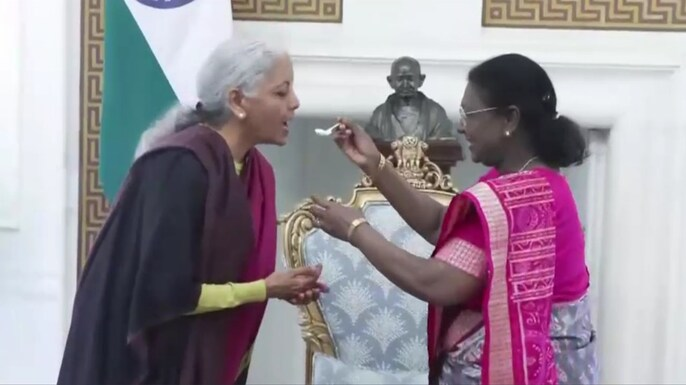
Adding cultural elegance to the occasion, the Finance Minister donned a stunning Kanjeevaram saree from Tamil Nadu—a strategic fashion choice as the southern state heads for assembly polls in coming months, where BJP has long sought electoral success.
Why Sunday? Breaking 77 Years of Precedent
This marks only the second time in Indian fiscal history that a budget is presented on Sunday. The previous instance occurred on February 28, 1999, when Yashwant Sinha delivered the budget during Atal Bihari Vajpayee’s NDA government. The unusual timing triggered a special Sunday trading session, creating unprecedented volatility for retail investors.
What’s Expected: Growth vs. Fiscal Discipline Balancing Act
Against the backdrop of US President Donald Trump’s sweeping tariffs and geopolitical uncertainties, Sitharaman faces the challenge of:
- Boosting consumption amid sluggish demand
- Manufacturing support and trade reforms through streamlined customs framework
- Job creation through employment-linked incentives
- Capital expenditure while maintaining decreasing fiscal deficit path
- Cross-sector reforms simplifying regulations and strengthening domestic production
Congress president Mallikarjun Kharge criticized the economy as being in “unprecedented mess,” questioning whether the budget offers real solutions to “multiple economic indicators in free fall.” The government can no longer hide behind “legacy” excuses after 12 years in power, he stated.
For detailed analysis on India’s economic reforms and budget impact on various sectors, explore our comprehensive coverage.
Focus on Part B: Long-Term Reform Roadmap
Unlike typical budgets emphasizing immediate tax relief, Budget 2026 is expected to prioritize Part B—featuring long-term economic goals, policy reforms, and trade competitiveness measures. Trade and customs reforms will prominently shield India from global trade pressures while improving ease of business domestically.
Middle-class tax relief expectations remain modest this year, with wishlists shorter and mood measured compared to previous budget seasons.
FAQs
Q: Why is Budget 2026 being presented on Sunday?
A: This is the first Sunday budget in independent India’s 77-year history, allowing uninterrupted parliamentary proceedings—the last Sunday budget was in 1999 under Yashwant Sinha.
Q: What is the significance of President Murmu feeding dahi cheeni to FM Sitharaman?
A: Dahi cheeni is a traditional Indian ritual symbolizing sweet beginnings and prosperity, believed to ward off obstacles before important endeavors like budget presentations.