Mohun Bagan
 Chennaiyin
 PSG
PSG Lyon
Lyon Sevilla
 Osasuna
 NED
NED OMA
OMA NZ
NZ IND
IND NAM
NAM IRE
IRE PAK
PAK SL
SL SA
SA AUS
AUS BAR1
BAR1 RMA2
RMA2 UDI0
UDI0 MIL2
MIL2 RSO2
RSO2 LEV1
LEV1 LEC0
LEC0 JUV2
JUV2 BRB
BRB MOW
MOW NZ-A317
 IND-A113 & 197/2 (55 ov)
 SYL280/2 (84 ov)
 KHU
KHU MYMS465/7d
 CHATT134/2 (40 ov)
 DHA521
 RAJ103/6 (26 ov)
 RAN402
 BAR179/3 (56.1 ov)
 LUL
LUL SPR
SPR TOK
TOK MIS
MIS MEX-W51 (12.5/20 ov, target 187)
 ARG-W186/7
 NGA148
 UGA147/9 (20 ov, target 149)
 GMB112/9
 LES109 (19.5/20 ov, target 113)
 MOZ110/7 (19/20 ov, target 110)
 ZMB109/9
 IND-W328/6
 ZIM-W207 (48.5/50 ov, target 329)
 ENG241
 LAFC
LAFC LA
LA Neftchi Fergana
 Al Ittihad
 Besiktas
 Istanbul BB
 Caykur Rizespor
 Trabzonspor
 Al Ahli
 Al-Gharafa
 SUN0
SUN0 LEE0
LEE0 SCF1
SCF1 MUN3
MUN3
The All India Football Federation (AIFF) has unveiled a proposed participation framework for the I-League that fundamentally reshapes how India’s second-tier competition could be governed and commercialized. Unlike the centralized approach adopted for the Indian Super League, this framework positions clubs at the heart of decision-making while limiting the federation’s role primarily to regulation and compliance.
The proposal, covering the 2025-26 season and a subsequent 20-year term, remains non-binding but offers unprecedented clarity on how the AIFF envisions the future of the I-League as a club-driven competition operating within the federation’s regulatory framework.
Core Principles of the Framework
The I-League will remain fully owned and operated by the AIFF while functioning as an open pyramid system with promotion and relegation intact. However, the critical difference lies in governance structure. A newly created League Governance Board will grant participating clubs collective control over commercial and operational decisions, marking a significant departure from traditional federation-controlled models.
| Framework Elements | Details |
|---|---|
| Ownership | 100% AIFF |
| Duration | Year 0 (2025-26) + 20 years |
| Governance Model | Club-led through League Governance Board |
| Competition Format | Open pyramid with promotion/relegation |
| AIFF Veto Powers | Limited to integrity, compliance, discipline |
League Governance Board: Power to the Clubs
Every participating I-League club will nominate one representative to the League Governance Board, with each club holding one vote. The Board’s Chairperson will either be an AIFF office-bearer or an independent member appointed in consultation with clubs.
The Board will exercise operational autonomy over broadcast rights, digital and media rights, sponsorship deals, marketing, branding, and financial planning. Crucially, these decisions will not require routine AIFF approvals, though they must comply with federation statutes.
This represents a fundamental shift in Indian football governance, placing commercial control directly in the hands of participating clubs rather than the national federation.
AIFF’s Limited Veto Rights
The framework explicitly defines where the AIFF can and cannot intervene. The federation may exercise veto powers exclusively on matters relating to sporting integrity, regulatory compliance, and disciplinary jurisdiction.
The proposal clearly states that the AIFF will not exercise veto, approval, or intervention rights over broadcast rights, digital or media rights, sponsorship arrangements, marketing and branding, or commercial exploitation of the league. This creates a clean separation between regulatory oversight and commercial operations.
| AIFF Can Control | AIFF Cannot Control |
|---|---|
| Sporting integrity | Broadcast rights |
| Regulatory compliance | Digital/media rights |
| Disciplinary matters | Sponsorship deals |
| Match officials | Marketing and branding |
| Anti-doping measures | Commercial operations |
Commercial Rights and Master Rights Agreement
The League Governance Board will hold exclusive rights to negotiate and execute a Master Rights Agreement covering broadcast, digital, sponsorship, and commercial exploitation of the I-League. While the AIFF maintains oversight, it will not control approval decisions.
This arrangement empowers clubs to collectively determine the commercial destiny of the competition, a stark contrast to models where federations retain final authority over revenue-generating agreements.
Financial Structure and Revenue Distribution
The I-League will operate on a central cost-recovery model through a Central Operational Budget covering league operations, broadcast production, marketing, prize money, match officials, and compliance costs. This budget must be approved by the League Governance Board and will be recovered before any revenue distribution occurs.
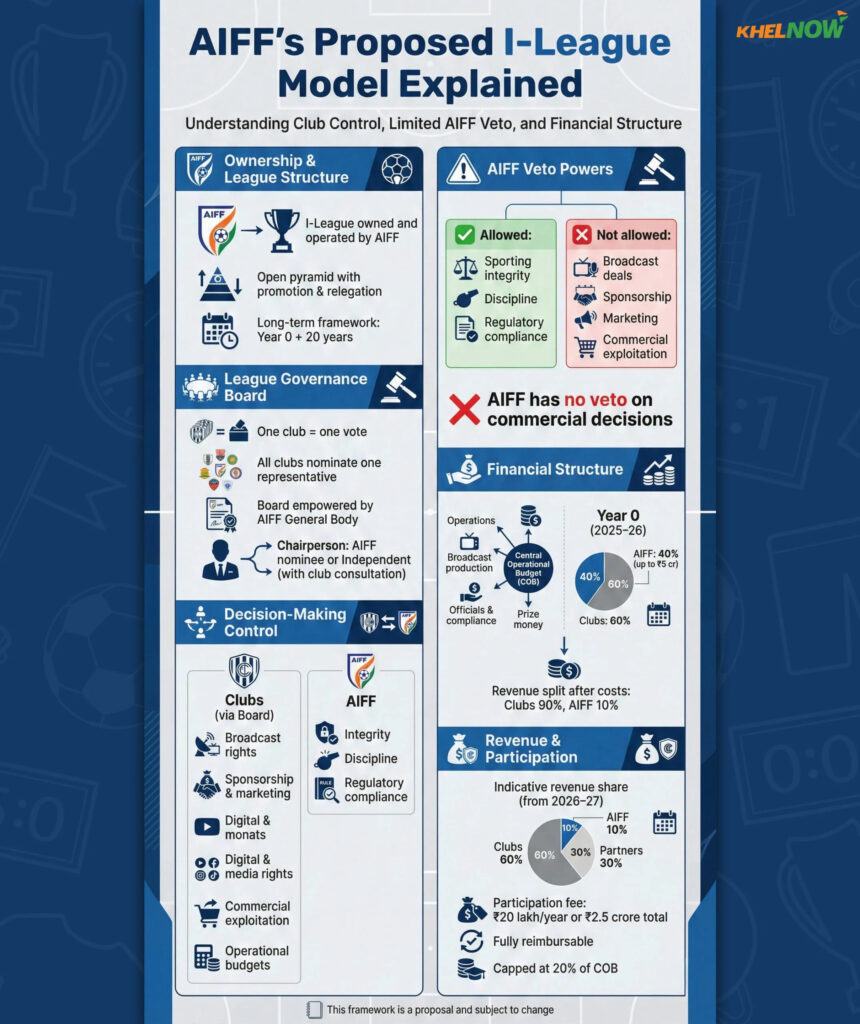
For the 2025-26 transitional season, the AIFF will underwrite 40 percent of league expenses, capped at five crore rupees, while clubs collectively cover the remaining 60 percent. After expenses, 90 percent of revenue goes to clubs with 10 percent retained by the AIFF.
From the 2026-27 season onward, the indicative revenue split changes significantly. Clubs will receive 60 percent, the AIFF 10 percent, and commercial or equity partners 30 percent of total revenues.
| Season | Clubs | AIFF | Partners | Expense Split |
|---|---|---|---|---|
| 2025-26 (Year 0) | 90% (post-expense) | 10% (post-expense) | N/A | AIFF 40%, Clubs 60% |
| 2026-27 onwards | 60% | 10% | 30% | TBD by Board |
Participation Fees and Compliance
Clubs will pay an annual participation fee of 20 lakh rupees or collectively contribute 2.5 crore rupees, capped at 20 percent of the Central Operational Budget. Importantly, these fees are fully reimbursable from central revenue, ensuring clubs are not financially penalized for participation.
Clubs must comply with licensing norms and competition regulations, while the AIFF retains responsibility for appointing match officials and ensuring integrity and anti-doping standards.
How This Differs from the ISL Model
The contrast with the AIFF’s proposed ISL governance framework is striking. While the I-League framework grants clubs extensive commercial and operational autonomy with strictly limited federation veto powers, the ISL model maintains far more centralized control within the AIFF.
This divergence raises important questions about the AIFF’s vision for governance across different tiers of Indian football. The I-League proposal suggests a willingness to embrace club-led governance at the second tier, while retaining tighter control over the top-tier ISL.
The two distinct philosophies reflect different approaches to risk, autonomy, and commercial control that will likely shape negotiations with clubs in the coming months.
Implementation Timeline
The framework remains non-binding until definitive agreements are signed, including Participation Agreements, League Regulations, the Master Rights Agreement, and Financial and Governance Charters. Clubs are currently reviewing the proposal, with discussions expected to continue in the coming weeks.

The 2025-26 season is positioned as a stabilization period, designed to establish operational structures and financial viability rather than maximize immediate profits. The subsequent 20-year term signals the AIFF’s commitment to long-term sustainability for the I-League.
Read More: ISL Clubs Retain Asian Competition Eligibility Despite Truncated 13-Match Season