
 SA329 (82.3 ov)
 AUS
 BAN
 WI
 IND-W
 ZIM-W
 GOA
 SC Delhi
 Milan
 Bologna
 Parma
 Udinese
 Venezia
 Inter Milan
 Genoa
 Juventus
 Monza
 Napoli
 ROMA4
 CAG2
 TOR1
 COMO3
 SAS2
 LAZ6
 AFG177
 ZIM140 (19.1/20 ov, target 178)
 AUCK
 CANT
 CD
 ND
 SIKM184
 NAGA187 & 58/4 (42.2 ov)
 JHK131/4 (47 ov)
 DELHI515/5d
 ODSA194
 SVCS13/0 (5 ov)
 BRODA616
 J & K6/0 (4 ov)
 CHD685/5d
 HP49/0 (14 ov)
 CGR216/8 (95 ov)
 AP231
 HYD193/2 (54 ov)
 PNJB431
 KNTKA297/7 (95 ov)
 TPURA194
 KER101/6 (35 ov)
 BENG350
 UAE
 OMA
 ENG
 SL
 DEN
 QAT
 KENYA
 KUW
 POA
 SPR
 PAK110
 NAM316/7
 IRE253 (44.5/50 ov, target 317)
 NZ198/3
 IND199/4 (13.2/20 ov, target 199)
 NED371/5
 JAB113 (19.3/20 ov, target 133)
 KAY132/9
 Al Khaleej
 Al Hazem
 Gamba Osaka
 Buriram
 ABH0
 ALF1
 Sevilla2
 Osasuna0
 PSG2
 Lyon0

Bharatnet stands as the cornerstone of India’s digital transformation, aiming to bridge the connectivity divide by bringing high-speed broadband to 600,000 villages.
Originally launched in October 2011 as the National Optical Fibre Network (NOFN), it was later rebranded to its current identity. This government-owned infrastructure project is managed by Bharat Broadband Network Limited (BBNL) under the Department of Telecommunications. Bharatnet plays a crucial role in shaping this narrative.
Initially, the focus was on establishing foundational fiber connectivity. However, the project has evolved into a massive, multi-modal initiative aimed at ensuring that rural India participates in the global digital economy. You can’t overlook the significance of Bharatnet in this context.
The financial scale of this initiative is enormous, with the Indian government allocating over ₹42,000 crore through the Universal Service Obligation Fund (USOF). This investment supports an extensive network that, as of 2024, has seen over 600,000 kilometers of optical fiber laid across the nation. Right now, the landscape for Bharatnet is changing quickly.
The goal is straightforward: provide broadband speeds of at least 100 Mbps at every Gram Panchayat connection point. By using a smart mix of optical fiber, radio, and satellite technologies, the project effectively navigates geographic barriers that have historically hampered internet access in remote, mountainous, and forested areas.
| Metric | Project Status |
|---|---|
| Primary Objective | 600,000 Villages |
| Minimum Speed | 100 Mbps |
| Funding Source | USOF (₹42,000 crore) |
| Infrastructure | Fiber, Radio, Satellite |
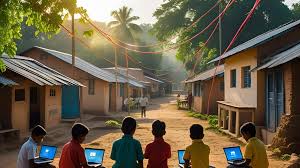
Bharatnet: Implementation Strategies and Public-Private Partnerships
A shift in strategy back in 2022 marked a crucial turning point for the project’s long-term sustainability. The Cabinet approved a revamped model that focuses on Public-Private Partnership (PPP) frameworks to speed up implementation across 16 states. (Source: The Verge)
By involving the private sector, BBNL aims to enhance maintenance standards and service delivery. These were identified as bottlenecks in earlier phases of the rollout. This collaborative approach allows for better management of the local loop, ensuring that the fiber reaches end-users instead of just connecting to the village council office.
Not everyone agrees on the current pace of deployment. Critics often point to challenges like last-mile connectivity and the maintenance of local infrastructure. Still, the data shows that the sheer scale of the network is unmatched, offering a strong foundation for other digital initiatives, like Jio-Google digital partnerships and potential advancements in localized AI integration.
The PPP model must adapt to meet the growing demand for data-heavy applications in rural areas. The combination of private operational agility with government-funded infrastructure is the only viable way to achieve full saturation. (Source: TechCrunch)
As the project matures into 2026, the focus is shifting toward improving service quality and reliability. While large infrastructure projects often encounter delays, the current roadmap for Bharatnet suggests that the next phase will emphasize optimizing existing links and integrating satellite-based backhaul for the most remote areas.
These developments will likely align with broader national goals, such as the next-gen launch vehicle initiatives, which could enhance satellite communications for underserved regions. Users can expect better uptime and more consistent bandwidth as the PPP model kicks in across the remaining states.
FAQs
Bharatnet: What is the primary goal of Bharatnet?
The primary goal is to provide high-speed broadband connectivity of at least 100 Mbps to 600,000 Gram Panchayats and villages across India.
How is the Bharatnet project funded?
The project is funded by the Indian government through the Universal Service Obligation Fund (USOF), with total allocations exceeding ₹42,000 crore for various phases.
What technologies are used for connectivity?
Bharatnet uses a hybrid approach, combining optical fiber, radio frequency, and satellite communications to reach diverse and remote geographical locations.
What is the primary objective of the Bharatnet project in 2026?
The main objective is to provide high-speed broadband connectivity of at least 100 Mbps to all 600,000 villages across India, effectively bridging the digital divide between urban and rural populations.
How does the Bharatnet initiative benefit rural residents in India?
The initiative empowers rural residents by enabling seamless access to digital services such as e-governance, online education, telemedicine, and e-commerce, fostering economic growth and improving the overall quality of life in remote regions.


