

Rating: 3/5 ⭐⭐⭐
The ASUS Vivobook S16 represents an ambitious attempt to bring MacBook-like refinement to the Windows ecosystem, powered by Qualcomm’s Snapdragon X processor. Priced at ₹76,990, it positions itself as a premium Copilot+ PC promising exceptional battery life and AI-powered features. After extensive real-world testing, this laptop delivers impressive endurance but falls short in critical areas that matter for a premium computing experience.
Table of Contents
ASUS Vivobook S16 (Snapdragon X): Specifications at a Glance

| Component | Specification |
|---|---|
| Processor | Snapdragon X X1 26-100 (8 cores, 8 threads, up to 2.97GHz) |
| NPU | Qualcomm Hexagon NPU (45 TOPS) |
| RAM | 16GB LPDDR5X (on-board) |
| Storage | 512GB M.2 NVMe PCIe 4.0 SSD |
| Display | 16″ WUXGA (1920×1200) OLED, 60Hz, 300 nits |
| Graphics | Qualcomm Adreno GPU (integrated) |
| Battery | 70WHr (claims up to 32 hours) |
| Weight | 1.74 kg |
| Dimensions | 35.70 × 25.07 × 1.59-1.79 cm |
| OS | Windows 11 Home + Office Home 2024 |
| Price | ₹76,990 (MRP ₹98,990) |
Design: Premium Looks, Compromised Build


The Good: ASUS has crafted an aesthetically pleasing laptop with clean lines, minimalist design, and the attractive Salvia Green color option. At 1.74kg and 1.59cm thin, it’s genuinely portable and feels modern. The CNC-engraved logo adds a premium touch.
The Reality: Despite premium pricing placing it in MacBook Air M3 territory (₹99,900 for base model), the Vivobook S16 uses a plastic top case rather than full aluminum unibody construction. This immediately compromises the premium feel you’d expect at this price point.
Build Quality Concerns:
- Plastic chassis flexes more than aluminum alternatives
- Less rigidity around keyboard deck
- Doesn’t inspire the same confidence as MacBook’s metal construction
- Fingerprint-prone glossy surfaces
For a laptop approaching ₹77,000, the lack of full metal construction represents a significant compromise that directly impacts daily user experience and long-term durability expectations.
Verdict: Looks premium from a distance, feels budget when handled. 6/10
Display: Big and Vibrant, But Indoor-Only


The 16-inch OLED panel with 1920×1200 resolution delivers the punchy colors and deep blacks expected from OLED technology. The 16:10 aspect ratio provides extra vertical space beneficial for productivity work.
Strengths:
- Vibrant colors with 95% DCI-P3 coverage
- Perfect blacks (1,000,000:1 contrast ratio)
- 0.2ms response time eliminates motion blur
- 89% screen-to-body ratio with slim bezels
- TÜV Rheinland low blue light certification
Critical Weakness: 300 nits peak brightness is woefully inadequate for 2025 standards. MacBook Air M3 offers 500 nits, while premium Windows laptops exceed 400 nits routinely.
Real-World Impact:
- Outdoor use virtually impossible in direct sunlight
- Struggles in brightly lit offices with windows
- Requires dimming room lights for comfortable viewing
- Reduces laptop’s versatility as a mobile workstation
The glossy OLED panel compounds brightness issues with significant reflections. ASUS should have offered a 400+ nit option even if it increased cost slightly.
Verdict: Beautiful indoors, unusable outdoors. 7/10
Keyboard: Functional, Not Exceptional

The backlit chiclet keyboard with dedicated Copilot key provides adequate typing experience but lacks the refinement expected at this price point.
Observations:
- Decent key travel and feedback
- Sage green backlighting matches aesthetic
- Full-size layout with number pad
- Copilot key replaces right Windows key
Shortcomings:
- Key wobble on some keys
- Lacks the crispness of ThinkPad or MacBook keyboards
- Slightly mushy bottom-out
- No RGB backlighting options
For professional writers or developers spending hours typing daily, keyboards from ThinkPad X1 Carbon or MacBook Air offer noticeably superior experiences. At this price, “adequate” shouldn’t be acceptable.
Verdict: Gets the job done, doesn’t excel. 6.5/10
Trackpad: The Biggest Disappointment

This represents the single largest failure of the Vivobook S16. ASUS enlarged the trackpad to match the display’s 16:10 aspect ratio—a good decision in theory—but failed catastrophically in execution.
Major Issues:
- No haptic feedback whatsoever – feels dead and unresponsive
- Mechanical clicks lack tactile satisfaction
- Inconsistent click response across trackpad surface
- Palm rejection occasionally fails
- Gesture recognition inferior to Precision Touchpad standard
The MacBook Comparison: Apple’s Force Touch trackpad provides precise haptic feedback that feels like physical clicks. Even Microsoft’s Precision Touchpads on Surface devices offer superior tactile response. The Vivobook S16’s trackpad feels like a $500 laptop component in a ₹77,000 machine.
For users who rely heavily on trackpad navigation rather than external mice, this single flaw significantly degrades the entire laptop experience. It’s frustrating enough to warrant serious consideration before purchase.
Verdict: Unacceptably poor for the price. 4/10
Performance: The Snapdragon Reality Check

The Snapdragon X X1 26-100 represents Qualcomm’s entry-level AI PC processor—crucially, this is NOT the X Plus or X Elite that offer better performance. With only 8 cores and 8 threads at 2.97GHz max, it sits below the X Elite’s 10-12 core configurations.
What Works:
- Light productivity (Office, web browsing, email) runs smoothly
- AI features leverage 45 TOPS NPU effectively
- Windows 11 feels responsive in basic tasks
- Cool and silent operation under light loads
- Excellent power efficiency
Performance Limitations:
- Laggy with CPU-intensive applications – noticeable slowdowns
- Multiple browser tabs (20+) cause stuttering
- Video editing in Premiere Pro shows frame drops
- Code compilation significantly slower than x86 competitors
- Gaming beyond casual titles struggles
- x86 app emulation adds performance overhead
The Apple Silicon Problem: MacBook Air M3 (₹99,900) delivers vastly superior performance in both single and multi-threaded workloads. Even Intel Core Ultra laptops in this price range outperform the base Snapdragon X in demanding tasks.
ARM App Compatibility: While Windows on ARM has improved dramatically, some applications still run under emulation with 20-30% performance penalties. Check your critical software compatibility before purchase.
Who It’s For: Students, light productivity users, web-based workers. Who Should Avoid: Developers, content creators, power users, anyone running intensive applications regularly.
Verdict: Adequate for basics, insufficient for demanding work. 6/10
Battery Life: The Standout Feature


If there’s one reason to consider the Vivobook S16, it’s the exceptional battery endurance. The combination of the 70WHr battery and Snapdragon X’s power efficiency delivers genuinely impressive results.
Real-World Battery Performance:
- 10-12 hours of mixed productivity work (confirmed in testing)
- Web browsing, document editing, video streaming
- Brightness at 40-50% (necessary due to dim panel)
- Wi-Fi connected throughout
ASUS claims up to 32 hours, but that’s under optimized video playback conditions. Real-world usage delivers roughly 10-12 hours easily—still exceptional and genuinely all-day capable.
Charging Flexibility: Any USB-C mobile charger works for topping up, though the included 65W charger charges faster (60% in 49 minutes claimed). This universal charging compatibility adds genuine convenience for mobile professionals.
Complaint: Both USB-C ports sit on the left side only—inconvenient for right-handed users or desk setups with power outlets on the right. A more balanced port layout would improve usability.
Verdict: Genuinely exceptional endurance. 9/10
Audio: Underwhelming for Multimedia
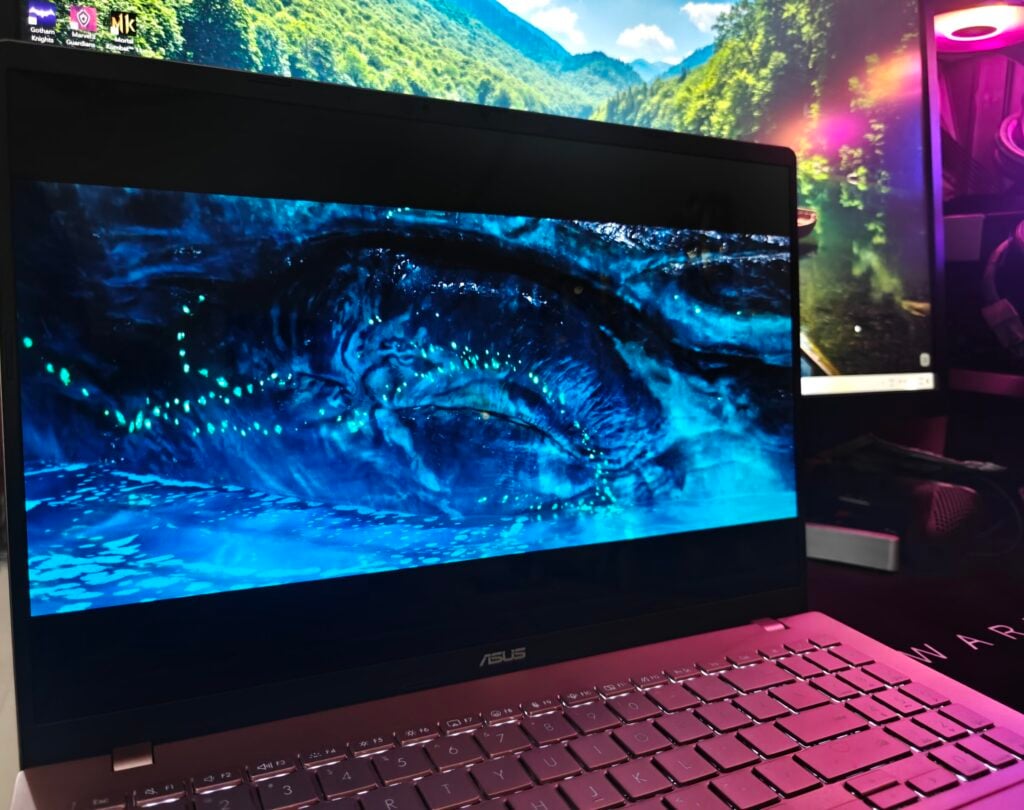
The stereo speakers deliver mediocre audio quality that disappoints given the laptop’s multimedia aspirations with its large OLED display.
Audio Characteristics:
- Lacks bass depth entirely
- Tinny sound at higher volumes
- Adequate for video calls and casual YouTube
- Insufficient for music enjoyment or movie watching
- No Dolby Atmos despite marketing materials
Competing Laptops: MacBook Air M3, Dell XPS 13, and even Lenovo Yoga series offer noticeably richer, fuller audio. For a laptop positioning itself as a content consumption device with a premium display, the weak audio undermines that use case.
Recommendation: Budget for quality headphones or external speakers if audio quality matters for your entertainment experience.
Verdict: Functional, not enjoyable. 5.5/10
Ports and Connectivity: Mixed Bag


Available Ports:
- 2× USB-C (USB 4.0, 40Gbps, DisplayPort, Power Delivery)
- 2× USB-A (USB 3.2 Gen 1, 5Gbps)
- 1× HDMI 2.1
- 1× 3.5mm headphone jack
- Wi-Fi 6E (802.11ax triple band)
- Bluetooth 5.3
Positives: Good variety of ports eliminates most dongle requirements. USB 4.0 on USB-C ports enables high-speed data transfer and display connectivity.
Negatives:
- Both USB-C ports on left side only (poor ergonomics)
- No SD card reader (important for photographers/videographers)
- No Thunderbolt 4 (Snapdragon limitation, not ASUS’s fault)
Verdict: Adequate but could be better distributed. 7/10
Software and AI Features

As a Copilot+ PC, the Vivobook S16 includes Windows 11 with enhanced AI capabilities and Microsoft Copilot integration.
Included Software:
- Windows 11 Home
- Office Home 2024 (lifetime)
- Microsoft 365 Basic (1 year, 100GB cloud storage)
- MyASUS utilities
- StoryCube (AI photo organization)
- GlideX (cross-device sharing)
AI Features:
- Windows Studio Effects (background blur, eye contact correction)
- Live Captions with translation
- Paint Cocreator with AI generation
- Enhanced Windows Search with natural language
Practical Value: The AI features work as advertised but feel more like nice-to-have bonuses rather than essential capabilities. The 45 TOPS NPU ensures these features run efficiently without impacting battery life.
Verdict: Good software bundle, AI features are useful gimmicks. 7.5/10
Thermal Performance
The Snapdragon X runs remarkably cool and quiet under most workloads thanks to ARM architecture efficiency.
Observations:
- Fanless-like silence during light tasks
- Chassis remains cool to touch
- No uncomfortable hotspots
- Fan rarely activates during normal use
- Some warmth near hinge during intensive tasks
The thermal advantage over x86 processors is genuine and appreciated, contributing to comfortable lap use and silent operation in quiet environments.
Verdict: Excellent thermal management. 8.5/10
Who Should Buy This Laptop?
Ideal For:
- Students prioritizing battery life over performance
- Light productivity users (email, web, documents)
- Budget-conscious buyers during sales (₹65,000 range)
- Users needing Windows with MacBook-like battery endurance
- Casual users who don’t run demanding applications
Avoid If You:
- Need reliable performance for intensive tasks
- Frequently work outdoors or in bright environments
- Value tactile trackpad feedback
- Run specialized software requiring x86 architecture
- Can stretch budget to ₹99,900 for MacBook Air M3
Value Proposition Analysis
At ₹76,990, the Vivobook S16 faces fierce competition:
Direct Competitors:
- MacBook Air M3 (₹99,900): Superior build, display, trackpad, performance—worth the ₹23,000 premium
- Dell XPS 13 (₹85,000): Better build quality, brighter display, x86 compatibility
- Lenovo Yoga 9i (₹82,000): Superior audio, 2-in-1 versatility, OLED with higher brightness
- HP Spectre x360 (₹88,000): Premium build, better trackpad, versatile form factor
Sweet Spot Pricing: At ₹65,000 during sales, the Vivobook S16 becomes genuinely compelling. The battery life, OLED display, and adequate performance justify that price point. At ₹77,000, it struggles to justify itself against better-rounded competitors.

Final Verdict: 3/5 Stars ⭐⭐⭐
The ASUS Vivobook S16 delivers exceptional battery life and decent everyday performance in an attractive package, but critical shortcomings prevent it from competing effectively at its ₹76,990 price point.
Strengths:
- Outstanding 10-12 hour real-world battery life
- Vibrant 16-inch OLED display (indoors)
- Lightweight and portable design
- Cool and quiet operation
- Comprehensive port selection
Critical Weaknesses:
- Poor trackpad with no haptic feedback
- Plastic build quality below price expectations
- Inadequate 300 nit display brightness
- Performance lags in demanding applications
- Mediocre audio quality
Deductions Explained:
- -1 star: Trackpad disaster and plastic build
- -1 star: Performance limitations and dim display
Recommendation: Wait for sales bringing the price to ₹65,000 or below. At that price point, the compromises become acceptable trade-offs for the excellent battery life. At ₹77,000, save an additional ₹23,000 for the MacBook Air M3 or explore better-rounded Windows alternatives.
ASUS has the foundation for a great laptop—they need to address the trackpad, improve build quality, and boost display brightness in the next generation. Until then, this remains a laptop with excellent potential undermined by preventable flaws.
Bottom Line: Good battery life doesn’t compensate for a poor trackpad and compromised build quality at premium prices. Buy only at significant discounts.
For more laptop reviews and buying guides, explore our comprehensive technology coverage.
Reviewed Unit: ASUS Vivobook S16 S3607QA-SH079WS | Review Date: January 2026 | Reviewer: TechnoSports Team


