

The laptop processor battle reached peak intensity at CES 2026, with Intel unveiling its highly anticipated Panther Lake architecture and AMD firing back with harsh criticism—claiming Intel’s flagship isn’t even worthy of comparison to AMD’s Ryzen AI Max (Strix Halo) processors.
In a combative interview with Tom’s Hardware, AMD’s SVP and GM of Client Product Group, Rahul Tikoo, dismissed Intel’s performance claims: “Strix Halo, or Ryzen AI Max will kill it. It’s not even a fair fight at that point, because it’s discrete-level graphics.”
Table of Contents
The Battlefield: Three-Tier Laptop War
AMD’s 2026 laptop strategy employs a segmented approach designed to dominate every price bracket:
| AMD Lineup | Target Market | Launch Timeline | Key Features |
|---|---|---|---|
| Ryzen AI 400 (Gorgon Point) | Mainstream | January 22, 2026 | 60 NPU TOPS, refreshed Zen 5 |
| Ryzen AI HX 470/475 | Performance | Q1 2026 | 12 cores, RDNA 3.5, high clocks |
| Ryzen AI Max+ (Strix Halo) | Creator/Gaming | Q1 2026 | Discrete-class GPU, 40 CUs |
Intel’s Response:
- Core Ultra Series 3 (Panther Lake) with 12 Xe3 GPU cores
- Built on Intel’s advanced 18A process node
- Claims of 73% better gaming performance vs AMD Ryzen AI 9 HX 370
Why AMD Isn’t Worried: The Strix Halo Advantage
AMD’s confidence stems from a fundamental architectural difference. While Intel’s flagship Core Ultra X9 388H integrates 12 Xe3 GPU cores—impressive for integrated graphics—AMD’s Strix Halo packs up to 40 RDNA 3.5 compute units in the Radeon 8060S configuration.
Performance Reality Check:
Independent benchmarks from Club386 confirm Intel’s Panther Lake delivers excellent integrated GPU performance, achieving 80+ fps in Cyberpunk 2077 and 100+ fps in F1 2024 at 1080p with XeSS upscaling enabled.
However, HotHardware’s testing places Intel’s Arc B390 iGPU below AMD’s Strix Halo Radeon 8060S but significantly above AMD’s mainstream Radeon 890M found in standard Ryzen AI processors.
The catch? Intel deliberately avoided comparing Panther Lake to Strix Halo in official slides, instead benchmarking against AMD’s mid-range Ryzen AI HX 370—a strategic omission AMD executives happily highlighted.
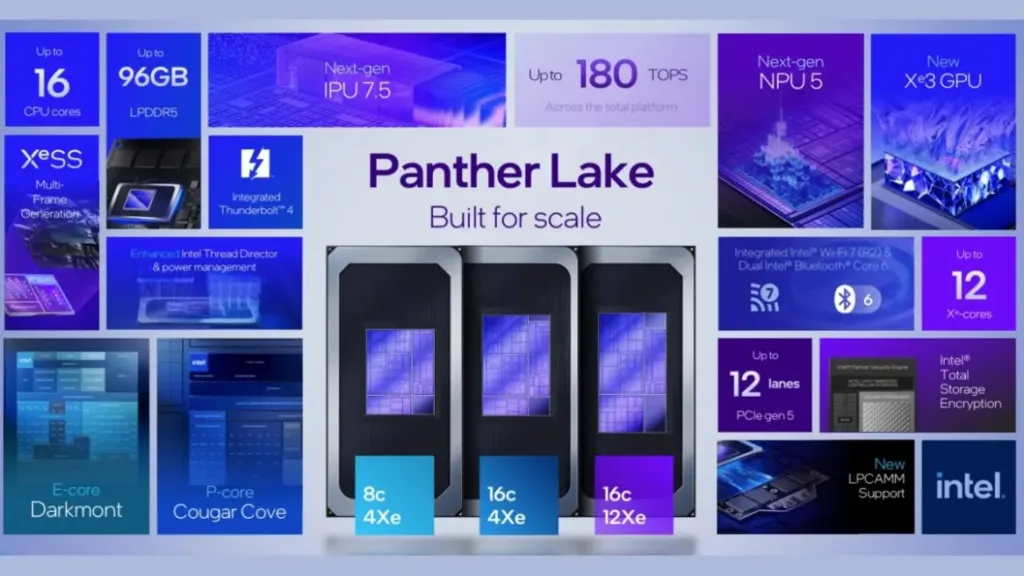
Intel’s Clever Deflection Strategy
Rahul Tikoo didn’t mince words about Intel’s benchmark methodology: “There’s a reason why they didn’t compare it right there. They compared their highest-end to our midpoint. Wait until you see the price point on that.”
This reveals Intel’s positioning dilemma. The Core Ultra X9 388H with 12 Xe3 cores targets creators and gamers who need strong integrated graphics, but it competes against AMD’s mainstream HX series—not the true performance flagship Strix Halo.
Intel has explicitly stated it has no plans to release a Strix Halo competitor, essentially ceding the ultra-high-end integrated graphics segment to AMD.
Performance Claims Breakdown
Intel’s Bold Promises:
- 24% improved multi-threaded performance vs its own Arrow Lake
- 50% better power efficiency than AMD Ryzen AI 300 series
- 73% better gaming performance vs Ryzen AI 9 HX 370
- 4.3x faster LLM inference than AMD’s XDNA2 NPU
AMD’s Counter-Attack:
- 30% better multitasking than Intel Core Ultra 9 288V
- 70% faster content creation output
- 70% better battery efficiency
- NotebookCheck reports Strix Halo’s discrete-level graphics crush Panther Lake’s integrated solution
The Market Segmentation Philosophy
AMD executive Rahul Tikoo articulated the strategic thinking behind AMD’s three-tier approach:
“For the mainstream of the market that don’t value that much graphics, because honestly, most of the people that are using notebooks outside of the creator or gaming spaces don’t need that graphics performance. People make choices based on their applications or gaming needs.”
This philosophy allows AMD to offer:
- Budget-conscious users: Efficient Ryzen AI 400 chips with adequate graphics
- Power users: High-performance HX series with strong CPU/GPU balance
- Creators/gamers: Strix Halo with near-discrete GPU performance
Intel’s Panther Lake, by contrast, attempts to be a jack-of-all-trades—strong in all areas but potentially master of none when stacked against AMD’s specialized offerings.
The Price Point Wild Card
Both Tikoo and industry analysts emphasize that pricing will determine market outcomes. Strix Halo systems require expensive high-speed RAM to fully utilize the massive integrated GPU, potentially pushing laptop prices into premium territory ($1,500-2,500).
If Intel can deliver Panther Lake systems at competitive mainstream pricing ($800-1,400), it could capture volume despite losing the performance crown. AMD must balance performance leadership with accessible pricing to avoid becoming a niche creator product.

India’s Laptop Market Implications
For India’s rapidly growing premium laptop segment, this CPU war brings both opportunities and challenges:
Consumer Benefits:
- Intense competition driving innovation and feature improvements
- Multiple compelling options across price brackets
- Strong integrated graphics eliminating need for dedicated GPUs in many scenarios
Market Realities:
- Strix Halo laptops likely priced ₹1,20,000+ limiting mainstream adoption
- Panther Lake systems potentially offering better price-to-performance for average users
- Growing creator economy in India creating demand for powerful integrated graphics
Indian laptop buyers prioritizing value over absolute performance may gravitate toward Intel’s Panther Lake, while professional content creators and mobile gaming enthusiasts will likely seek Strix Halo’s unmatched integrated GPU power.
Launch Timeline: AMD Strikes First
AMD appears to be launching Ryzen AI 400 on January 22, five days before Intel’s January 27 Panther Lake rollout—a strategic move to capture early adopter attention and establish market presence before Intel’s marketing machine kicks into high gear.
The staggered launch allows AMD to dominate tech news cycles for nearly a week without direct Intel competition, though Intel’s massive CES 2026 keynote generated substantial counter-momentum.
The Harsh Truth: Different Products, Different Buyers
Despite AMD’s combative rhetoric, the companies aren’t directly competing in all segments. AMD’s Strix Halo targets a premium niche willing to pay for discrete-class graphics in thin-and-light form factors. Intel’s Panther Lake targets mainstream users seeking balanced performance across CPU, GPU, and AI workloads.
Tom’s Guide’s comprehensive analysis suggests both will succeed within their respective segments, with Qualcomm’s Snapdragon X2 Elite potentially disrupting both through superior power efficiency.
What Laptop Buyers Should Know
Choose Intel Panther Lake if:
- You want balanced CPU/GPU performance at mainstream pricing
- Battery life and efficiency matter more than absolute graphics power
- You use AI-accelerated applications leveraging NPU capabilities
- You prefer established OEM partners with broad laptop selection
Choose AMD Ryzen AI Max (Strix Halo) if:
- You’re a content creator needing GPU-intensive workflows
- You game regularly and want laptop-tier performance without discrete GPU
- You’re willing to pay premium for best-in-class integrated graphics
- You prefer cutting-edge architecture over ecosystem maturity
Choose AMD Ryzen AI 400/HX if:
- You want good all-around performance at competitive pricing
- You prioritize multitasking and productivity over gaming
- You prefer AMD’s software ecosystem and driver support
- You’re upgrading from older AMD platforms
The Verdict: AMD’s Swagger is Justified, But Context Matters
AMD’s aggressive stance reflects genuine technical advantages in specific segments—particularly the creator and gaming niches where Strix Halo dominates. However, Intel’s Panther Lake represents a significant architecture leap that closes gaps in areas Intel traditionally struggled.
The real winner? Consumers, who benefit from fierce competition driving rapid innovation and competitive pricing across the laptop market.
Follow the latest developments in the AMD vs Intel CPU war at TechnoSports.co.in.


