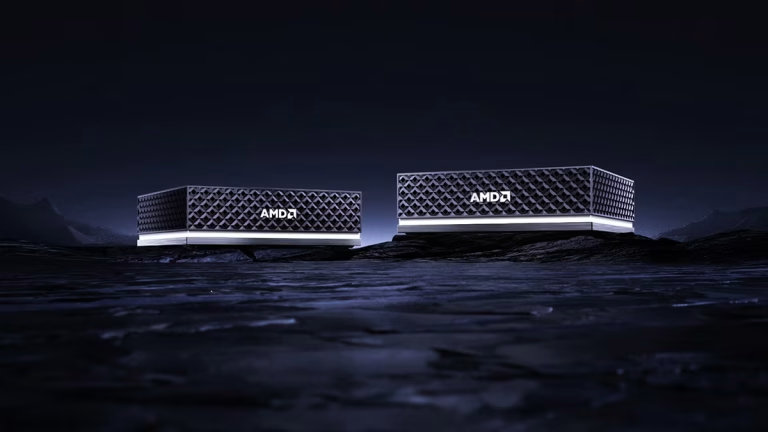
AMD has released a powerful new mini-PC aimed at AI developers, and it comes with a very large memory pool. The AMD Ryzen AI Halo Developer Platform, based on the Gorgon Halo chip, is on sale in the US with up to 160GB of VRAM, 10 Gigabit Ethernet and a price of $7,299 for the 192GB RAM and 2TB storage configuration, according to Notebookcheck on October 13, 2026.
It arrives less than a week after Asus and Dell revealed their own Nvidia RTX Spark mini-PCs, so the small-form-factor AI workstation race is heating up. Here is what the box offers and what to watch.
What Is Inside
The system uses the Ryzen AI Max+ Pro 495 processor paired with a Radeon 8065S GPU that has 40 RDNA 3.5 compute units. Notebookcheck describes the GPU as a minor revision of the Radeon 8060S despite the new name. The big change is memory: up to 192GB of RAM, of which up to 160GB can be assigned as VRAM. Read more about the company on AMD’s Wikipedia page and the official site at amd.com.

AMD Ryzen AI Halo at a Glance
| Spec | Detail |
|---|---|
| Processor | Ryzen AI Max+ Pro 495 |
| GPU | Radeon 8065S, 40 RDNA 3.5 compute units |
| Memory | Up to 192GB RAM; up to 160GB as VRAM |
| Storage | 2TB in the listed configuration |
| Networking | 10GbE, Wi-Fi 7, Bluetooth 5.4 |
| Ports | Four USB Type-C |
| OS | Linux (per Micro Center listing) |
| Price | $7,299 (192GB / 2TB) |
| Predecessor | Strix Halo, up to 128GB RAM, listed at $3,999 |
Why Big VRAM Matters
Large language models need a lot of memory to run locally. A graphics card with 24GB or 32GB of VRAM can struggle with bigger models, while a shared-memory design like this lets developers load much larger ones on a desktop. That is the appeal for researchers and developers who want to test models without renting cloud GPUs. For more on the chips behind this trend, see our AMD Ryzen AI Halo page.
Gains Over the Predecessor
Compared with the earlier Strix Halo version, which topped out at 128GB of RAM, the new platform offers 50% more maximum RAM and up to 66% more VRAM. Notebookcheck’s benchmarks show only modest CPU gains, and the GPU is essentially the same 40-compute-unit design, so day-to-day speed is not dramatically different. The chassis design is unchanged.
The Price Question
The jump from $3,999 for the predecessor to $7,299 is steep. Memory costs are part of the story, since RAM prices have risen across the industry this year, but buyers will want to weigh whether the extra capacity justifies the premium over cheaper configurations or competing mini-PCs. It is sold through AMD and a Micro Center listing.
What Is Not Confirmed
These details are not confirmed or remain open:
- Availability and pricing outside the US, including India.
- Prices of lower-memory configurations, since $7,299 is the one reported figure.
- Real-world performance on large AI models, which depends on software support.
- Whether the Linux-only listing applies to every retailer.
Mini-PCs like this are becoming a category of their own because they combine desktop-class memory with a small footprint and low noise. For a developer, being able to experiment locally with large models avoids cloud bills and keeps data on the machine, which matters for private projects. The trade-off is cost and software maturity: unified-memory systems depend on drivers and frameworks that handle large VRAM allocations well, and Linux support will be key. Compare against the Nvidia RTX Spark mini-PCs from Asus and Dell once their prices are confirmed, and wait for independent reviews before spending this much.