SA329
 AUS85/2 (26.2 ov)
 BAN213/3 (74 ov)
 WI
 IND-W
 ZIM-W105/6 (29.5/50 ov)
 GAM0
 BUR0
 KAN0
 POH0
 FC Goa
 SCD
 MIL
 BOL
 PAR
 UDI
 VEN
 INT
 GEN
 JUV
 MON
 NAP
 UAE
 OMA
 ENG
 SL
 AS Roma4
 Cagliari2
 Torino1
 Como3
 Sassuolo2
 Lazio6
 AFG177
 ZIM140 (19.1/20 ov, target 178)
 DEN
 QAT
 KENYA
 KUW
 SIKM184 & 87/4 (32 ov, target 212)
 NAGA187 & 208
 JHK131/4 (47 ov)
 DELHI515/5d
 ODSA194
 SVCS13/0 (5 ov)
 BRODA616
 J & K170/7 (56 ov)
 CHD685/5d
 HP287/3 (87.4 ov)
 CGR216/8 (95 ov)
 AP231
 HYD358/8 (115 ov)
 PNJB431
 POA
 SPR
 BRB
 VAG
 LIONS
 EASTN
 WELL
 OTAGO
 MIS
 TOK
 PAK110
 NAM316/7
 IRE253 (44.5/50 ov, target 317)
 NZ198/3
 IND199/4 (13.2/20 ov, target 199)
 NED371/5
 AUCK361/5 (50 ov)
 CANT311 (44.1/46 ov, target 345)
 Al Khaleej
 Al Hazem
 Frosinone
 Lecce
 Abha0
 Al Faisaly1
 Fleetwood Town1
 Arsenal1
 Bradford2
 Peterborough0

AI-driven workforce disruption has become a pressing issue for many boards. A notable survey released on May 25, 2026, shows that 99% of CEOs expect AI to lead to significant layoffs in the next two years.
While we still don’t have confirmed details about the number of participants or the organization behind this survey, the findings indicate a decisive shift in corporate strategy. Executives are no longer debating if artificial intelligence will change employment; they’re focusing on how fast they can restructure operations to take advantage of automation. AI-driven workforce disruption plays a crucial role in this evolving narrative.
The difference between past projections and current data is striking. In PwC’s 2024 CEO Survey, only 25% of leaders intended to cut jobs due to AI. Now, an overwhelming 99% reflect a dramatic rise in executive confidence about the readiness and capabilities of generative AI tools.
This trend suggests that by mid-2028, we’ll see a major transformation in the workforce as companies rush to incorporate agentic AI in key areas, from software development to customer service. The significance of AI-driven workforce disruption can’t be ignored here.
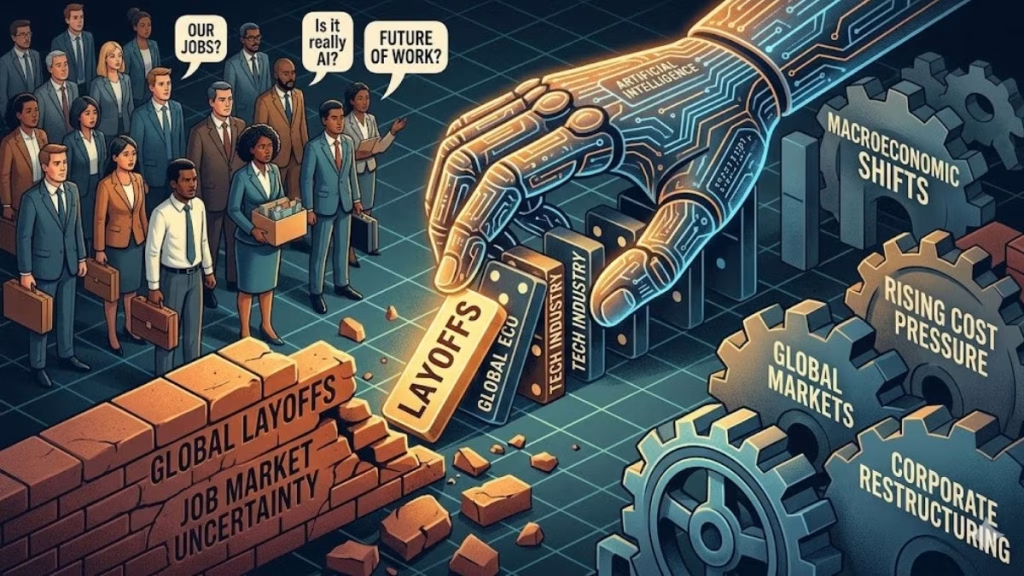
AI-driven Workforce Disruption: The Scale of Economic and Corporate Realignment
So, what’s behind this near-universal alignment among global leaders? The pressure seems to come from the rapid commoditization of AI capabilities, making efficiency gains a necessity rather than a luxury. (Source: TechCrunch)
Goldman Sachs estimated back in 2023 that AI could potentially displace up to 300 million full-time jobs worldwide. What was once a speculative long-term prediction is now the baseline for corporate strategies. The landscape for AI-driven workforce disruption is changing quickly.
Not everyone agrees with this accelerated timeline. Some analysts argue that previous technological shifts, such as the internet, actually created more jobs than they took away.
Yet, the data in 2026 reveals a different trend. Unlike earlier cycles, AI now targets knowledge-based tasks that once seemed safe from automation. Companies are shifting toward “lean” operations, where a smaller human team oversees a large network of autonomous agents.
| Metric | Historical Baseline (2024) | Current Projection (2026) |
|---|---|---|
| CEOs planning AI-related layoffs | 25% | 99% |
| Timeframe for impact | Long-term / Multi-year | 24 months (Mid-2028) |
| Global displacement potential | Up to 300 million jobs | Accelerating trend |
Implications for Global Labor Markets
The focus has shifted from straightforward automation to implementing complex, agentic AI frameworks. Reports from companies like McKinsey and IBM emphasize that this transition isn’t just about cutting costs; it’s also about reallocating resources to high-value technical roles. But the impact on workers is real. For many employees, the next two years are crucial for upskilling, as AI is increasingly taking over roles that are essential to the entry-level corporate economy.
What we’re seeing is a fundamental separation between output and headcount. We anticipate a rise in “AI-native” business models where revenue grows with compute power rather than staff size.
This shift promises higher margins for shareholders, but it raises tough questions about the social contract between tech firms and their employees. The race to 2028 is officially on, and the corporate message is clear: automate or get left behind.
FAQs
How does this 99% figure compare to previous surveys?
The leap from 25% in 2024 to 99% in 2026 marks a significant change in executive attitude, moving from cautious testing to a near-universal acceptance of AI-driven workforce reductions.
Which sectors are most at risk of these AI-driven layoffs?
While the survey covers a wide range, industries focused on knowledge-based tasks, like software engineering, data analysis, and customer support, are seeing the fastest adoption of AI agents.
Is this two-year timeline realistic?
Most industry experts believe that the two-year window reflects the current speed of AI hardware deployment and software integration, making mid-2028 a key deadline for companies to finalize their automated systems.
When will the projected AI-driven workforce disruption occur?
According to the 2026 survey, 99% of CEOs expect that AI-driven workforce disruption will lead to widespread layoffs by mid-2028.
Why are CEOs planning to implement AI-driven layoffs?
CEOs are planning these workforce reductions to adopt AI-driven efficiencies and stay competitive as automation technologies continue to reshape global labor markets.