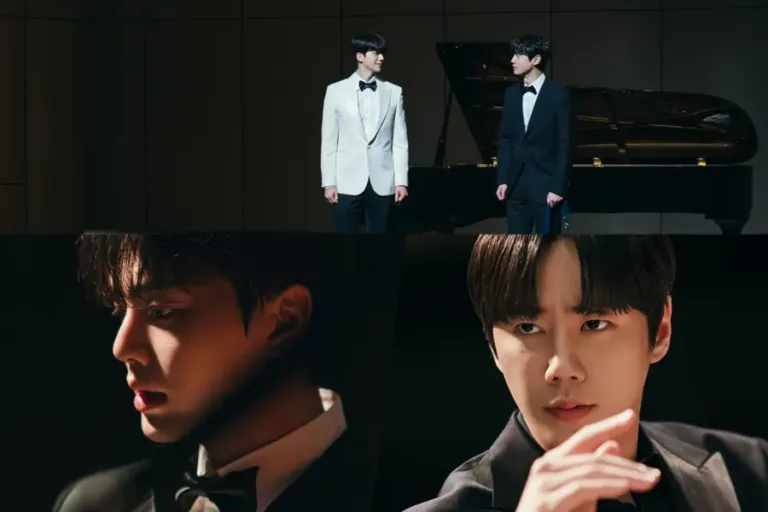
Some K-dramas use music as background noise. Four Hands, Two Sonatas uses it as the story itself — and two specific performances have just been revealed as the emotional hinges the entire narrative swings on. Here’s a closer look at both, and why the second one carries even more weight than it first appears.
Table of Contents
Performance One: Rachmaninoff’s Piano Concerto No. 2 — Kang Pio’s Breaking Point
Kang Pio (Song Kang) originally wanted to perform Piano Concerto No. 3, a piece he felt confident with. His teacher, Do Hyun Soo (Kim Joo Hun), pushed him toward the far more demanding No. 2 instead — a decision that immediately raised the stakes.
Then came the gut-punch: Kang Pio discovered his friend-turned-rival Choi Jeong Yo (Lee Jun Young) had chosen the exact same piece as his free selection for the concours. Rather than folding under that pressure, Kang Pio leaned into it — practicing relentlessly and even drawing from Choi Jeong Yo’s own music sheets to reshape the piece into something distinctly his own. The performance became less about winning a competition and more about Kang Pio proving to himself that he could rise past his self-imposed ceiling.

Four Hands, Two Sonatas: Performance Two: Saint-Saëns’ “Danse Macabre” — Choi Jeong Yo’s Double Return
This is where the story deepens considerably. “Danse Macabre” isn’t just a difficult piece for Choi Jeong Yo — it’s tied directly to trauma. As a child, he watched his mother pass away at the very concours where he was performing, an experience that left him unable to play in front of an audience for years.
His first return to the stage came through a four-hands performance of this same piece, alongside Kang Pio — a moment of quiet trust that allowed him to reclaim music as something safe again.
The more significant beat, though, is the second return. Nine years later, after vanishing from public life entirely, Choi Jeong Yo resurfaces at a conducting competition — and chooses “Danse Macabre” once more. This time, he’s not the traumatized child leaning on a friend for support; he’s a matured musician commanding the piece from behind the podium instead of the keys. The choice to return with the exact same composition transforms it from a symbol of grief into a symbol of full-circle growth, making it arguably the more powerful of the two turning points.
| Performance | Character | Emotional Core | Significance |
|---|---|---|---|
| Rachmaninoff’s Piano Concerto No. 2 | Kang Pio | Overcoming self-doubt and rivalry pressure | Marks his growth as a soloist |
| Saint-Saëns’ “Danse Macabre” (1st return) | Choi Jeong Yo | Healing from childhood trauma | Reclaims his ability to perform |
| Saint-Saëns’ “Danse Macabre” (2nd return) | Choi Jeong Yo | Full-circle mastery, nine years later | Reveals his transformation into a conductor |
Catch the next episode of Four Hands, Two Sonatas on September 27 at 9:10 PM KST. For more K-drama recaps and character breakdowns like this, check out our entertainment coverage on TechnoSports Entertainment.
The Danse Macabre, composed by French composer Camille Saint-Saëns, is according to Wikipedia a symphonic poem inspired by the legend of Death summoning skeletons from their graves to dance at midnight on Halloween.
FAQs
Q1. Why does “Danse Macabre” appear twice in the drama?
It marks two separate returns for Choi Jeong Yo — first reclaiming his ability to perform, then later showcasing his growth as a conductor.
Q2. Did Kang Pio and Choi Jeong Yo originally plan to perform the same piece?
No — it was a coincidence that intensified their rivalry right before the concours.