Zen 6 chips haven’t even hit the market yet, and AMD is already telling us what happens after Zen 7 and Zen 8
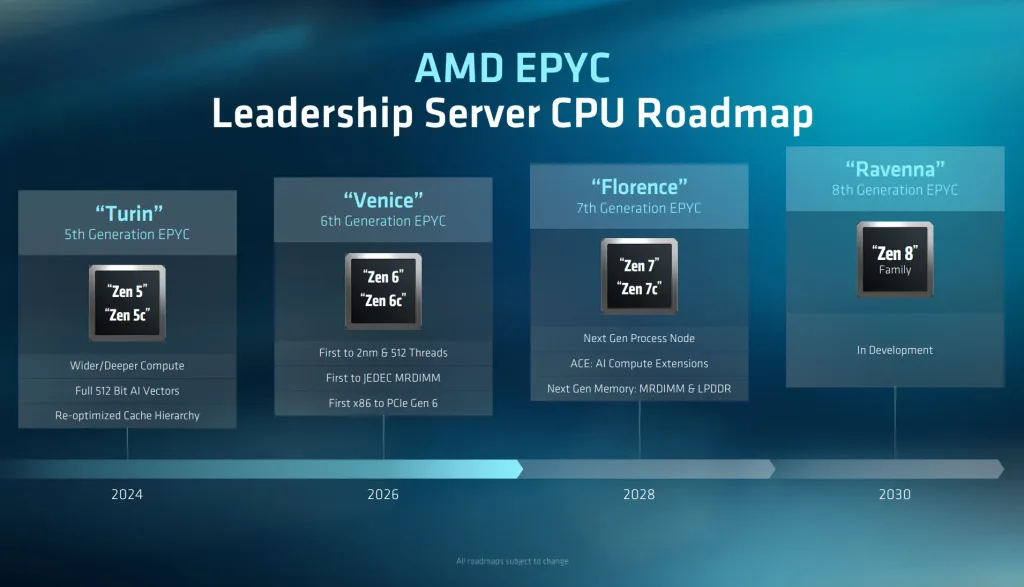
At its Advancing AI 2026 event, AMD didn’t just launch new Zen 6 EPYC server chips — CEO Lisa Su used the moment to pull back the curtain on the company’s roadmap all the way through 2030. According to VideoCardz, AMD has now officially confirmed 7th Gen EPYC “Florence” built on Zen 7, 8th Gen EPYC “Ravenna” built on Zen 8, and the Instinct MI600 accelerator series — giving the clearest look yet at AMD’s plans for the rest of the decade.
This kind of long-horizon roadmap disclosure matters beyond enthusiast circles — it signals how AMD plans to keep pace with Nvidia in the AI data centre race TechnoSports has been following closely all year.
Table of Contents
The Roadmap at a Glance
| Product | Codename | Architecture | Expected Year |
|---|---|---|---|
| EPYC (6th Gen) | Venice | Zen 6 | 2026 (launching now) |
| Instinct MI400 Series | — | CDNA 5 | 2026 |
| Instinct MI500 Series | — | CDNA 6 | 2027 |
| EPYC (7th Gen) | Florence | Zen 7 | 2028 |
| Instinct MI600 Series | — | CDNA Next | 2028 |
| EPYC (8th Gen) | Ravenna | Zen 8 | 2030 |
What’s New in Florence (Zen 7)
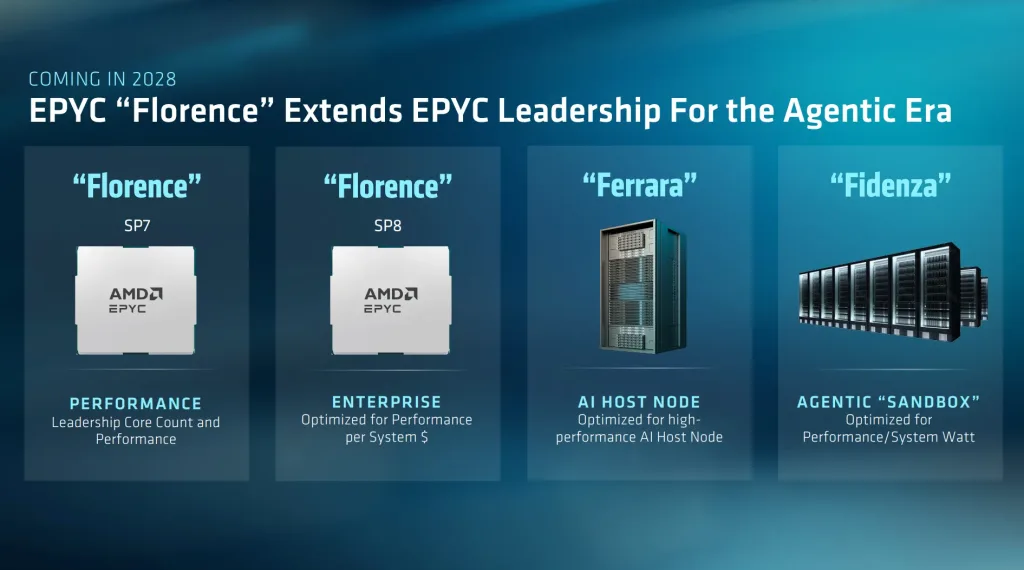
Florence, due in 2028, is the star of this reveal. AMD confirmed it will use a next-generation process node alongside new “ACE” AI Compute Extensions — the fruit of a working group between AMD and Intel, designed to boost AI performance in a way similar to Intel’s existing AMX extensions. Florence will also support next-gen MRDIMM and LPDDR memory, and will split across two platforms: one variant, SP7, focused on raw core count and performance, and another, SP8, tuned for performance-per-dollar in enterprise systems. AMD also name-dropped Zen 7-based siblings Ferrara, built for AI host nodes, and Fidenza, optimized around performance per watt.
Instinct MI600: AMD’s Answer to Nvidia’s Feynman
On the GPU side, the Instinct MI600 series is targeted for 2028 with a “CDNA Next” architecture, positioned as AMD’s direct response to Nvidia’s rumoured Feynman-generation chips. MI600 will anchor AMD’s Helios 600 rack platform alongside Ferrara CPUs and Pensando networking silicon — following the MI500 series (CDNA 6, HBM4e memory) arriving a year earlier in 2027.
Zen 8 and Ravenna: The Far Horizon
Beyond Florence, AMD confirmed that Zen 8 is already in development and will power 8th Gen EPYC “Ravenna” chips around 2030. True to how early this is, AMD hasn’t disclosed process node, core counts, or memory support yet — this is a placeholder confirmation to show AMD’s roadmap discipline rather than a detailed spec reveal.
Bottom Line
AMD is signalling a consistent, predictable release cadence stretching years into the future — a deliberate contrast to the more incremental updates typical of the CPU and GPU industry. With Zen 6 chips barely shipping, having Zen 7 and Zen 8 already named and dated shows just how far in advance AMD is now planning to keep up with soaring AI infrastructure demand.
Based on reporting from VideoCardz, Tom’s Hardware, and Phoronix, citing AMD’s Advancing AI 2026 keynote. Full technical specifications for Zen 7, Zen 8, and Instinct MI600 have not yet been disclosed.