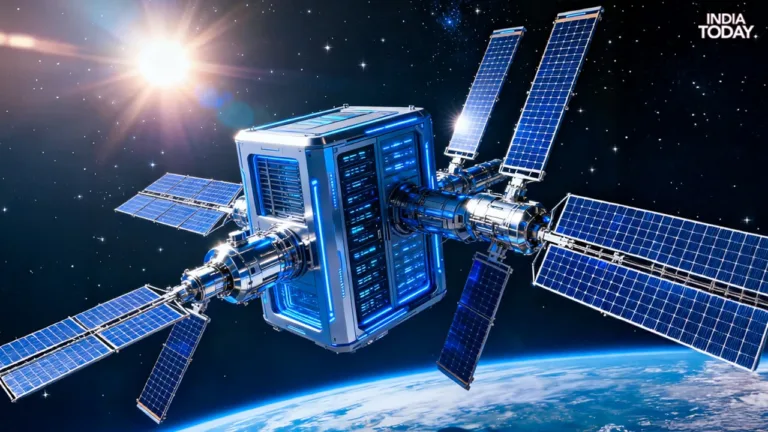
Ambitious or absurd? Google announces Project Suncatcher—a moonshot plan to launch solar-powered satellites carrying AI chips into orbit, with the first demo mission targeting early 2027.
Table of Contents

Beyond Earth’s Energy Limits
Google’s new research moonshot aims to scale machine learning in space through an interconnected network of solar-powered satellites equipped with Tensor Processing Unit AI chips. The reason? In the right orbit, solar panels can be up to 8 times more productive than on Earth and produce power nearly continuously.
Project Suncatcher Key Details
| Element | Specification |
|---|---|
| Launch Timeline | First demo satellites in early 2027 |
| Partner | Planet (satellite imagery firm) |
| Hardware | Google TPU AI chips |
| Orbit Type | Dawn-dusk sun-synchronous LEO |
| Solar Efficiency | 8x more productive than Earth |
| Communication | Free-space optical links, terabits/sec |
| Required Launch Cost | Under $200/kg by 2035 |
| Mission Lifespan | 5-6 years (chip replacement needed) |
The Energy Crisis Driving Space Ambitions
Google’s emissions went up by 51 percent, and in 2026 it is projected to equal the emissions of the whole of Japan, driven primarily by AI data center expansion. The Sun emits more power than 100 trillion times humanity’s total electricity production, making space an attractive—if wildly ambitious—solution.

How It Works
The proposed system consists of a constellation of networked satellites operating in a dawn-dusk sun-synchronous low earth orbit, where they would be exposed to near-constant sunlight. High-bandwidth optical links between satellites would enable them to function like terrestrial data centers, processing AI workloads collaboratively.
Google tested its Trillium v6e Cloud TPU chips against space radiation at UC Davis, and results were promising, with chips only beginning to show irregularities after cumulative doses nearly three times the expected five-year mission exposure.

The Reality Check
Despite CEO Sundar Pichai’s optimism that “a decade or so away we’ll be viewing it as a more normal way to build data centers,” massive challenges remain. Launch costs would need to fall to under $200 per kilogram by 2035 for their vision to make sense—a dramatic reduction from today’s rates.
Environmental concerns persist too. While Starcloud estimates that a solar-powered space data center could achieve 10 times lower carbon emissions compared with a land-based data center powered by natural gas generators, rocket launches themselves produce significant emissions, and the space junk problem worsens with every satellite deployed.
Competition Heats Up
Google isn’t alone. SpaceX, Amazon’s Blue Origin, and startups like Starcloud and Aetherflux are all pursuing orbital data centers. Elon Musk said SpaceX plans to pursue orbital data centers, a factor in its consideration of a potential initial public offering as early as 2026.
For updates on this ambitious project and other tech innovations, follow Technosports and check our AI technology coverage.
FAQs
When will Google’s space data centers actually launch?
First demo satellites with Planet launch in early 2027, but operational data centers are a decade+ away if feasible.
Won’t space data centers create more environmental problems than they solve?
Yes, potentially—rocket launches emit greenhouse gases, and increased space junk poses risks despite solar power benefits.