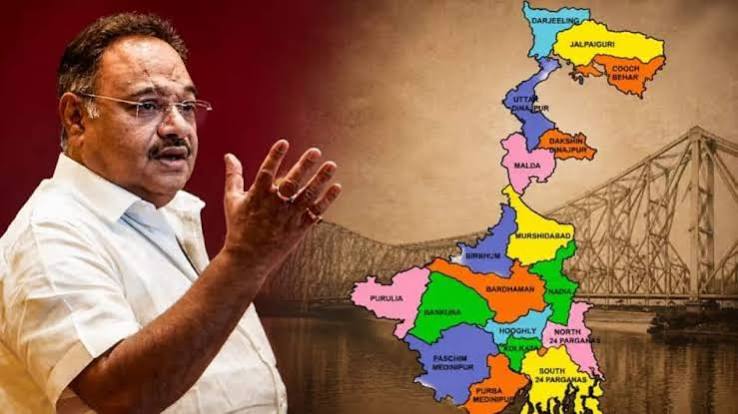
A state’s name is more than a label on a map. It carries history, identity and, sometimes, a quiet argument that has run for decades.
West Bengal’s name is back in the headlines after the state BJP chief said a bill to rename it “Paschim Banga” is coming. Here is a clear, neutral look at what was said, where the idea comes from and how a state name actually changes in India.
West Bengal to Paschim Banga: The Proposal
| Detail | Info |
|---|---|
| Proposed new name | Paschim Banga |
| Who announced it | Samik Bhattacharya, West Bengal BJP president |
| Plan | A bill is to be introduced in the Assembly’s first session |
| Names he ruled out | Names pursued under the earlier Trinamool Congress government |
| Legal step needed beyond the state | Parliament’s approval under Article 3 of the Constitution |
What Was Said?
According to reports, the state BJP chief said the government would bring a bill in the Assembly’s first session to rename West Bengal “Paschim Banga”. He said the aim is for the name to stay linked to the state’s history and identity.
One report also says he rejected the earlier proposal to call the state “Bangla”. For background on the state itself, see West Bengal on Wikipedia. uniindia

A Name With a Long History
This is not a new debate. Based on an explainer summarising the timeline:
| Period | Development |
|---|---|
| 1999 | The Left Front government proposed the name Paschim Banga |
| July 2018 | The West Bengal Assembly passed a resolution proposing the name Bangla |
| October 2026 | BJP state president Samik Bhattacharya announced the intention to introduce a bill proposing Paschim Banga |
One report adds that the earlier Trinamool government argued that “West Bengal” placed the state near the end of alphabetical lists at national meetings. For more political and policy stories, browse our national news coverage on Technosports. outlookindia
How a State Gets Renamed in India?
A state cannot change its name through its own Assembly alone. The process, as outlined in a civics explainer, works like this:
| Step | What Happens |
|---|---|
| 1. Presidential recommendation | A bill under Article 3 may be introduced in Parliament only on the President’s recommendation |
| 2. Reference to the state legislature | If the proposal concerns a state’s name, the President refers it to that state’s legislature to get its views within a set period |
| 3. Parliament’s examination | Parliament examines and passes the bill through the usual process |
| 4. Presidential assent | The bill becomes law once the President gives assent proposal for renaming of west bengal +3 |
In short, a state Assembly bill or resolution signals intent, but the final decision rests with Parliament.
What This Could Mean in Practice?
If a name change goes through, a few practical effects usually follow:
- Official records: Government documents, signage and portals would need updating.
- Institutions: Bodies carrying the old name may be renamed over time.
- Public conversation: Language, identity and history often become part of the debate.
These are general consequences of any renaming, not details announced for this proposal.
Different Names, Different Arguments
The sources show that the choice of name has been contested over the years. Supporters of a given name typically point to history, language or identity, while others raise different preferences. The reports used for this article mainly cover the BJP chief’s statements, so they do not capture the full range of political or public reactions.
If you want to follow the story, look for official statements, the text of any bill, and responses from other parties and cultural groups.
What We Still Don’t Know?
- The exact date the bill will be introduced
- The final text of the bill and any official reasoning
- How other parties and the Centre will respond
- The timeline for any parliamentary process
Frequently Asked Questions
Q1. Will West Bengal be renamed Paschim Banga?
The state BJP chief says a bill will be brought in the Assembly’s first session, but a renaming also needs approval from Parliament, so it is not final yet.
Q2. Who decides a state’s name in India?
Parliament decides under Article 3 of the Constitution, after the President refers the proposal to the state legislature for its views.