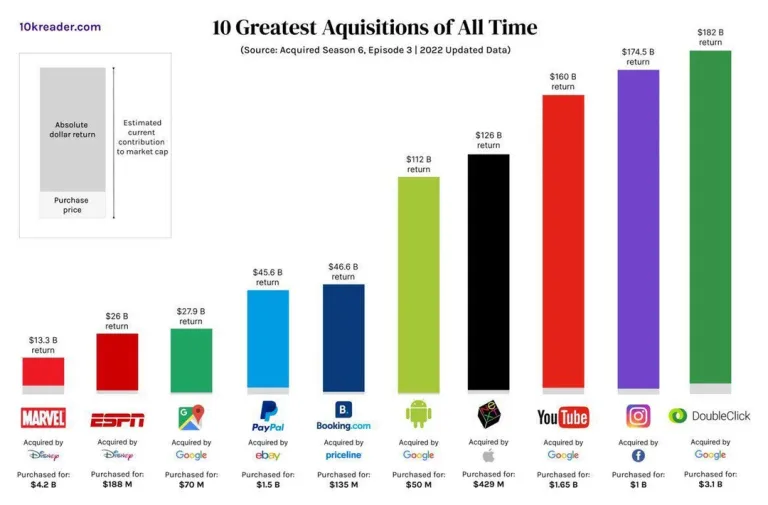
Some deals look expensive on the day they are signed and turn out to be the bargain of the century. Which ones? A well-known ranking based on the Acquired podcast (Season 6, Episode 3, with 2022 updated data) lists the greatest acquisitions of all time by how much value each deal is estimated to add today, measured against what the buyer paid. Google appears four times, and the top spot may surprise you.
Before we count down, one note on the numbers: “return” here means the estimated current contribution to the buyer’s market cap, which is a rough measure, not audited profit. The data is from 2022, so today’s values would be different.
Table of Contents
Top 10 Greatest Acquisitions of All Time
| Rank | Acquisition | Buyer | Purchase price | Estimated return |
|---|---|---|---|---|
| 1 | DoubleClick | $3.1 billion | $182 billion | |
| 2 | $1 billion | $174.5 billion | ||
| 3 | YouTube | $1.65 billion | $160 billion | |
| 4 | NeXT | Apple | $429 million | $126 billion |
| 5 | Android | $50 million | $112 billion | |
| 6 | Booking.com | Priceline | $135 million | $46.6 billion |
| 7 | PayPal | eBay | $1.5 billion | $45.6 billion |
| 8 | Google Maps | $70 million | $27.9 billion | |
| 9 | ESPN | Disney | $188 million | $26 billion |
| 10 | Marvel | Disney | $4.2 billion | $13.3 billion |
The Story Behind Each Deal
1. DoubleClick (Google). The online advertising technology company became the backbone of Google’s ad business. A $3.1 billion price tag looked large in its time, yet the estimated return is $182 billion, the biggest in the list.

2. Instagram (Facebook). The photo-sharing app was bought for just $1 billion. Today it is one of the world’s most influential social platforms, and the ranking credits it with $174.5 billion in value.
3. YouTube (Google). At $1.65 billion, it was seen as a risky bet for a video site with copyright headaches. It became the planet’s default video platform, with an estimated $160 billion return.
4. NeXT (Apple). Apple paid $429 million for Steve Jobs’ company and got the software foundation behind Mac OS X and later iOS, plus Jobs’ return. The estimated return is $126 billion.
5. Android (Google). Perhaps the cheapest in terms of price, at only $50 million, for the operating system that now runs most of the world’s smartphones. Return: $112 billion.

6. Booking.com (Priceline). A $135 million purchase that turned into the engine of a travel giant, valued at $46.6 billion in return.
7. PayPal (eBay). eBay paid $1.5 billion and later spun the payments company out. Even so, the ranking credits the deal with $45.6 billion in return.
8. Google Maps (Google). A $70 million purchase became a product that billions use daily for navigation. Estimated return: $27.9 billion.
9. ESPN (Disney). Bought for $188 million, it brought a sports media empire into Disney’s portfolio and earned an estimated $26 billion return.
10. Marvel (Disney). The priciest at $4.2 billion, but its films and characters created a cinematic universe. Return: $13.3 billion.
What the List Teaches
Three lessons stand out. First, small prices can hide huge outcomes: Android, Google Maps and Booking.com each cost less than $150 million. Second, platform deals compound: buyers who plugged acquisitions into big distribution networks, as Google and Meta did, saw outsized gains. Third, the same company can win repeatedly. Google sits at ranks 1, 3, 5 and 8, which shows how much a strong acquirer can gain from spotting products early.
For India’s startup ecosystem, the message is useful: acquisitions can create more value than the headline price suggests, but only when the buyer integrates the product well. Our acquisitions tag follows other big deals, and you can read how the companies grew on Instagram and YouTube on Wikipedia.
What to Keep in Mind
Rankings like this depend on how you measure value. “Contribution to market cap” is an estimate and the figures are from 2022, so current numbers would differ. Different analysts might also pick other deals, such as those where the buyer faced regulators or integration problems. Treat the list as a guide to patterns, not a final scoreboard.
Quick Answers
Which acquisition ranks first? DoubleClick by Google, at an estimated $182 billion return.
Which was the cheapest? Android, bought for $50 million.
Which company appears most often? Google, with four entries.
Source: Acquired podcast (Season 6, Episode 3, 2022 data), chart by 10kreader.com