MEX-W
MEX-W ARG-W
ARG-W ARS2
ARS2 EVE0
EVE0 COV0
COV0 FUL1
FUL1 OFC0
OFC0 NEU0
NEU0 NEOM2
NEOM2 ABH0
ABH0 RAC0
RAC0 ESP1
ESP1 KHO0
KHO0 ETT0
ETT0 BLK2
BLK2 WXM0
WXM0 NAP
NAP ROMA
ROMA CHE
CHE TOT
TOT VAL
VAL VIL
VIL DOR
DOR SGE
SGE RIY
RIY TAA
TAA LAZ
LAZ PAR
PAR RCL
RCL PAR
PAR FCA1
FCA1 FCU1
FCU1 KOE0
KOE0 S040
S040 M052
M052 SVW3
SVW3 RBL4
RBL4 ELV0
ELV0 TTN-W
TTN-W WPR-W
WPR-W KNGHT66/0 (10.1/20 ov)
 MPUMA
MPUMA NZ-A135/3 (41 ov)
 IND-A113
 SYL
SYL KHU
KHU MYMS299/4 (87 ov)
 CHATT
CHATT DHA293/3 (84.1 ov)
 RAJ
RAJ RAN320/5 (80 ov)
 BAR
BAR UAE
UAE NED
NED PAK
PAK ENG
ENG IND-W
IND-W ZIM-W
ZIM-W GMB
GMB LES
LES MOZ
MOZ ZMB
ZMB NGA
NGA UGA
UGA NAM321/6
 IRE290 (47.3/50 ov, target 322)
 NZ180/5
 IND181/6 (19.5 ov)
 CAR1
CAR1 BIR0
BIR0 LCN4
LCN4 BUR1
BUR1 PNE1
PNE1 WBA1
WBA1 QPR4
QPR4 SWA0
SWA0 STK0
STK0 BRC0
BRC0 ATM
ATM DEP
DEP SCP1
SCP1 HSV0
HSV0 CAG0
CAG0 BOL2
BOL2
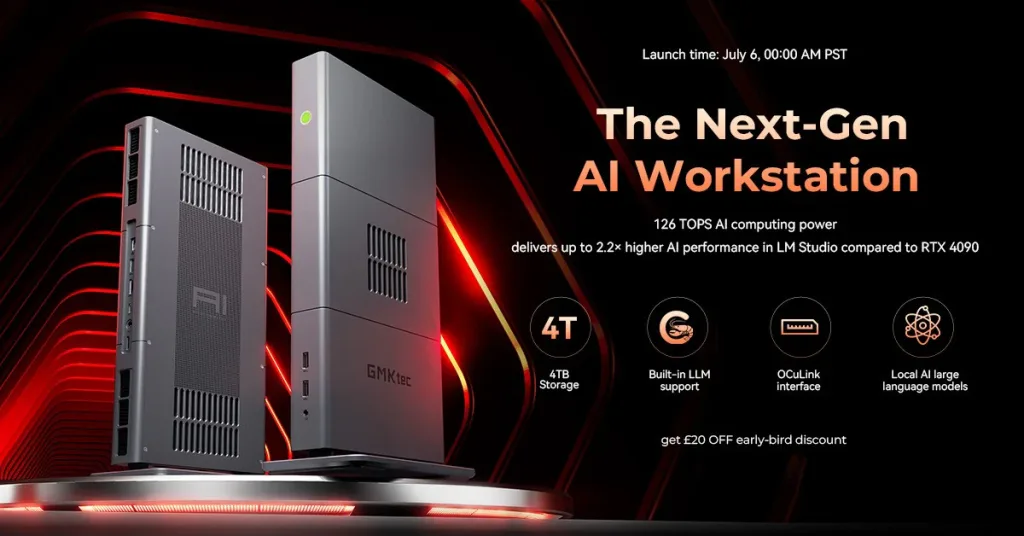
Gmktec Evo-X3 Mini PC: A desktop GPU that costs $1,500 on its own. A chip that runs large AI models on 128GB of shared memory. A box small enough to sit behind a monitor. The Gmktec Evo-X3 is a genuinely unusual machine — and Gmktec’s claim that it outperforms an RTX 4090 in specific local AI workloads is either one of the boldest marketing lines of the year, or a sign of just how much the mini PC category has changed.
Gmktec Evo-X3 Mini PC: Full Spec Sheet
| Spec | Detail |
|---|---|
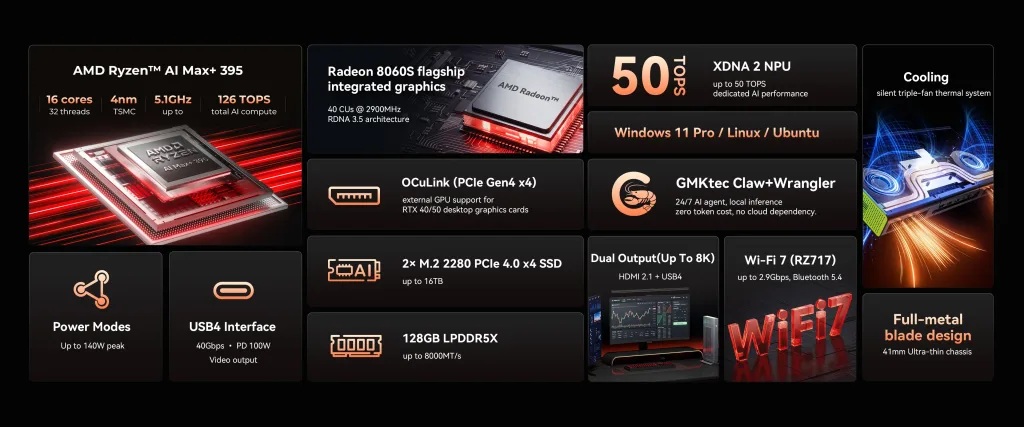
| Processor | AMD Ryzen AI Max+ 395 (4nm, 16 cores / 32 threads) |
| Integrated GPU | AMD Radeon 8060S |
| NPU | XDNA2, 50 TOPS dedicated |
| Total AI compute | Up to 126 TOPS |
| RAM | 128GB LPDDR5X @ 8,000MT/s |
| Max VRAM allocation | Up to 96GB (from system RAM) |
| Storage | Dual PCIe 4.0 x4 M.2 (up to 16TB) |
| External GPU | OCuLink (RTX 40/50-series compatible) |
| Connectivity | USB4, Wi-Fi 7, 2.5G Ethernet |
| Display output | Dual 8K |
| Cooling | 3 copper heat pipes, 3 fans |
| Chassis | CNC-machined metal |
| Global launch | July 6, 2026 |
The 96GB VRAM Trick
Here’s the engineering choice that makes this machine interesting. Because the Ryzen AI Max+ 395 uses unified memory — where the CPU and GPU share the same pool — Gmktec lets you allocate up to 96GB of that 128GB as VRAM. Dedicated desktop GPUs, including the RTX 4090, max out at 24GB of VRAM. That gap matters enormously for running large local language models, where model size is often the hard ceiling. Gmktec says the Evo-X3 can run Qwen3 235B in LM Studio and benchmarks faster than an RTX 4090 in that specific workload — not in gaming, not in rendering, but in LLM token generation speed, where memory capacity is the bottleneck.
| Evo-X3 vs RTX 4090 | Evo-X3 | RTX 4090 |
|---|---|---|
| VRAM available | Up to 96GB | 24GB |
| LLM model ceiling | 235B+ parameters | ~70B parameters |
| Gaming performance | Integrated (far behind) | Best-in-class |
| Local AI inference speed | Faster (specific workloads) | Slower (VRAM constrained) |
| Power consumption | Lower (single unit) | High (separate GPU + CPU) |
OCuLink: The Safety Valve
The 96GB VRAM story is compelling for AI, but anyone who also wants to game on this machine will run into the integrated Radeon 8060S’s limits fast. That’s where the native OCuLink port earns its place — it lets you plug in a full-size desktop GPU (RTX 40-series or 50-series) when you need it. The same port feature appeared in the OneXPlayer G1 gaming handheld, where OCuLink support made it genuinely dual-purpose for gaming and productivity. The Evo-X3 takes the same approach, just in a stationary form factor.
Pricing and Availability
| Config | Price |
|---|---|
| 128GB RAM + 1TB SSD | $3,205 (21,699 yuan) |
| 128GB RAM + 4TB SSD | $3,796 (25,699 yuan) |
| Global launch | July 6, 2026 |
These are China launch prices — global pricing may shift slightly. No India-specific availability has been confirmed yet, but given AMD’s growing footprint in the Indian professional PC space — including the AMD x S8UL partnership backing India’s top esports org and the broader RTX Spark and AI laptop wave coming this fall — demand for local AI compute hardware at this tier is only heading in one direction.
The Bottom Line
The Evo-X3 isn’t trying to be everything. It’s a single-purpose machine for people who want to run large AI models locally without a cloud subscription, in a box that doesn’t require a separate PC tower and GPU. At $3,200, it’s expensive — but compared to building an equivalent local AI rig with a separate CPU, motherboard, and 24GB GPU, the maths get closer than you’d expect. The RTX 4090 claim needs independent verification, but the underlying logic — that 96GB of available VRAM beats 24GB for large models regardless of raw GPU compute — is real.
Source: Gizmochina, citing Gmktec’s official product listing.