

What if your next Mini-PC ran completely silent — no fan hum, no vibration, just pure performance? That future just got a lot closer. At Computex 2026, Ventiva and ASUS announced a strategic partnership to explore next-generation thermal architectures for compact AI computing systems, and it’s one of the most interesting tech stories to come out of Taipei this year.
Table of Contents
What’s the Partnership About?
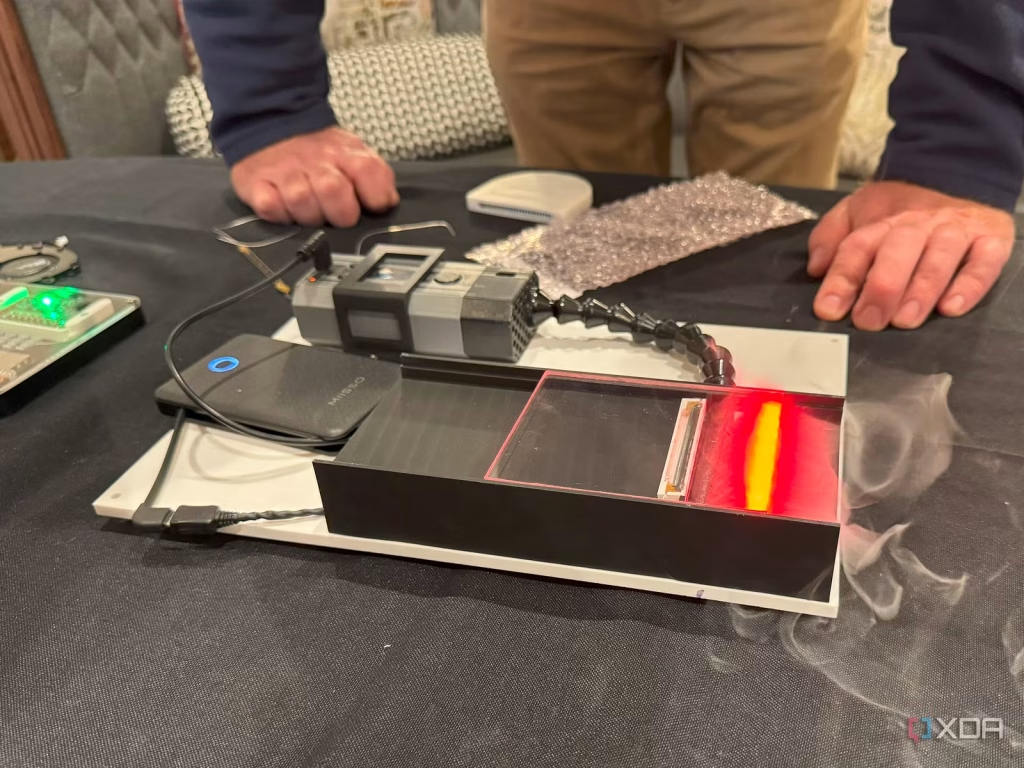
Ventiva, a pioneer in solid-state ionic cooling technology, is teaming up with ASUS to evaluate how its fanless cooling solutions can power future ASUS NUC and Mini-PC designs. The collaboration is being showcased live at Computex 2026 through a working ASUS NUC demonstration platform.
This isn’t just a product announcement — it’s a signal that thermal management is shifting from an afterthought to a core architecture decision.

Why Conventional Cooling Is Hitting a Wall
As AI workloads grow more demanding, cramming more processing power into smaller devices has exposed a fundamental problem: traditional fans are running out of room.
| Problem with Traditional Cooling | Impact |
|---|---|
| Consumes significant board space | Limits component placement |
| Generates vibrations | Creates noise tradeoffs |
| Struggles with distributed heat sources | Poor performance under AI loads |
| Bulk increases with performance needs | Harder to miniaturize |
The more powerful and compact a device gets, the worse these tradeoffs become.
Enter Ventiva’s Ionic Cooling
Ventiva’s technology uses electrohydrodynamic (EHD) flow — essentially, electrically charged particles move ionized air without any spinning parts. The result is a cooling system that is:
- Completely silent (tested below 15 dBa in anechoic chambers)
- Vibration-free with no mechanical components
- As thin as 5mm, enabling ultra-compact designs
- Modular, so each thermal zone (SoC, memory, power delivery) can be cooled independently
This is a fundamentally different approach to heat management — and for AI mini-PCs, it could be a game-changer. For context on how AI inference creates concentrated, multi-zone heat challenges, check out our breakdown of compact AI computing trends.
What ASUS and Ventiva Are Building Together
The partnership focuses on prototype development and technical evaluation, with both teams exploring where ionic cooling delivers the greatest design impact in future NUC and Mini-PC architectures.
As Christian Schlachte, Director of Product Management at Ventiva, put it — thermal management is no longer a component-level decision. It’s a platform architecture decision. How you cool a system determines what you can build.
ASUS’s Alex Gilpin echoed this, noting that thermal architecture is increasingly central to how next-gen compact AI systems are designed from the ground up.
Why This Matters for the Future of Mini-PCs
AI-capable Mini-PCs are becoming a serious category — from home labs to edge computing to enterprise deployments. The problem has always been: more AI power = more heat = more noise. Ventiva’s approach breaks that equation entirely.
If this partnership delivers, future ASUS NUCs could sustain peak AI performance continuously — silently — in a form factor smaller than what’s possible today. Pair that with the latest NUC-class hardware specs and you have a genuinely compelling machine.
FAQs
Q: What is ionic cooling and why does it matter for AI devices?
Ionic cooling moves air using electrically charged particles instead of spinning fans, making it silent and vibration-free — ideal for compact AI systems that generate intense, sustained heat.
Q: Will ASUS NUCs use Ventiva ionic cooling soon?
The partnership is currently in prototype and evaluation phase, with both companies assessing design possibilities before any commercial integration is confirmed.


