Horror movies often draw from folklore and urban legends—but Sumathi Valavu takes inspiration from a genuinely tragic real-life event. The Malayalam film starring Arjun Ashokan and Gokul Suresh isn’t just fiction—it’s rooted in one of Kerala’s most infamous paranormal mysteries that haunts locals even today.
What’s the Sumathi Valavu real story? Picture a quiet street in 1950s Thiruvananthapuram where a woman named Sumathi met an unimaginable tragedy. The incident sparked decades of supernatural claims, criminal theories, and haunting whispers that persist 70+ years later. Let’s uncover the truth behind this chilling real-life inspiration.
Sumathi Valavu Real Story: The Tragic True Incident
Location: Mylamoodu, Thiruvananthapuram, Kerala (exact same street where the film is set)
The Incident: According to urban legend, a woman named Sumathi, who was pregnant at the time, was murdered by her lover in the 1950s at the very same spot. This wasn’t a quick death—it was brutal, devastating, and deliberately concealed from authorities for years.
Why It Matters: The Sumathi Valavu real story transformed an ordinary Kerala street into the most feared location in Thiruvananthapuram. Locals stopped frequenting the area. Stories circulated about spiritual hauntings, supernatural occurrences, and inexplicable phenomena. The grief from an unsolved crime created a collective paranoia that shaped an entire region’s folklore.
Sumathi Valavu Real Story: What Locals Believe
| Aspect | Urban Legend Account | Possible Reality |
|---|---|---|
| Victim Identity | Pregnant woman named Sumathi | Historical record suggests woman murdered in 1950s |
| Perpetrator | Lover/intimate partner | Criminal element unclear, possibly covered up |
| Timeline | 1950s tragedy | ~70 years ago (1950s-era event) |
| Supernatural Claims | Spirit hauntings, unexplained phenomena | Psychological responses to tragic history |
| Criminal Activity | Murder concealment | Potential criminal use of haunted reputation |
| Modern Status | Still considered “haunted” | Popular media/cultural mythology |
The Sumathi Valavu real story has two competing narratives: one supernatural (spirit seeking justice), another practical (criminals exploiting fear for illegal activities).
Sumathi Valavu Real Story: Fact vs. Fiction
What We Know (Documented):
- A woman died tragically at this Mylamoodu location in the 1950s
- The incident created long-lasting local trauma
- The street became associated with paranormal activities
- Generations of Keralites grew up fearing this location
What Remains Mysterious: The Sumathi Valavu real story lacks official documentation. Police records from the 1950s are either lost or inaccessible. No formal criminal investigation is publicly documented. This information vacuum created the perfect environment for legend-building and folklore expansion.
Criminal Theory: Some reports suggest the location was exploited by criminals who created the facade of a supernatural entity to cover up their illegal activities. This hypothesis suggests the “haunting” served as a deterrent keeping civilians away while allowing criminals to operate undetected.
For comprehensive understanding of South Indian horror cinema and true-crime adaptations, explore our detailed guide to regional horror films examining how folklore influences contemporary Malayalam storytelling.
Sumathi Valavu OTT Release & Film Adaptation
Theatrical Release: August 1, 2025
OTT Platform: ZEE5 Malayalam
Streaming Date: September 26, 2025
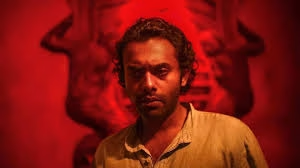
The film transforms the Sumathi Valavu real story into horror-comedy entertainment, blending genuine historical tragedy with fictional scares. When a group of youngsters ventures onto the street, they begin to experience disturbing and eerie instances. The movie explores what happens when living people encounter legends rooted in real trauma.
Cast & Crew: Arjun Ashokan and Gokul Suresh lead the cast, with supporting performances from Saiju Kurup, Balu Varghese, Sshivada, and Malavika Manoj. Director Vishnu Sasi Shankar adapted writer Abhilash Pillai’s screenplay, with producers Murali Kunnumpurath and Gokulam Gopalan backing the project.
Discover South Indian cinema’s evolution through comprehensive regional film studies to understand how historical events shape contemporary storytelling traditions.
Why Sumathi Valavu Real Story Still Matters
Psychological Impact: The Sumathi Valavu real story demonstrates how collective trauma becomes cultural mythology. When communities experience tragedy without resolution, stories fill the void. Each generation adds details, reinterprets events, and creates new narratives.
Social Commentary: The film’s horror-comedy approach asks: What happens when entertainment meets tragedy? Can filmmakers respectfully adapt real suffering into entertainment? Does dramatization honor or exploit the original victim?
Folklore Preservation: The Sumathi Valavu real story shows how oral history preserves forgotten crimes. In a pre-internet era, urban legends were the only mechanism keeping tragic histories alive.