MEX-W
MEX-W ARG-W
ARG-W KHO0
KHO0 ETT2
ETT2 NAP1
NAP1 ROMA0
ROMA0 EST0
EST0 CPAC2
CPAC2 Samsunspor1
 Amed SFK0
 CHE
CHE TOT
TOT VAL
VAL VIL
VIL DOR
DOR SGE
SGE RIY
RIY TAA
TAA LAZ
LAZ PAR
PAR RCL
RCL PAR
PAR ATM
ATM DEP
DEP RAC2
RAC2 ESP1
ESP1 ARS2
ARS2 EVE0
EVE0 COV0
COV0 FUL1
FUL1 OFC0
OFC0 NEU0
NEU0 KNGHT109/5 (18/20 ov)
 MPUMA
MPUMA NZ-A135/3 (41 ov)
 IND-A113
 SYL
SYL KHU
KHU MYMS299/4 (87 ov)
 CHATT
CHATT DHA293/3 (84.1 ov)
 RAJ
RAJ RAN320/5 (80 ov)
 BAR
BAR UAE
UAE NED
NED PAK
PAK ENG
ENG IND-W
IND-W ZIM-W
ZIM-W GMB
GMB LES
LES MOZ
MOZ ZMB
ZMB NGA
NGA UGA
UGA NAM321/6
 IRE290 (47.3/50 ov, target 322)
 NZ180/5
 IND181/6 (19.5 ov)
 BRA2
BRA2 NOR0
NOR0 GHA1
GHA1 CAN0
CAN0 BHA0
BHA0 WHU0
WHU0 Inter Milan
 Fiorentina
 NEOM2
NEOM2 ABH0
ABH0 FCA1
FCA1 FCU1
FCU1
StradVision and AMD unveiled groundbreaking multi-camera perception technology at CES 2026, showcasing SVNet MultiVision software running on AMD’s Versal AI Edge Series Gen 2 platform. The demo delivers up to 185 INT8 TOPS compute power, enabling real-time, synchronized processing of multiple camera streams for Level 3 autonomous driving.
StradVision SVNet MultiVision: Production-Ready Perception
The demonstration uses the AMD Versal AI Edge Series Gen 2 VEK385 Evaluation Kit as a technical reference, highlighting how production-proven perception software scales across heterogeneous compute resources. The platform processes simultaneous camera streams for advanced ADAS and automated driving use cases with high-throughput performance.
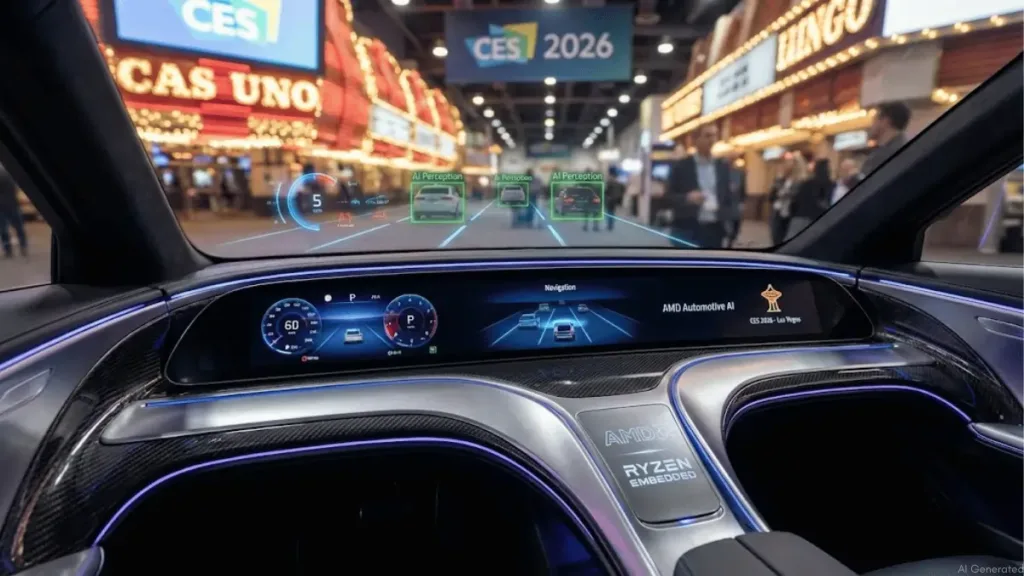
This CES showcase builds on a multi-year collaboration announced in November 2025, following initial joint demonstrations at CES 2025. The partnership targets software-defined vehicles and scalable perception architectures for OEMs and Tier-1 suppliers evaluating next-generation autonomous systems.
| Specification | Details |
|---|---|
| Software | SVNet MultiVision perception stack |
| Hardware | AMD Versal AI Edge Gen 2 VEK385 |
| Compute Power | Up to 185 INT8 TOPS / 370 MX6 TFLOPS |
| Capabilities | Multi-camera sync, object detection, lane recognition |
| Autonomy Levels | Level 2 ADAS to Level 3/4 prototypes |
| AI Engines | AIE-ML v2 (quantized inference, near-FP16 accuracy) |
| Target Market | Software-defined vehicles, centralized compute |
| CES Booth | AMD W223, LVCC West Hall Level 2 |
Bridging L2 to L3 Autonomy
The collaboration addresses a critical automaker challenge: transitioning from Level 2 assistance to Level 3 autonomy without redesigning entire electronic architectures. The solution enables L2 systems with rich object, lane, and free-space detection, plus L3 prototypes with high-precision perception for real-time environmental modeling.
The AMD Versal platform leverages integrated AIE-ML v2 engines to run quantized inference with near-FP16 accuracy while cutting power and latency—a critical balance for edge deployment inside vehicles where thermal management and energy efficiency determine viability.
StradVision’s MultiVision software optimizes advanced perception features including pedestrian detection, environmental understanding, and free-space recognition. These capabilities enhance both performance and thermal efficiency in autonomous driving systems, meeting stringent automotive safety requirements.
For comprehensive autonomous driving technology analysis and automotive AI reviews, explore TechnoSports. Learn more about StradVision‘s perception software and AMD’s automotive platforms.
The combined solution accelerates time-to-market through pre-integrated, production-ready AI perception while reducing system complexity and power consumption. With ISO 26262 functional safety certification and TISAX AL3 information security standards, StradVision delivers validated capabilities for real-world deployment.
This demonstration marks significant progress in the expanding AMD automotive ecosystem, building foundations for AI perception that scales intelligently across software-defined vehicle architectures.