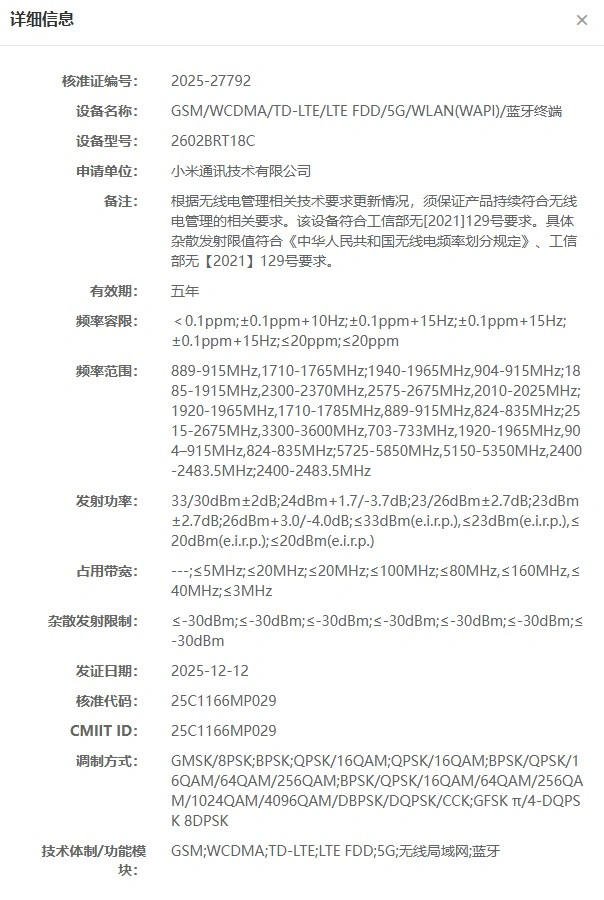
Xiaomi edges closer to launching the Redmi Turbo 5 series as the Pro model (2602BRT18C) cleared SRRC radio certification in China—a regulatory milestone signaling imminent release. According to Weibo tipster Smart Pikachu, the flagship-tier device will debut before Chinese Spring Festival (late January 2026), potentially arriving within weeks as Xiaomi accelerates its 2025 product roadmap.
Table of Contents

Redmi Turbo 5 Series Launch Details
| Model | Certification Status | Launch Window | Global Name |
|---|---|---|---|
| Redmi Turbo 5 | Approved (October) | January 2026 | POCO X8 Pro |
| Redmi Turbo 5 Pro | Approved (December) | Before Spring Festival | POCO X8 Pro Max |
| Chipset | Flagship-class | Performance-tuned | Dimensity 9500 expected |
| Battery | Segment-leading | 9,000mAh claimed | 100W fast charging |
Flagship Performance at Mid-Range Pricing
Digital Chat Station reveals the Turbo 5 Pro will feature the only flagship processor in its segment with intensive tuning and optimized cache—likely the Snapdragon 8s Gen 5 or Dimensity 9500. This strategic positioning bridges the gap between affordable mid-rangers and premium flagships, offering near-flagship performance without premium pricing.
The aggressive tuning approach mirrors the successful Turbo 4 Pro strategy, which launched as the first Snapdragon 8s Gen 4 device. Xiaomi’s focus on performance optimization rather than raw specs creates devices that outperform competitors with technically superior hardware.
Battery Revolution: 9,000mAh Capacity
If leaks prove accurate, the Turbo 5 Pro’s 9,000mAh battery would be segment-defining. Paired with 100W fast charging, this represents the largest battery in any mid-range smartphone—surpassing even gaming phones like ROG Phone and Red Magic series. For mobile power users, this means genuine multi-day battery life without compromises.
The standard Turbo 5 reportedly packs 7,500mAh, suggesting Xiaomi prioritizes endurance across the lineup. This aligns with industry trends as DRAM shortages push manufacturers toward battery capacity as differentiation rather than RAM counts.
Premium Design & Features
The Turbo 5 Pro adopts a metal frame with minimalist industrial design—departing from plastic mid-rangers. Additional features include 3D ultrasonic fingerprint sensor (faster and more secure than optical), full IP68 water resistance, and symmetrical stereo speakers typically reserved for flagships.
The 6.83-inch 1.5K flat OLED display matches specifications found in phones costing twice as much, with leaks suggesting 120Hz+ refresh rates and HDR10+ support. This comprehensive feature set positions the Turbo 5 Pro as a flagship-killer.
Global Availability as POCO X8 Pro Max
Following Xiaomi’s naming convention, the Turbo 5 Pro launches globally as POCO X8 Pro Max—targeting markets like India, Europe, and Southeast Asia. Previous Turbo models remained China-exclusive, but recent POCO rebranding ensures wider availability. Expect aggressive pricing around $400-500 (₹33,000-42,000) undercutting OnePlus, Samsung, and Motorola equivalents.

Why the Accelerated Timeline?
Xiaomi fast-tracks the Turbo 5 series to capitalize on first-mover advantage with new MediaTek Dimensity chips. Beating competitors like OPPO Reno 15 Pro and Realme Neo 8 to market with shared processors creates mindshare advantages. The pre-Spring Festival launch also captures holiday spending in China, Xiaomi’s largest market. For tech enthusiasts tracking Xiaomi’s evolution, this represents confidence in supply chain stability despite component shortages.