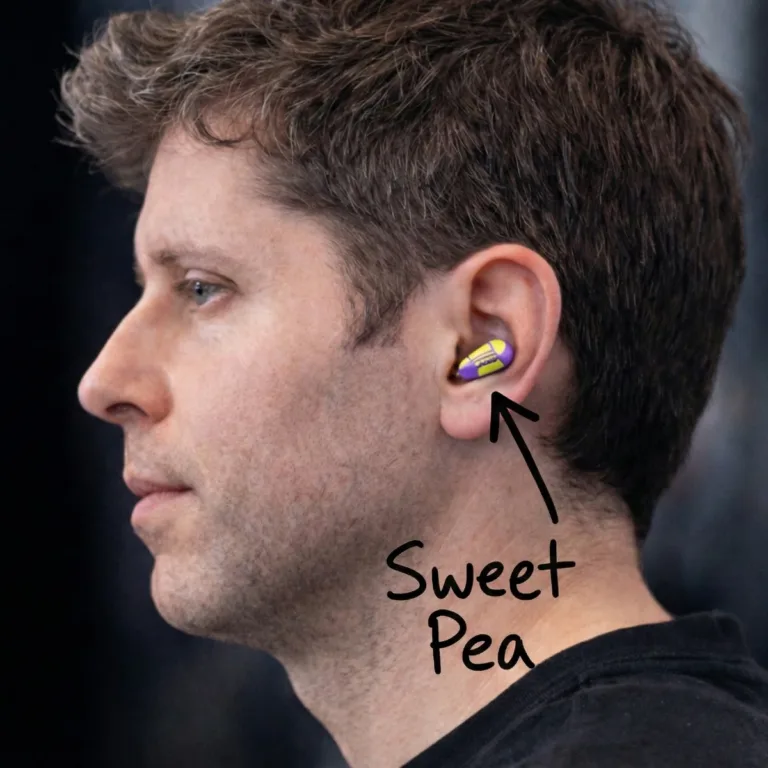
OpenAI is preparing to disrupt Apple’s audio dominance with “Sweetpea”—AI-powered earbuds featuring a 2nm smartphone-class processor designed by legendary Apple designer Jony Ive. This ambitious device aims to transform wireless earbuds from simple audio players into always-on AI companions capable of replacing iPhone functions through voice commands.

Beyond Audio: OpenAI’s Computer-in-Earphones Vision
| Feature | Details |
|---|---|
| Codename | “Sweetpea” |
| Launch Target | September 2026 (conflicting reports suggest 2028) |
| Designer | Jony Ive (io Products, acquired May 2025 for $6.5B) |
| Processor | 2nm chip (likely Samsung Exynos) + custom AI silicon |
| Form Factor | Metal “eggstone” case with behind-ear pill modules |
| Manufacturer | Foxconn |
| First-Year Target | 40-50 million units |
| Key Feature | Replace iPhone actions by commanding Siri |
| Bill of Materials | Smartphone-level costs (premium pricing expected) |
| Product Family | 5 devices total by Q4 2028 (pen, home device included) |
Ear-Worn AI Computer, Not Just Earbuds
Unlike conventional wireless earbuds, Sweetpea is positioned as an always-on AI companion with smartphone-grade computing power. The unique metal “eggstone” case houses two detachable pill-shaped modules that rest behind the ear, maximizing space for sensors, microphones, and advanced processing.
Leaked component diagrams reveal skin contact sensors and ultrasonic transmitters, suggesting health monitoring or environmental sensing capabilities that differentiate Sweetpea from standard headphones. This aligns with OpenAI CEO Sam Altman’s vision of a “third device” that complements smartphones rather than replacing them.
Custom Silicon for iPhone Replacement
The breakthrough feature is a custom chip designed to replace iPhone actions through Siri commands. This suggests Sweetpea could handle tasks like messaging, navigation, and app control without pulling out your phone—transforming voice interaction from a convenience feature into the primary interface.
The 2nm processor—likely from Samsung’s cutting-edge Exynos lineup—provides computational power approaching flagship smartphones, enabling sophisticated on-device AI processing without cloud dependency.

Jony Ive’s Design Prioritization
Following OpenAI’s $6.5 billion acquisition of io Products in May 2025, Jony Ive’s design team has prioritized Sweetpea as their first consumer product. This marks the legendary designer’s return to consumer hardware after leaving Apple, bringing his minimalist aesthetic and user-centric philosophy to AI-first devices.
Aggressive Production Targets
With projected first-year shipments of 40-50 million units, OpenAI is targeting flagship smartphone territory. However, smartphone-level bill of materials suggests premium pricing well beyond conventional earbuds—potentially positioning Sweetpea closer to $300-500 rather than the $150-250 range of standard wireless audio devices.
Broader Hardware Ecosystem
Sweetpea headlines a five-device roadmap by Q4 2028, with Foxconn preparing prototypes for a ChatGPT-powered pen and home device. This signals OpenAI’s serious commitment to “physical AI”—moving conversational intelligence off screens into everyday objects.

Strategic Timing
The rumored September 2026 launch (though some reports suggest 2028) would coincide with Apple’s expected AirPods Pro 4 refresh, creating a direct head-to-head competition. OpenAI’s entry represents the most credible challenge yet to Apple’s wireless audio dominance, backed by substantial capital, legendary design talent, and proven AI capabilities.
For users seeking next-generation AI interfaces beyond smartphones, Sweetpea could validate the concept of earbuds as full-fledged computing platforms—if OpenAI can deliver meaningful functionality that justifies the premium hardware investment.