BAN88/3 (40 ov)
 WI356
 AFG113/1 (35 ov)
 ZIM504
 FC Goa1
 BFC1
 SHL1
 CHA1
 HSV
 BMG
 VEN
 UDI
 TOU
 STR
 EVE
 COV
 SEV
 ALA
 NZ
 IND
 Inter Kashi
 SC Delhi
 Leeds
 Spurs
 AZ Alkmaar1
 Juventus2
 Leverkusen0
 Marseille1
 Benfica3
 Lech Poznan1
 Celta Vigo1
 Union SG2
 MOUNT198
 ROCKS191/5 (45.5/50 ov, target 199)
 TUSK222/2 (44.2/50 ov, target 245)
 RHINO244
 CHR151/6
 POA121/9 (18.5/20 ov, target 152)
 RWA-W
 USA-W
 ZIM-A237/6 (71.2 ov)
 IRE-A424
 WI-A
 LIONS
 MR-W
 AS-W
 BH-W
 HH-W
 SS-W
 ST-W
 EASTN
 DOLPH
 NAM-W
 DOL-W
 LIO-W
 MS-W159/7 (20 ov, target 161)
 PS-W183/3
 KAY137/7 (20 ov, target 177)
 SPR176/6
 UGA-W74/6 (19.3/20 ov, target 74)
 WAR138/7 (20 ov)
 BOL138/5
 Málaga
 Racing
 Celtic3
 Besiktas2
 Hapoel Be'er0
 OFI Crete2

Hugging Face says NVIDIA announced Cosmos 3 open models on November 6, 2026, for interactive world simulation. Cosmos 3 is a family of models built for AI applications that simulate interactive worlds. Details come from leaks and supply-chain reports, not official confirmation.
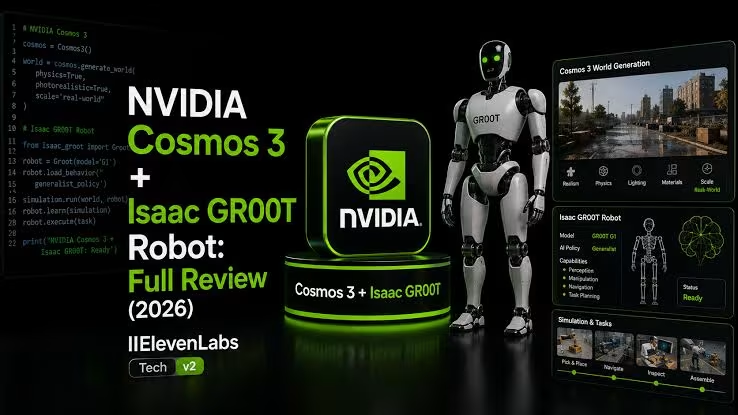
Before Cosmos 3: World Simulation Needed a Different Approach
Before this announcement, the information available in this story didn’t identify a new NVIDIA model family specifically for interactive world simulation. Cosmos 3 changes that picture: its stated purpose puts world simulation at the centre, rather than treating it as a general AI capability.
That distinction matters to developers weighing models for applications built around interacting with simulated environments. The name also makes Cosmos 3 part of a wider open-model discussion, but openness alone doesn’t answer practical questions about access, computing needs or deployment. Our earlier coverage of Open Models offers broader context on how developers assess open model releases. For this launch, the key question is whether teams can use its stated simulation focus with the resources and infrastructure they already have.
The Catalyst: NVIDIA’s Cosmos 3 Announcement
The announcement marks a shift: NVIDIA designed the Cosmos 3 family for interactive world simulation in AI applications. Release information directs developers to GitHub and NVIDIA NGC for access. Those give technical teams places to examine the release, though the available facts don’t specify licensing terms, model variants or supported workflows.
Training the architecture uses advanced multi-node GPU configurations. That points to a substantial infrastructure footprint for model development, but doesn’t establish a specific training duration or GPU count. For teams considering adoption, access to model files is just one part of the decision. The training setup also gives a sense of the computing scale behind the system.
After the Announcement: Memory and Deployment Matter
The stated memory requirement is a high-performance subsystem using HBM3e, or high-bandwidth memory 3e. That puts memory capacity and bandwidth at the centre of deployment planning, alongside the GPUs themselves. NVIDIA’s deployment guidance points to enterprise-grade servers running Hopper or Blackwell GPUs, linking the model family to high-end infrastructure rather than an ordinary developer workstation.
That recommendation narrows the likely audience for initial evaluation. Research groups and businesses with compatible server capacity can investigate the release directly, while teams without that infrastructure may need to wait for more guidance on access and deployment options. The listed platforms give buyers a concrete starting point for checking compatibility, but the announcement doesn’t establish performance levels or guarantee support for every server configuration. Compared with the situation before the announcement, Cosmos 3 now has a stated simulation purpose, access routes and named hardware requirements. Still, important adoption details remain unspecified, including model choices and licensing. Developers should treat the announcement as an invitation to assess the release, not proof that it’ll suit every simulation project.
Cosmos 3 Open Models: What Changed
The shift is from no newly identified NVIDIA offering for this use case to a named family with a declared interactive-simulation focus and an enterprise deployment path. That gives teams a useful way to map model options against their existing infrastructure.
It also gives the open-model ecosystem a distinct point of comparison. Simulation-focused systems have different practical requirements from models built for other tasks, as our coverage of Moonshot AI’s Models illustrates in a separate context.
| Area | Before the announcement | Cosmos 3 details |
|---|---|---|
| Stated purpose | No newly named NVIDIA family in this story | Interactive world simulation |
| Training setup | Not specified here | Advanced multi-node GPU configurations |
| Memory | Not specified here | HBM3e |
| Deployment | Not specified here | Enterprise servers with Hopper or Blackwell GPUs |
| Developer access | Not specified here | GitHub and NVIDIA NGC |
How Developers Should Choose
If your team already runs enterprise servers with Hopper or Blackwell GPUs and can meet HBM3e requirements, Cosmos 3 is the first release to evaluate for interactive world-simulation work. Without those resources, wait for more information on model options, licensing and deployment paths before planning a production rollout.
The announcement makes infrastructure fit the first question, not an afterthought. Practical documentation on model access and deployment will be the next useful signal, showing how closely the stated requirements match real development environments. Takeaway: If you have the recommended GPU and memory infrastructure, assess Cosmos 3. If not, wait for fuller deployment guidance.
FAQs
What Are NVIDIA Cosmos 3 Open Models?
NVIDIA Cosmos 3 Open Models are advanced simulation tools designed for creating interactive worlds. These models allow developers to integrate realistic environments and characters into their projects.
How Can Developers Access NVIDIA Cosmos 3 Open Models?
Developers can access NVIDIA Cosmos 3 Open Models through the NVIDIA developer portal, where they can find resources, documentation, and community support to implement these models in their applications.
Source: Huggingface
Read Next
- Samsung Android XR Smart Glasses Pre-Orders Start November 12
- Claude Personal Finance Tool Can Analyze Your Spending
- iPhone Duo Durability Test Passes 260,000 Folds on Livestream
Was this article helpful?
Your feedback directly improves future articles on this site.