In the fast-moving world of Large Language Models (LLMs), bigger isn’t always better. As we move through April 2026, the industry has pivoted toward efficiency. Developers and enterprises are no longer just asking, “What can this model do?” they are asking, “How fast and how cheaply can it do it?”
Today, we’re looking at a specific heavyweight bout currently trending on OpenRouter: the lightning-fast MiniMax M2.7 versus the highly-optimized GLM-5 Turbo from Zhipu AI.
If you’re looking to scale your AI applications without breaking the bank, this is the comparison you’ve been waiting for.
Table of Contents

MiniMax M2.7: The Latency Killer
MiniMax has carved out a niche for itself by being the “Formula 1” of the AI world. The M2.7 iteration is built on a highly refined Mixture of Experts (MoE) architecture that allows it to activate only the necessary parameters for any given task.
- The Edge: It is designed for Real-Time Interactivity. If you are building a voice assistant, a real-time translator, or an interactive gaming experience, every millisecond counts. MiniMax M2.7 consistently stays under the 50ms per token threshold.
- The Context: Despite its speed, it doesn’t sacrifice “memory.” Its handling of mid-range context is robust enough for most enterprise chatbots.

GLM-5 Turbo: Logic at Scale
Zhipu AI’s “Turbo” series has always been about bringing elite-level reasoning to a mid-tier price point. GLM-5 Turbo is the “leaner, meaner” version of the flagship GLM-5.
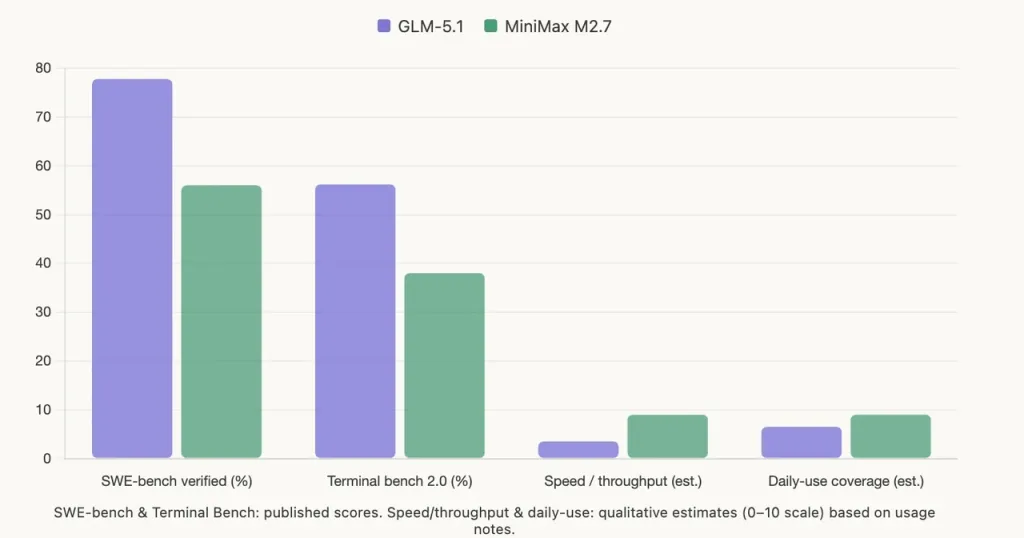
- The Edge: Logic and Structured Data. While MiniMax wins on raw speed, GLM-5-Turbo often wins on accuracy for structured outputs like JSON or complex coding snippets. It’s the “thinking man’s” turbo model.
- Multilingual Mastery: Given its roots, GLM-5-Turbo remains the superior choice for businesses operating across Asian and Western markets, offering deeper linguistic nuance than almost any other model in its class. This is a critical factor as global AI trends shift toward localized intelligence.
Head-to-Head: Which One Fits Your Workflow?
| Metric | MiniMax M2.7 | GLM-5-Turbo |
| Tokens per Second | Ultra-High (100+) | High (70-85) |
| Cost (per 1M tokens) | Extremely Competitive | Aggressive / Low |
| Best For | Gaming, UI/UX, Chat | Coding, Logic, Data Extraction |
| Reasoning Depth | Strong | Superior |
| Architecture | MoE (Mixture of Experts) | Optimized Dense/Hybrid |
The Efficiency Revolution
Why does this comparison matter so much in April 2026? Because the “Brute Force” era of AI is ending. We are seeing a massive shift toward specialised hardware, with NVIDIA’s latest chips and next-gen CPUs being optimised specifically to run models like M2.7 and GLM-5-Turbo at the “edge.”
If you are a developer using OpenRouter to swap between these models, you’ve likely noticed that the gap in quality has narrowed significantly. The choice now comes down to latency vs. logic.
When to choose MiniMax M2.7:
- You need the lowest possible latency.
- Your app requires high-volume, short-burst conversations.
- You are building for mobile devices where speed equals user retention.
When to choose GLM-5 Turbo:
- You are performing complex data extraction or summarization.
- You need a model that follows strict formatting (like XML or JSON) flawlessly.
- Your primary user base is multilingual and requires high-fidelity translation.
Final Thoughts: The Era of “Good Enough” is Over
In 2026, we don’t settle for “good enough” AI. We choose the right tool for the right job. MiniMax M2.7 and GLM-5 Turbo represent the pinnacle of mid-tier model optimization—offering performance that would have been unthinkable just two years ago at a fraction of the cost.
For the latest deep dives into how these technologies are changing the way we work and play, keep your eyes on TechnoSports.
Are you prioritizing speed or reasoning for your next project? Let’s discuss in the comments!