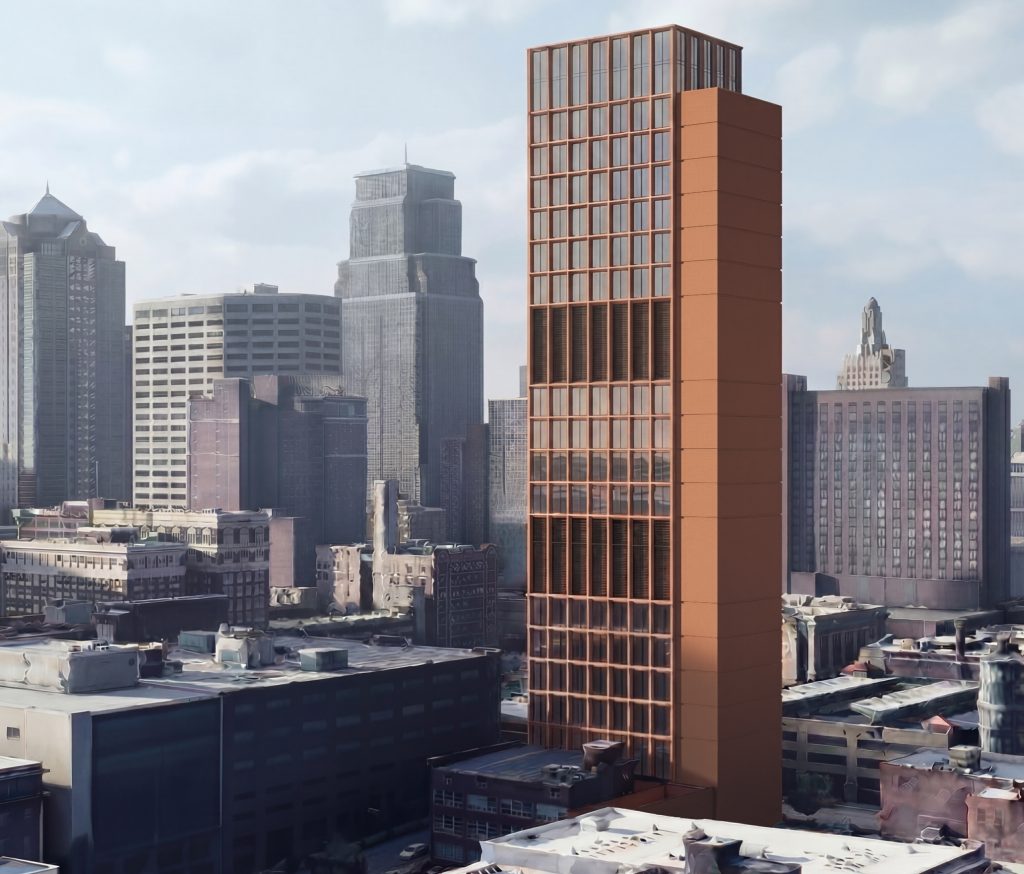
Kansas City has reportedly proposed a 20-story vertical data centre. The project would stack liquid-cooled AI server racks and target more than 100 megawatts of power, but officials haven’t decided its budget or completion date.
Why Kansas City Proposes a Vertical Data Centre
The main challenge is physical capacity. Artificial Intelligence (AI) workloads need dense accelerator clusters, cooling equipment, power distribution, and redundant network connections, while conventional data centers use large horizontal sites. A 20-story structure could fit those systems into a smaller footprint, though its height would bring added construction, safety, and maintenance demands.
The proposed facility would target high-density AI server racks with advanced liquid cooling. This method moves heat away from tightly packed hardware more efficiently than air cooling, but it also needs specialised plumbing, pumps, monitoring, and emergency systems throughout the building. The proposal is part of a broader data-center capacity story, alongside our coverage of the Amazon Data Center and its pressure on infrastructure planning. Kansas City’s design would move that pressure upward instead of outward.
10 Factors Shaping the Kansas City Proposal
- Vertical footprint: A 20-story building could conserve land by stacking computing floors. The trade-off is that structural loads, elevator systems, fire controls, and equipment movement become harder to manage than in a low-rise campus.
- AI rack density: The facility is intended for high-density AI server racks. Higher density can increase computing capacity on each floor, but it also produces more heat and puts extra pressure on electrical and cooling systems.
- Liquid cooling: Advanced liquid cooling sits at the heart of the reported design. It can support dense hardware, although leaks, pump failures, fluid maintenance, and service access introduce risks that air-cooled facilities may avoid.
- NVIDIA accelerators: The building aims to support next-generation accelerators from NVIDIA. That could attract demanding AI workloads, but hardware road maps and product availability may change before construction finishes.
- Advanced Micro Devices accelerators: Advanced Micro Devices (AMD) is also named as a potential accelerator supplier. Supporting multiple chip platforms could give operators more flexibility, yet different systems may need separate software, networking, and cooling configurations.
- Power above 100 megawatts: Site planning targets more than 100 megawatts for machine-learning workloads. That scale could support a large AI cluster, but grid studies, equipment procurement, and local capacity could slow deployment.
- Redundant fibre routes: The proposed network plan includes redundant fibre-optic routing. Multiple paths can keep operations running when one connection fails, although route construction and carrier coordination add cost and planning work.
- Regional carrier involvement: Evergy and AT&T are identified in the connectivity planning. Their participation could tie power and communications needs together, but the available facts don’t establish final contracts or operations.
- Kansas City location: A city-based vertical model could put AI capacity close to businesses, research users, and network exchanges. Urban land constraints, traffic, noise, and public-service demands could make approval tougher than it would be for a remote campus.
- Unfinished budget and schedule: Kansas City municipal planners haven’t finalised the capital investment or projected completion timeline. That uncertainty avoids premature promises, but it also keeps customers and equipment suppliers from making firm deployment plans.
Which AI Infrastructure Model Fits Kansas City?
A vertical centre makes the most sense if Kansas City prioritises land efficiency and can secure more than 100 megawatts with dependable fibre routes. It isn’t a simple replacement for a conventional campus, since stacked facilities concentrate electrical, cooling, and safety risks inside one structure. For more detail, see VentureBeat AI.
A low-rise campus would make equipment movement, expansion, and maintenance easier, but it would need more land and longer site infrastructure. A distributed regional model could reduce reliance on one building, though it would make networking, operations, and workload placement more complicated. The practical recommendation is straightforward: if Kansas City can confirm power, fibre, cooling, and construction economics, it should advance the vertical design; if any of those conditions fail, a lower-rise or distributed model is safer. Specific investment figures and completion dates remain open. For more detail, see OpenAI Blog.
What Comes Next for Kansas City’s Vertical Data Center Proposal
The next phase should test the engineering rather than promise construction. Before customers can assess the project, planners need to clarify the final power interconnection, accelerator mix, liquid-cooling architecture, fibre routes, capital requirement, and delivery schedule.
The proposal could give Kansas City a distinctive place in AI infrastructure, but its value will come down to execution. A tall building alone isn’t enough; the centre must provide reliable power, cooling, connectivity, and service access at once. Kansas City’s AI ambition now depends less on height than on whether its infrastructure can carry the load.
FAQs
What is the Kansas City vertical data center proposal?
It’s a proposed 20-story facility built to house high-density AI server racks with liquid cooling and more than 100 megawatts of planned power capacity.
Which companies’ accelerators could the facility support?
The plan names next-generation accelerators from NVIDIA and AMD, although officials haven’t established the final hardware selection.
When will the data center be completed?
Kansas City municipal planners haven’t finalised the completion timeline or the project’s capital investment figures.
Why use a vertical data center design?
A vertical design could reduce the land needed for dense AI infrastructure, but it would add structural, cooling, safety, and maintenance complexity.
Was this article helpful?
Your feedback directly improves future articles on this site.